

 Midnight pulled my attention for a reason that feels almost uncomfortable to admit. Not because it promises privacy, but because it treats privacy like a problem that actually needs to work under pressure. I have seen this space spend years glorifying transparency like it is automatically good, even when it clearly exposes users, businesses, and anyone doing something even slightly sensitive. That model always felt incomplete. Midnight does not reject transparency completely, but it does not worship it either. It sits somewhere in between, trying to build a system where some things stay private, some things stay visible, and disclosure becomes a choice instead of a default. That sounds simple when you say it like that, but the moment you think about how that plays out inside a real network, it starts to get complicated very quickly.
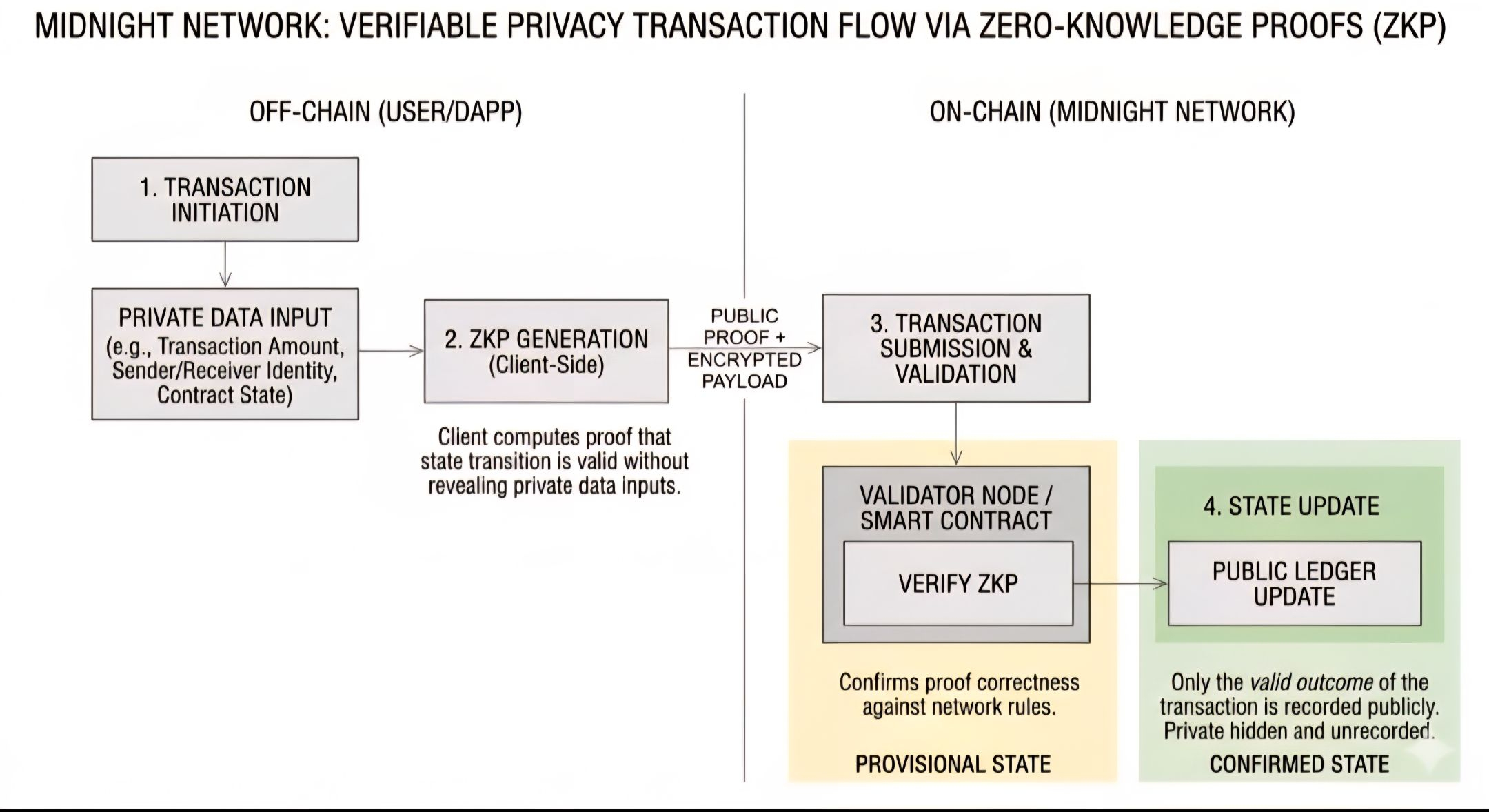
What makes Midnight different is not the idea itself, but the direction it is taking that idea. It is not going down the usual path of hiding everything behind a black box and asking users to trust it blindly. That approach has never scaled beyond small circles of believers. Instead, Midnight is trying to make privacy coexist with verification. It wants transactions, contracts, and interactions to be provably correct without exposing all the underlying data. That means using things like zero knowledge proofs in a way that is not just theoretical, but actually usable by developers who are building real applications. And that is where things start to get heavy, because zero knowledge systems are powerful, but they come with real costs in complexity, performance, and developer friction.
The part that keeps me watching is not the promise, but the pressure that comes with it. Every layer of privacy adds weight to the system. It makes debugging harder, makes user behavior less transparent, and forces developers to think differently about how they design applications. On a fully transparent chain, if something breaks, you can usually trace it. You can see the transaction, follow the state changes, and figure out where things went wrong. In a privacy-focused system, that visibility is no longer guaranteed. You are often working with partial information, and that changes how problems get solved. Midnight will need to prove that it can handle this without turning everyday usage into a confusing experience where nobody really understands what is happening under the hood.
There is also a structural layer to this that I find interesting. Midnight is not just building a protocol, it is shaping how that protocol evolves. By separating long-term ecosystem direction from active technical development, it creates a system where governance does not slow down execution, and execution does not override long-term stability. That might sound like a small design choice, but in practice it matters a lot. Privacy systems do not have the luxury of slow iteration. When something breaks or becomes unclear, it has to be fixed quickly, and it has to be fixed without compromising the trust of the network.
Then there is the economic side, which is where many technically impressive projects quietly struggle. Privacy is expensive. It requires more computation, more processing, and often more time per interaction. That directly affects fees, scalability, and user experience. If the system becomes too heavy, users will not stay. If developers find it too complex to build on, they will move to simpler environments. Midnight has to balance all of this while still delivering on its core promise, and that balance is not easy to maintain.
What I respect, at least for now, is that Midnight does not feel like it is pretending these problems do not exist. It does not come across as a perfectly polished solution. It feels more like something that understands where things can break and is trying to prepare for that reality. And honestly, that is what makes it more interesting than most of the usual privacy narratives floating around this market.
Because the real test has not happened yet. The real test begins when developers start building at scale, when users start interacting in unpredictable ways, when edge cases begin to appear, and when small issues start stacking into bigger ones. That is when systems stop being ideas and start becoming infrastructure. That is also the moment when most projects reveal whether they were built to last or just designed to sound good.
I do not see Midnight as something finished or proven. I see it as something approaching its first real confrontation with reality. And that is exactly why I am paying attention. Because if it works, it will not just prove that privacy sounds good. It will prove that privacy can actually function inside a system that people use, question, depend on, and sometimes break. And if it fails, it will fail in the same place where most ambitious systems fail, not in theory, but in the messy, unpredictable, everyday reality of real usage.