$SIGN #SignDigitalSovereignInfra @SignOfficial

I didn’t expect search to be the thing that felt broken.
Not in crypto.
We keep hearing the same line everything is on-chain, everything is transparent, everything is verifiable. So I assumed the hard part was proving things.
But that’s not where I got stuck.
The moment I tried to actually use that data, it felt different.
I wasn’t asking anything complicated. Just simple things.
Who is valid right now.
Which attestations still hold.
What changed since the last check.
And every time, I ended up doing the same thing.
Going backwards.
Scanning events.
Trying to reconstruct state.
Checking if something was revoked somewhere else.
It works, technically. But it doesn’t feel like a system you can rely on. It feels like you’re stitching things together each time you need an answer.
That’s the part that didn’t sit right with me.
Because if everything is “transparent,” why does it still feel like I can’t see what I need?
It took me a while to realize the problem wasn’t visibility.
It was retrieval.
We’ve built systems where truth exist but doesn’t surface easily.
And once that clicked, it was hard to ignore.
Because in practice, I wasn’t struggling to verify anything.
I was struggling to find it in a usable form.
And that changes how the whole system feels.
At that point, I stopped thinking in terms of “can this be proven?”
I started thinking in terms of “can this be queried?”
And those are not the same thing.
If you can’t query it cleanly, you can’t really use it.
That’s where @SignOfficial started looking different to me.
Not because of how attestations are created. That part is clear. They’re structured, schema-based, tied to issuers, with a defined lifecycle.
The issue shows up after that.
When you try to treat those attestations like something you can actually ask questions to.
Because that’s what they’re meant for.
They’re not just records. They’re supposed to be referenced, filtered, checked again later.
But without a proper indexing layer, they don’t behave like that.
They behave like scattered facts.
You can get to them, but not directly.
And that’s where everything starts feeling heavier than it should be.
I kept noticing how quickly things fall back into reconstruction.
Even for something simple, you’re piecing together:
what schema it belongs to
who issued it
whether it’s still valid
whether it was revoked somewhere along the way
You’re basically rebuilding the answer every time.
And the more I thought about it, the more it felt like we built this part wrong.
Not broken. Just incomplete.
Because systems weren’t designed around retrieval.
They were designed around recording.
We got very good at writing truth.
We didn’t think as much about reading it back in a usable way.
That gap doesn’t show up early.
But once things scale, it becomes obvious.
You don’t notice failure.
You notice friction.
Things take longer.
Systems feel heavier.
Answers don’t come cleanly.
And then you start compensating for it outside the system.
That’s where it gets uncomfortable.
Because now the chain is correct but the way you access it isn’t consistent anymore.
Different teams reconstruct differently.
Different tools interpret things differently.
And even though everyone is looking at the same data, they don’t always land on the same answer.
That’s not a data problem.
That’s a query problem.
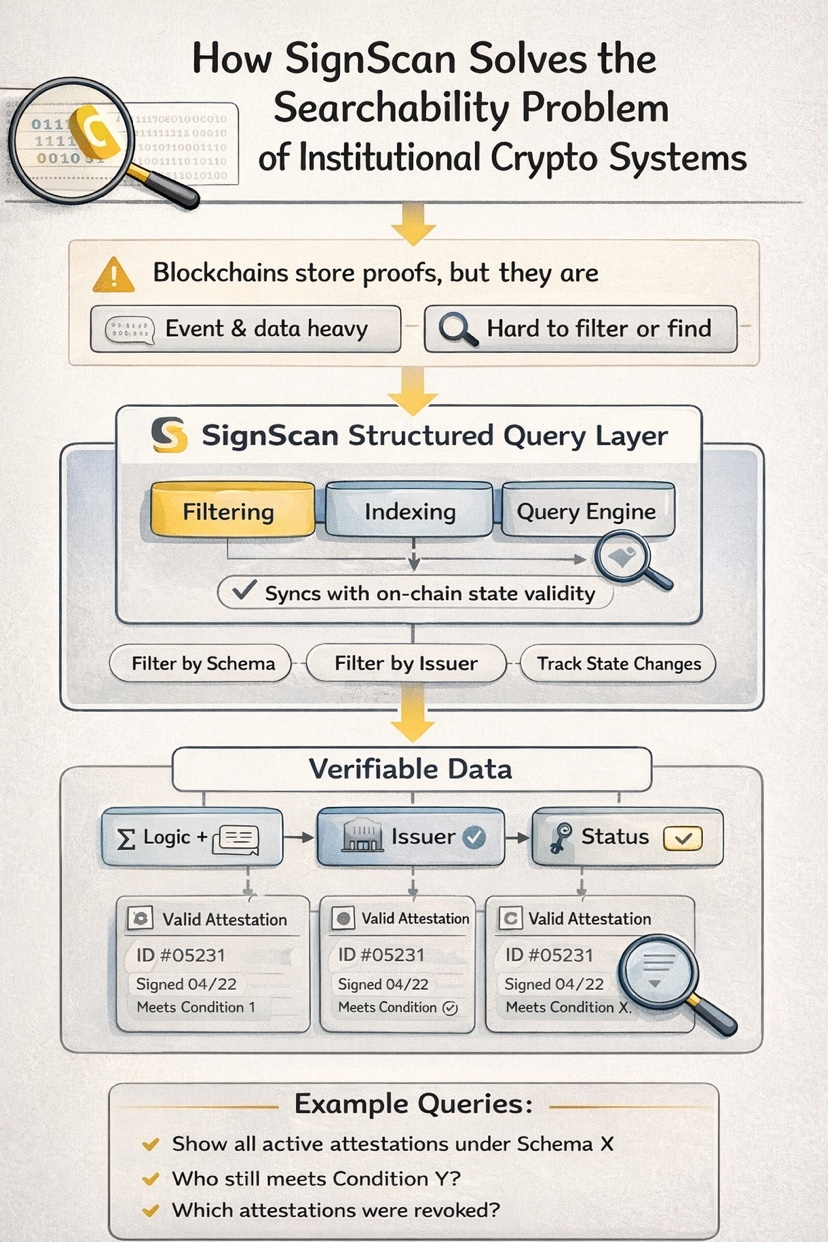
That’s where something like SignScan started to make sense to me.
Not as a “better explorer,” but as something that removes that constant need to go backwards.
Because what it’s really doing is simple.
It lets attestations behave like objects you can query directly.
Not raw events.
Not fragments of history.
Something that already carries:
its schema
its issuer
its current state
And that last part matters more than I expected.
Because the difference between “what happened” and “what is true right now” is where most confusion comes from.
If the system can’t give you the current state directly, you’re always one step away from uncertainty.
That’s why indexing here isn’t just about speed.
It’s about making sure that when you ask a question, the answer reflects state, not reconstruction.
Which means it can’t just replay logs.
It has to follow state transitions in a way that keeps queries aligned with what’s actually valid now.
Once I looked at it like that, the whole thing felt less like a feature and more like a missing layer.
Because without it, everything above starts to feel manual.
Audits turn into processes.
Automation becomes fragile.
Operations slow down.
Not because the system lacks truth.
But because it doesn’t surface it cleanly.
And that’s the part I think we’ve been underestimating.
We built systems that can prove truth
but we didn’t make it easy to use that truth once it exists.
That’s the gap.
And once you notice it, it’s hard to go back to thinking that “everything being on-chain” is enough.
Because at some point, you don’t just need truth to exist.
You need to reach it, without rebuilding it every time.