

Stacked launched in early 2026 without a forty-page whitepaper. No tokenomics diagrams. No color-coded roadmap slides. Just one line the Pixels team kept repeating throughout the rollout: built in production, not in a deck.
There's a pattern in Web3 gaming communities that I've noticed over the years. When a new project drops, the first questions are rarely "does it work." They're "what's the tokenomics," "who's the team," "is there a working demo." That's not a failure of critical thinking. It's a rational response after years of being taught that what gets announced today usually doesn't survive long enough to be tested.
Stacked is different. Not because the team says so.
Pixels started building its reward system in 2021, not to launch an external product, but to solve its own problems. When the game migrated to Ronin in November 2023 and daily active users jumped from 4,000 to 180,000 in days, bots and real players flooded in simultaneously. The economy started leaking in ways the original design hadn't anticipated. Every farming pattern, every reward exploit, every time the system got stress-tested by someone with real financial incentive became input for the next iteration.
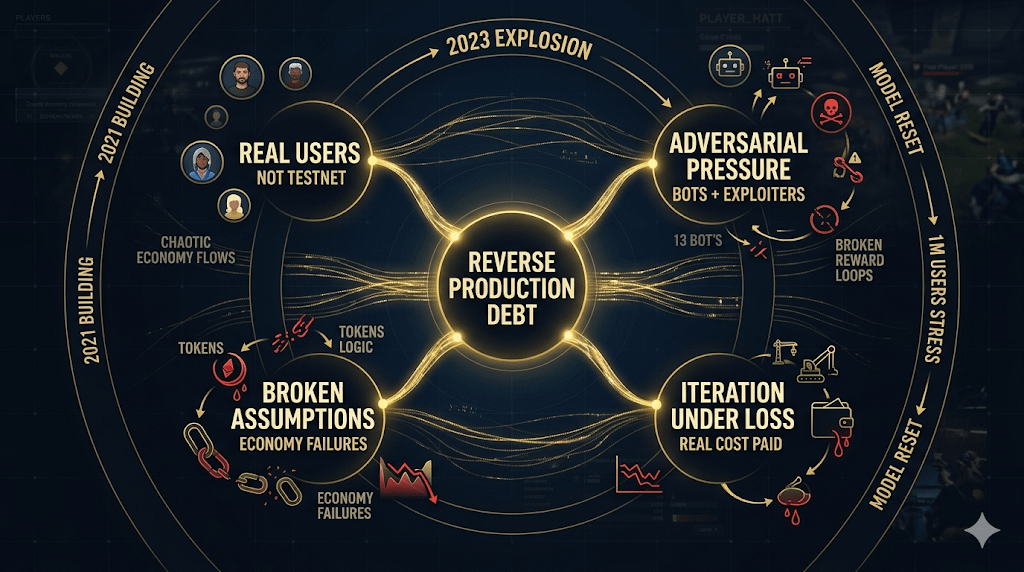
I call that reverse production debt.
Not the technical debt you accumulate by cutting corners. The knowledge you can only accumulate by running a real system under real adversarial pressure. And it's worth being precise here: production debt isn't telemetry. Plenty of studios have logs. Plenty have dashboards. What's different is that every countermeasure in Stacked was paid for with real liquidity, real players leaving, real tokens getting dumped before the team could respond. You can't simulate that in a test environment. The threat model on paper is never the threat model that shows up in production.
Two hundred million reward transactions processed. Thousands of experiments. Scaling to one million daily active users, watching the economy crack under that pressure, eventually killing $BERRY entirely because the original model couldn't survive adversarial usage at that scale. Stacked wasn't built from a whitepaper describing that scenario. It was built after the scenario had already happened, left real damage behind, and forced the team to reverse-engineer from scratch what actually retained players versus what just attracted people who were never going to stay.
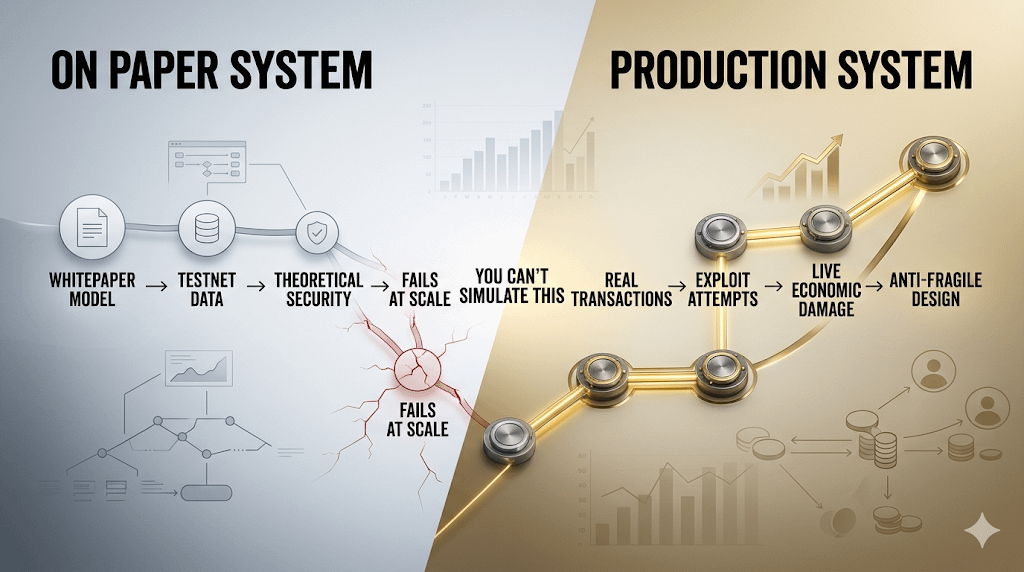
A lot of projects use the phrase "battle-tested."
Usually it means a few months on testnet, or a live deployment in a game too small to attract serious attacks. The thing that separates genuine production debt from the marketing version is simple: can the team tell you about a specific assumption that got broken, by whom, and what they paid for it? That's the question I use when evaluating any new reward system now. It tends to produce very short answers.
The output of those four years is $25M in revenue inside the Pixels ecosystem and a fraud prevention layer built from real attack patterns rather than theoretical threat models.
The gap between "a reward system" and "a reward system that survives adversarial usage at scale" is real. Most teams are building the first one while believing they're building the second. Stacked is one of the few cases where you don't have to take the team's word for it. The evidence existed before there was anything to announce.