

I wasn’t planning to spend time on another Web3 game. Honestly, I think I’ve developed a kind of quiet resistance to them. You’ve probably felt it too the cycle is predictable now. A new project appears, promises ownership, community, digital economies, maybe throws in some nostalgia, and suddenly everyone’s farming tokens instead of crops. It’s not that the ideas are bad. It’s just that they rarely survive contact with reality.
So when I first opened Pixels, I didn’t go in expecting much. I assumed it would be another thin layer of gameplay wrapped around a token economy, dressed up as something deeper than it really is. But after spending time inside it actually moving around, interacting, observing how it behaves I found myself slowing down a bit. Not because it’s revolutionary, but because it feels like it’s asking a slightly different question than most projects.
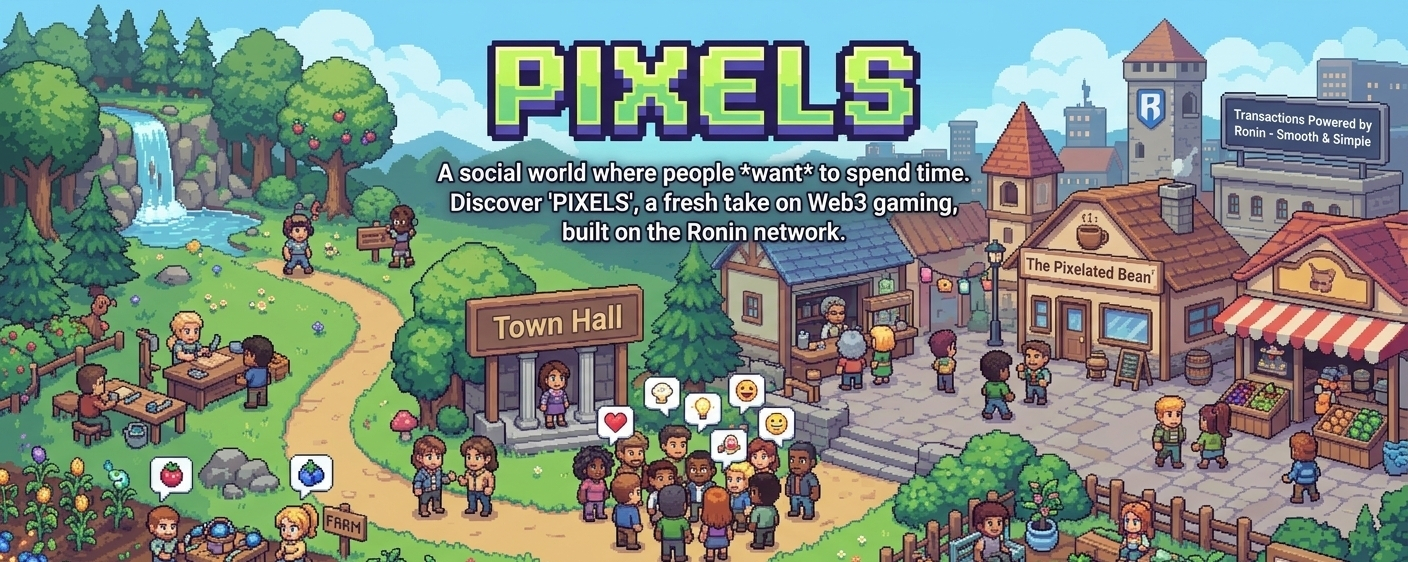
At its surface, Pixels looks simple. Farming, gathering, exploring nothing we haven’t seen before. If anything, it leans into familiarity. There’s something almost intentionally low-pressure about it, like it’s not trying to overwhelm you with complexity or push you into some aggressive progression loop. And that alone feels unusual in crypto, where everything tends to be optimized for growth, engagement, and extraction.
But the more time I spent inside it, the more I started noticing what sits underneath that simplicity. It’s not just a game layered onto a blockchain it’s more like a social environment that happens to include game mechanics. That distinction might sound small, but I think it matters.
Most Web3 games I’ve seen treat gameplay as a vehicle for token distribution. You do tasks, earn rewards, and ideally those rewards have some external value. It’s a system that often collapses into itself because the incentive structure becomes the only reason people are there. When the rewards slow down, so does the interest.
Pixels seems aware of that trap. Or at least, it behaves like it is.
The core loop farming, crafting, exploring doesn’t feel aggressively tied to financial output. It feels more like a scaffold for interaction. You’re not just optimizing yield; you’re existing in a shared space. And that’s where things get interesting, because it shifts the question from “how much can I earn?” to “why would I stay?”
That’s a harder problem than most crypto projects admit.
If you think about it, the real challenge in Web3 gaming isn’t ownership or interoperability or even tokenomics. It’s retention without artificial incentives. It’s creating something that people would still engage with even if the financial layer disappeared or became irrelevant. That’s where the industry keeps slipping confusing temporary engagement with genuine interest.
Pixels doesn’t solve that problem outright. I don’t think any project has. But it feels like it’s at least oriented in that direction.
Part of that comes from its architecture. Being built on Ronin gives it a certain kind of efficiency transactions are smoother, the friction is lower, and you don’t constantly feel the weight of the blockchain underneath every action. That matters more than people think. A lot of Web3 experiences fail not because of bad ideas, but because the underlying infrastructure makes everything feel heavier than it should.
Here, that friction is mostly invisible. You’re not constantly reminded that you’re interacting with a decentralized system. And that subtlety changes the experience. It lets the game breathe a little.
But infrastructure alone isn’t enough. What I kept coming back to was the pacing. Pixels doesn’t rush you. It doesn’t bombard you with urgent tasks or force you into high-stakes decisions. In a space that thrives on urgency buy now, mint now, act before it’s too late that slower rhythm feels almost out of place.
And maybe that’s intentional.
Because if you step back and look at the broader crypto ecosystem, a lot of it is built around compression. Time gets compressed, attention gets compressed, even decision-making gets compressed. Everything is designed to move quickly, to capture value before it disappears. But that kind of environment isn’t sustainable for something that’s supposed to feel like a world.
Games, at their best, are expansive. They give you room to wander, to experiment, to exist without constant pressure. That’s what traditional gaming figured out a long time ago, and it’s something Web3 still struggles to replicate.
Pixels feels like it’s trying to reclaim a bit of that space.
That said, I’m not entirely convinced it escapes the usual gravity of crypto. The token is still there. The economy is still a central piece of the design. And inevitably, players will start optimizing around it. They always do. It’s not even a criticism it’s just how these systems evolve.
The question is whether the social and experiential layers are strong enough to coexist with that optimization, or if they eventually get overshadowed by it.
I’ve seen this play out before. A project launches with a focus on community and experience, but over time, the economic layer takes over. Conversations shift from “what can we build here?” to “what’s the most efficient way to extract value?” And once that shift happens, it’s hard to reverse.
Pixels might face that same tension.
But there are moments small ones where it feels like it could resist it, at least partially. Watching players interact without immediately turning everything into a transaction, seeing spaces that feel lived-in rather than optimized… those things matter. They suggest that there’s at least a foundation for something more organic.
And maybe that’s the real point here.
Not that Pixels is solving Web3 gaming, but that it’s nudging it in a slightly different direction. Away from pure financialization and toward something that feels a bit more human, even if it’s still imperfect.
Because if you strip away all the narratives, all the promises, all the buzzwords, what we’re really trying to build in this space are environments where people want to spend time. Not because they have to, not because they’re being incentivized to, but because it feels meaningful in some small, personal way.
That’s a high bar. And most projects don’t even try to reach it.
Pixels, at least from what I’ve seen so far, seems to be trying. Quietly, without making a big deal out of it.
Of course, trying isn’t the same as succeeding. There are still open questions about scalability, about long-term engagement, about how the economy evolves as more users come in. And there’s always the risk that it becomes just another example of a good idea constrained by the realities of the space it exists in.
I don’t think skepticism goes away here. If anything, it becomes more nuanced.
Because now it’s not just “this probably won’t work,” it’s “this might work, but only if it avoids the same patterns that have derailed everything else.” And that’s a harder thing to evaluate. It requires time, observation, and a willingness to sit with uncertainty.
Which, ironically, is something crypto doesn’t always allow for.
Everything moves so fast that projects are often judged before they’ve had a chance to evolve. Early hype sets expectations, and when reality doesn’t match up immediately, interest fades. It’s a cycle that rewards short-term excitement over long-term development.
Pixels doesn’t feel built for that kind of cycle. Or at least, it doesn’t feel like it fits neatly into it.
And maybe that’s why it stuck with me more than I expected.
Not because it’s dramatically different, but because it’s slightly misaligned with the usual incentives. It doesn’t scream for attention. It doesn’t try to convince you of its importance. It just exists, quietly building its own rhythm.
I don’t know if that’s enough. I don’t know if it scales, or if it holds up under pressure, or if it eventually gets pulled into the same patterns as everything else.
But for the first time in a while, I found myself not rushing to answer those questions.
I was just... observing.
And in this space, that alone feels like a small shift.