
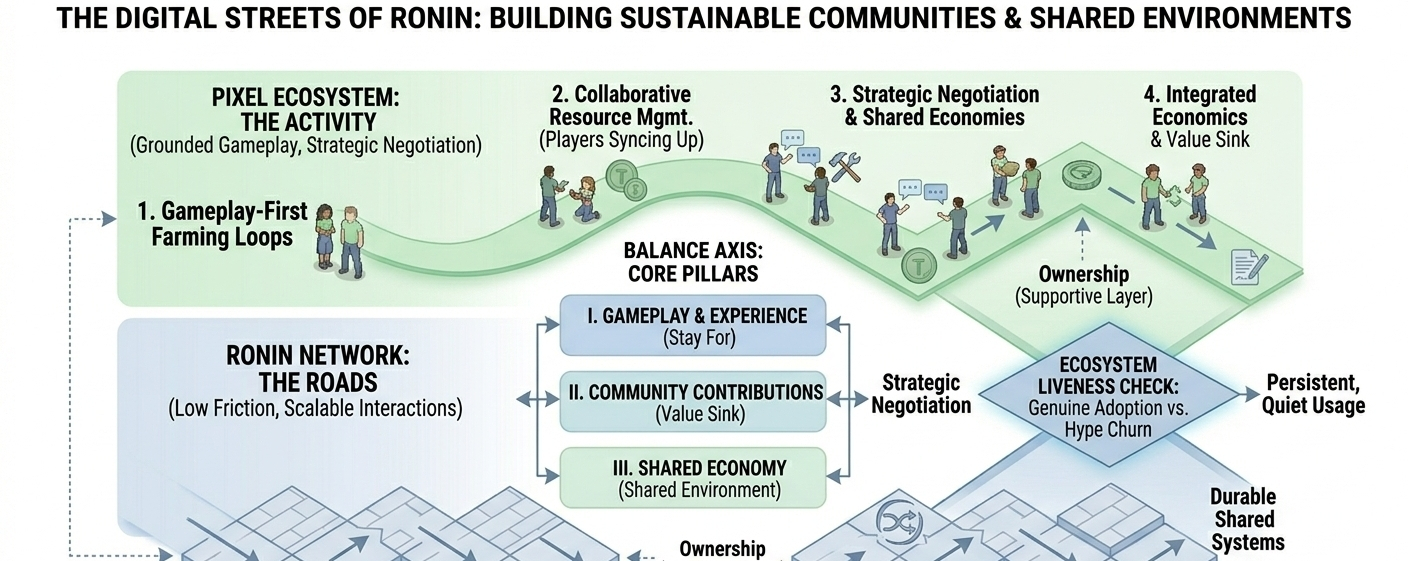
I was sitting at a small chai stall near the edge of the market, the kind of place where the cups are never fully clean and the conversations never fully stop. My phone was in my hand, screen glowing against the dim yellow light, half-focused on a game running on Ronin Network. I didn’t expect much. Just another routine check, maybe a few clicks, then back to scrolling. But something felt different that night. It wasn’t the graphics or rewards. It was the people. Players weren’t just playing—they were syncing up, waiting on each other, trading small advantages like they actually mattered. It didn’t feel like a game session. It felt like a system quietly organizing itself.
That moment stayed with me, because it reframed how I look at both PIXEL and the chain it lives on. Not as isolated pieces, but as layers of something trying to become real.
Ronin has always had a clear identity. Built initially around Axie Infinity, it solved a simple but critical problem—how do you make constant, small interactions actually affordable? Fast transactions, low fees, minimal friction. That was the pitch. But lately, it feels like Ronin is stepping into a broader role. Not just supporting one breakout success, but quietly preparing to host multiple smaller worlds at once.
That shift matters more than it looks on the surface.
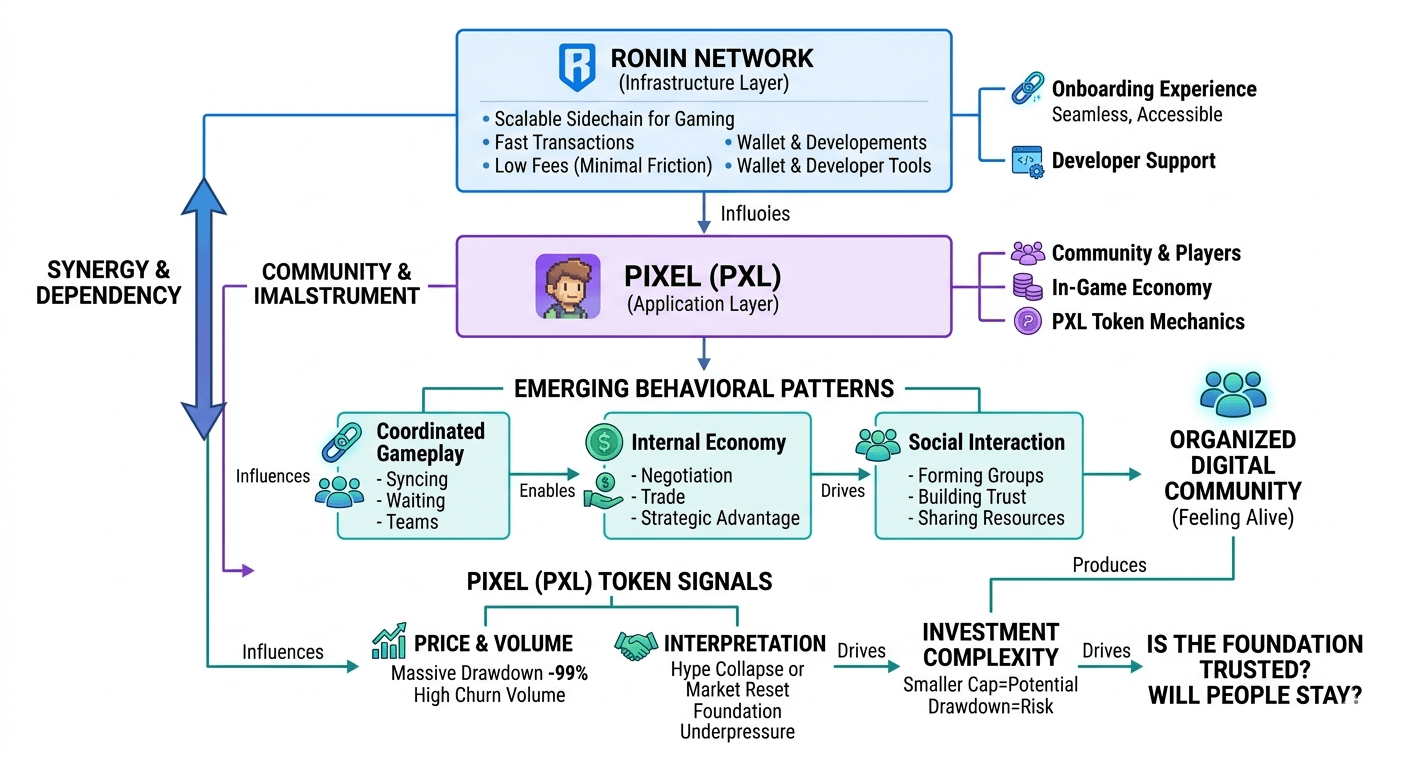
Because a network built around one game is fragile. A network supporting many interconnected communities—that’s where things start compounding.
PIXEL sits right in the middle of this transition, but not comfortably.
At the time of writing, the token is hovering around fractions of a cent, with a market cap that suggests it’s far from dominant, and a daily trading volume that feels unusually active for its size. There’s a visible disconnect there. Price has collapsed heavily from earlier highs, the kind of drop that usually clears out noise and leaves behind either silence or intent. And I’ve been trying to figure out which one this is.
So instead of guessing, I spent time inside it.
Not just watching charts or reading threads, but actually participating. Farming, trading, waiting on timers, talking to players. What stood out wasn’t the token mechanics everyone likes to debate—it was how quickly interactions turned social when resources became limited.
At one point, I needed something I couldn’t easily produce myself. Normally, that’s where a solo grind kicks in. But instead, I asked. Someone responded. Not instantly, not generously—but strategically. There was negotiation. A bit of hesitation. A sense that both sides were weighing value, not just clicking buttons.
That’s when it clicked for me.
The real product here isn’t the game loop. It’s the behavior that forms around it.
And that’s where PIXEL either proves itself—or fades out.
Because price alone doesn’t tell you if something is alive. Behavior does.
Still, there are signals that can’t be ignored. A token dropping over 99% from its peak isn’t just market noise. It’s a story. Sometimes it’s the story of hype collapsing. Sometimes it’s the story of something resetting under pressure. The difficult part is that both stories can look identical from the outside.
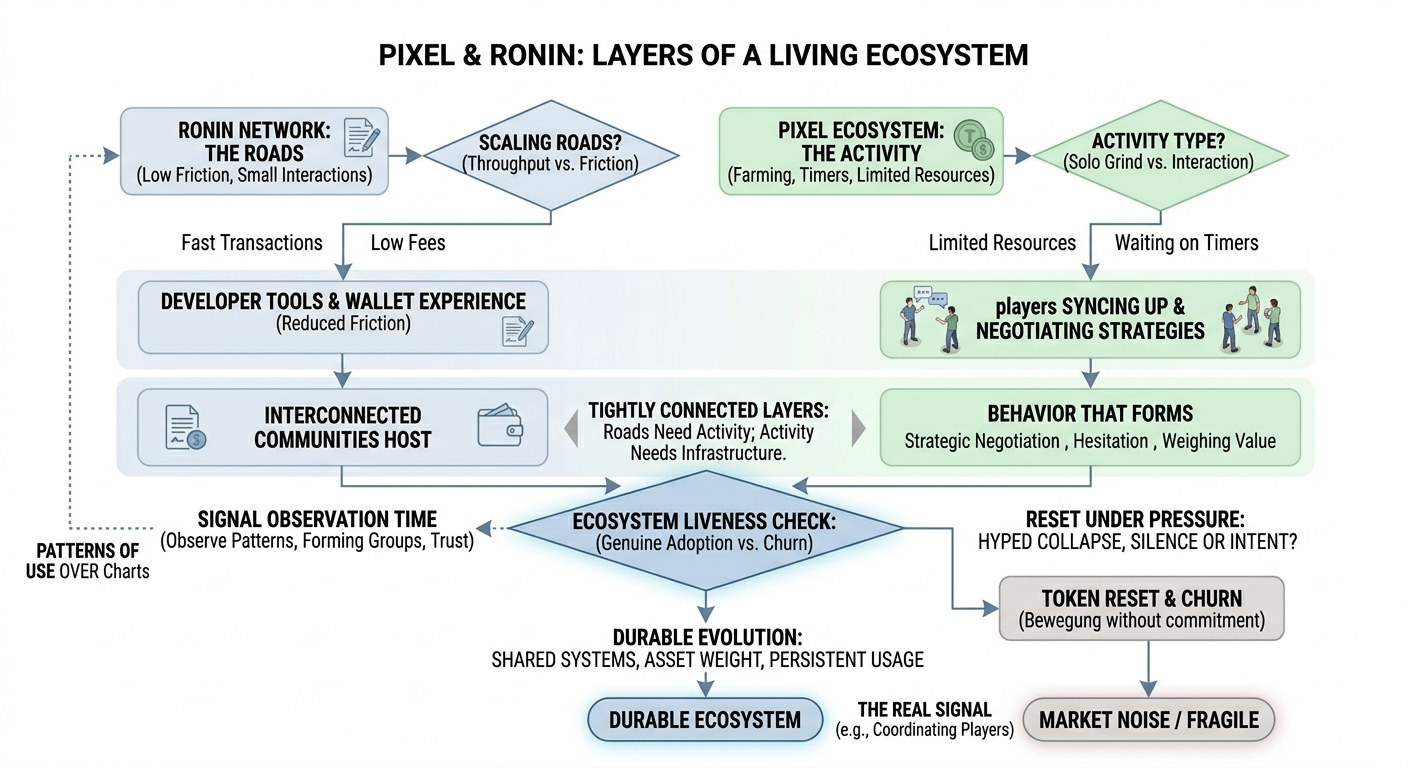
What adds complexity here is the trading activity. Volume staying relatively high while price stays low usually points to churn. Movement without commitment. People stepping in and out quickly, not building positions, not anchoring themselves to the ecosystem.
I’ve seen that pattern before. It doesn’t automatically mean failure, but it does mean the foundation isn’t fully trusted yet.
On the other side, Ronin has been evolving in a quieter, more deliberate way. Improvements in wallet experience, smoother onboarding, better tools for developers—none of these create headlines, but they reduce friction. And in gaming, friction is what decides whether someone comes back tomorrow or forgets entirely.
That’s the part most people underestimate.
You can have the best token model in the world, but if interacting with it feels like effort, users leave. Not dramatically. Just gradually, until the system feels empty.
What makes this interesting is how tightly connected these layers are.
Ronin provides the roads. PIXEL tries to build activity on those roads.
If the roads are efficient but empty, nothing grows. If activity exists but the infrastructure slows it down, users get frustrated. Both sides need each other, but there’s no guarantee they’ll scale at the same pace.
From an investment angle, that’s where things get complicated.
A smaller market cap suggests room to expand, but only if there’s genuine adoption underneath. A massive drawdown suggests risk, but also forces a deeper question—what actually broke? Was it the market cycle, or did users simply stop caring?
I’ve learned not to answer that question too quickly.
Because the real signals don’t come from charts. They come from patterns of use. Are players showing up daily without being forced? Are they forming small groups, building trust, creating their own internal economies? Or are they just extracting value and leaving?
Those answers take time to observe.
What I do see, though, is a broader shift starting to form. Games are no longer trying to exist as isolated experiences. They’re slowly moving toward shared systems—where assets, decisions, and interactions carry weight beyond a single session.
Ronin seems positioned to support that kind of environment.
Whether PIXEL becomes a meaningful part of it is still uncertain.
Because right now, everything still feels early. Not in a broken way—but in a way where nothing is fully settled yet. Systems are working, but not refined. Communities are forming, but not fully stable. It’s the kind of stage where things can either evolve into something durable—or quietly dissolve.
And I keep thinking back to that moment at the chai stall.
Not the price, not the charts—but the interaction. Players coordinating without being told to. Negotiating without a script. Acting like they were part of something shared, even if small.
That’s the real signal.
So the question isn’t just whether a token has fallen too far.
It’s whether what’s being built underneath it is strong enough to make people stay.