
Let’s try to understand what the real story is.
I’ve come to feel that in crypto, strong technology can still end up carrying a weak idea.
A blockchain can be fast, transparent, and technically impressive. A token can be live, tradable, and easy to plug into a system. But none of that, on its own, creates a healthy game economy. That’s what makes Pixels interesting to me. Under the farming game surface, it feels like the real thing the project is struggling with is much deeper: how do you build incentives in a way that makes players, rewards, and the game itself strengthen each other instead of quietly pulling the whole system apart?
That is why I’ve never found “it’s on-chain” to be a satisfying answer.
Yes, blockchain can prove ownership. It can make movement visible. It can make assets transferable. But it cannot make people care. It cannot make them stay longer, spend with intention, or feel genuinely connected to a system. Those are not technical outcomes. Those are human outcomes. And a lot of Web3 projects seem to blur that line. They assume that once ownership exists, alignment will naturally follow. But ownership only matters when the surrounding system gives it real weight — emotional weight, practical weight, or economic weight. Without that, a token is just something people receive and move on from.
To me, that is where many projects get the sequence wrong. Technology gets pushed to the front because it is easier to explain. Tokenization is easy to explain. Wallets are easy to explain. On-chain assets are easy to explain. Incentive design is much harder. What exactly are you rewarding? What kind of behavior starts to make sense inside the system? What makes spending feel smarter than withdrawing? What makes participation deeper than extraction? What makes someone come back instead of slowly drifting away?
That is where Pixels becomes more interesting than it first appears.
Its own material is unusually direct about the problems it ran into: token inflation, selling pressure, and rewards that were not really reaching the behaviors that created long-term value. To me, that does not sound like a blockchain problem. It sounds like an incentive problem. The code may be working perfectly, but if the system is rewarding the wrong things, the economy can still weaken from the inside.
And that kind of weakness can be deceptive.
A bad incentive loop does not always look bad at first. Rewards go out. Activity rises. The system looks alive. Numbers move. Everything seems active. But that movement can be misleading if there are no real sinks, no good reasons to reinvest, and no deeper loop that keeps value circulating. Pixels describes some of this in very plain terms: an incomplete core loop, not enough sinks, oversupply, hoarding, and too few reasons for players to keep putting value back into the game. That matters more than it sounds like it does. If players can earn, but have no meaningful reason to cycle that value back into the world, the economy starts leaking. And once leaking becomes normal, extraction starts to feel like the default behavior.
That is the point where Pixels stops sounding to me like just another game project and starts sounding more like a systems design experiment.
What stands out is that it does not frame the answer in the usual vague way, with broad talk about “more utility.” Instead, it talks about “Fun First,” smarter reward targeting, and a data-driven flywheel. What that suggests to me is a shift in thinking. The game has to be worth playing on its own. Rewards have to reach the kinds of users who are actually likely to add durable value. And the system has to learn from behavior instead of just throwing incentives everywhere and hoping alignment appears on its own.
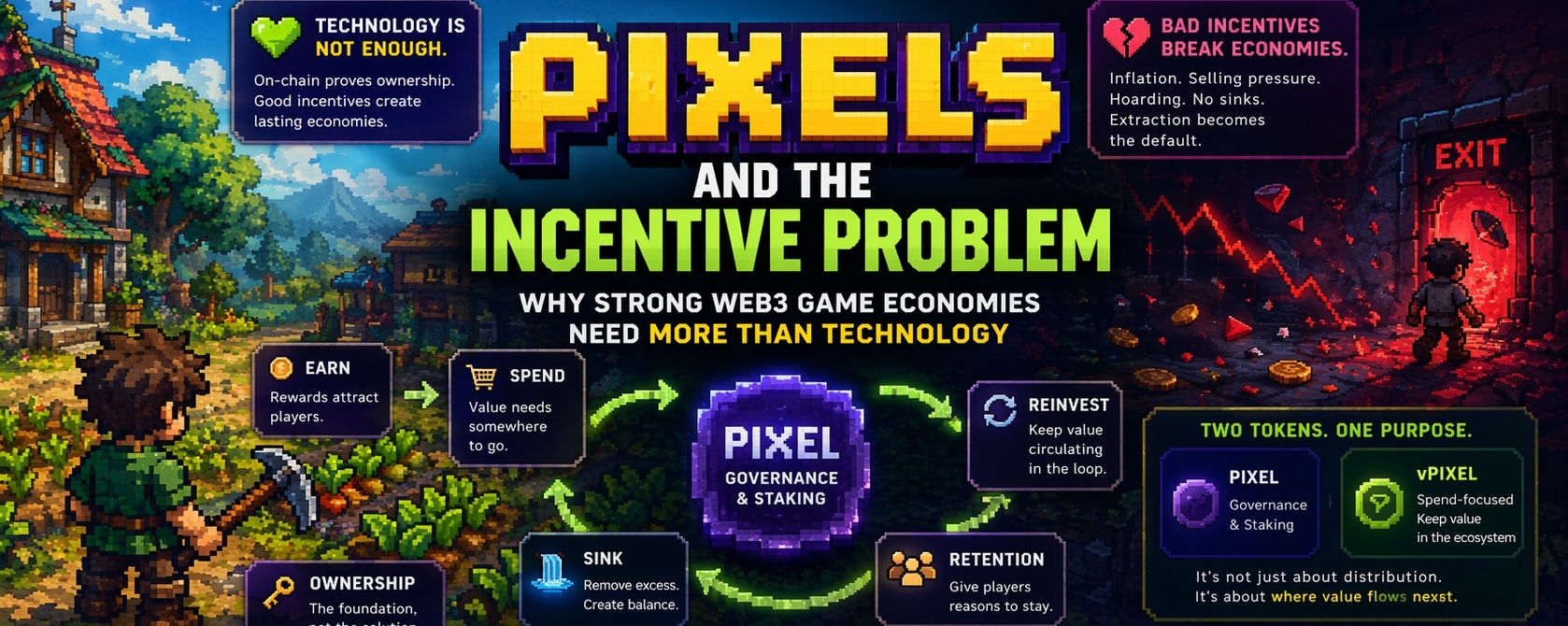
That is really the center of the whole thing: reward, spend, sink, retention, and participation are not separate pieces. They live or fail together.
Rewards can attract attention. Spending and sinks give value somewhere to go. Retention gives the system enough time to become stable. Reinvestment prevents the entire thing from turning into a one-way exit flow. If one of those pieces is weak, the whole loop starts losing balance. That seems to be why Pixels talks about upgrades, durability, higher-tier crafting, inventory limits, and gated earning structures. None of that is flashy. None of it sounds like a breakthrough technology. But that is exactly the point. These are design choices meant to shape behavior over time.
The same idea shows up in the token structure too.
Pixels presents PIXEL as the main governance and staking asset, while vPIXEL is meant to work as a spend-focused token designed to keep more value moving inside the ecosystem instead of immediately spilling out of it. I do not find that interesting because it adds another token layer. I find it interesting because of what it says about the team’s thinking. It suggests they understand that the path value takes after rewards are distributed matters just as much as the rewards themselves. Distribution alone does not create alignment. The system has to give value a reason to circulate in ways that support retention, spending, and healthier participation.
So when I think about what makes a Web3 game strong, I do not start with the chain or the token launch.
I start with whether the system really understands people.
Does it reward the right actions?
Does it make staying feel more sensible than leaving?
Does it create loops that can actually hold value instead of just pushing it outward?
That, to me, is the bigger lesson in Pixels. Sustainable systems are not built from code alone. They are built from incentives that understand human behavior. And most of the time, when these systems fail, it is not because the technology was too weak. It is because the incentive design never really saw people clearly in the first place.
