

It showed up somewhere between checking a chart and refreshing a feed — one of those in-between moments where you’re not fully focused on anything, just scanning. Usually, things that appear there don’t last more than a few seconds. Another token, another loop, another system asking for attention.
This one didn’t ask.
That’s what made me stop.
At first, it looked almost too simple to matter. You walk around, plant crops, collect resources, maybe trade a little. No flashing indicators. No timers pushing you to come back. No sense that you’re already late to something important.
It felt… optional.
And that’s unusual in crypto.
Most systems here are built around urgency. Even when they call themselves “games,” they behave more like mechanisms of extraction. Rewards decay, opportunities disappear, incentives stack in ways that make inactivity feel like loss. You’re not really playing — you’re managing your position inside a system that doesn’t want you to leave.
Pixels felt like it didn’t care if I stayed.
But I did.
Not because there was something to chase, but because there wasn’t.
And that’s where something started to feel different.
Underneath that calm surface, the structure is still there. There’s an economy running. There are tokens moving between players. There’s land, resources, progression. It’s not empty — it’s just not loud about it.
The system doesn’t introduce itself as a financial layer first. It lets you exist inside it before you realize there’s value attached to what you’re doing.
That order matters more than it seems.
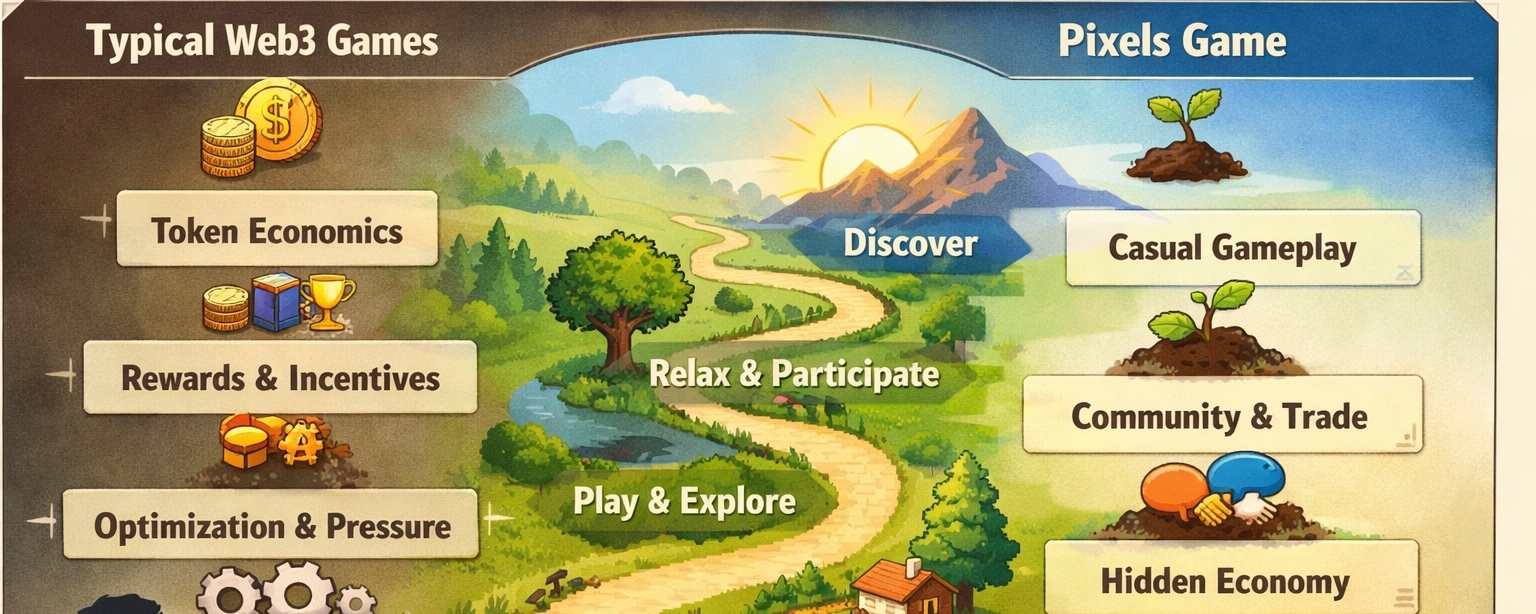
In most Web3 games, the economy is the entry point. You understand the token, the reward loop, the potential upside — and then you decide whether to engage. Here, it feels reversed. You engage first, almost casually, and only later notice that what you’re doing has economic weight.
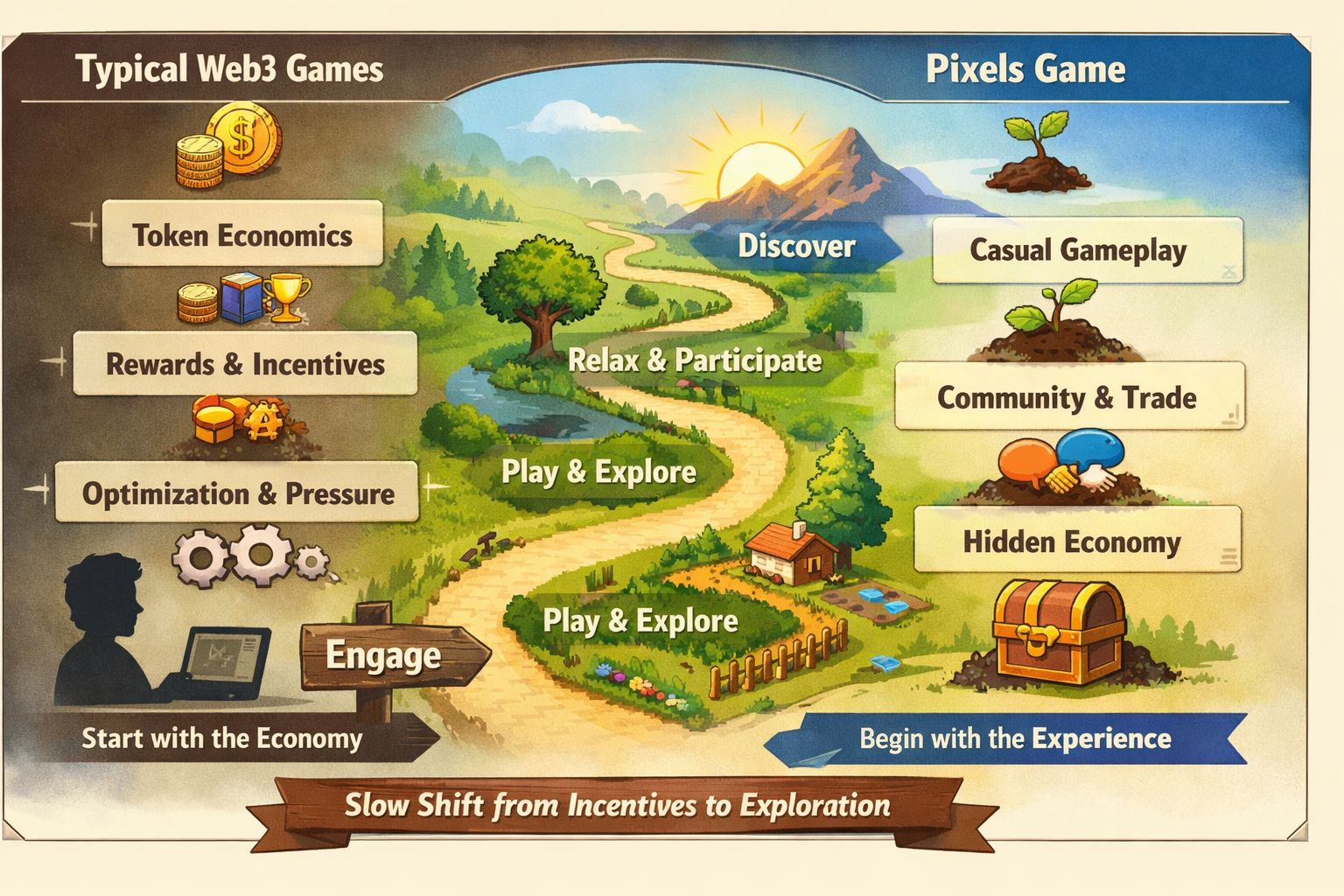
It’s a subtle shift, but it changes the entire relationship between the player and the system.
You’re not optimizing from the beginning.
You’re just… participating.
And participation without pressure feels closer to something real.
I kept thinking about how rare that is in digital environments. Almost everything online is designed to guide behavior — to push, suggest, nudge. Even the quiet systems are usually quiet on the surface but aggressive underneath.
Pixels doesn’t feel aggressive. But that doesn’t mean it isn’t structured.
It just hides the structure better.
Or maybe it delays it.
Because at some point, every system with value attached starts to attract optimization. Players figure out the most efficient loops. Resources get priced. Time becomes measurable. What felt like routine slowly turns into strategy.
And that’s the part I’m not sure about yet.
Can something like this stay “quiet” once enough people start paying attention?
Or does it eventually become like everything else — a system where behavior is shaped more by incentives than by interest?
The Ronin Network underneath it explains part of why this works. Transactions are fast, cheap, almost invisible. You don’t feel the friction that usually reminds you you’re interacting with a blockchain. It fades into the background, the way infrastructure probably should.
But that also raises another question.
If the technology becomes invisible, what’s left as the defining layer?
Is it the economy?
Or the experience?
Pixels seems to lean toward the experience, at least for now. It doesn’t introduce itself as “Web3 first.” It just exists as a place you can spend time in, and the blockchain part quietly supports it instead of dominating it.
That feels closer to how these systems might need to evolve if they’re going to last.
Not everything needs to announce itself as infrastructure.
Some things just need to work, and let people discover the depth on their own.
Still, I can’t tell if what I felt was intentional design or just an early-stage calm before things get more complex. A lot of systems start simple and become heavy over time — layers of incentives, governance, monetization slowly stacking until the original experience gets buried.
Maybe Pixels avoids that.
Or maybe it doesn’t.
But for a moment — somewhere between planting something and forgetting to check the price of anything — it felt like I wasn’t inside a system trying to extract something from me.
It felt like I was just there.
And in this space, that alone feels like a signal worth paying attention to.
