
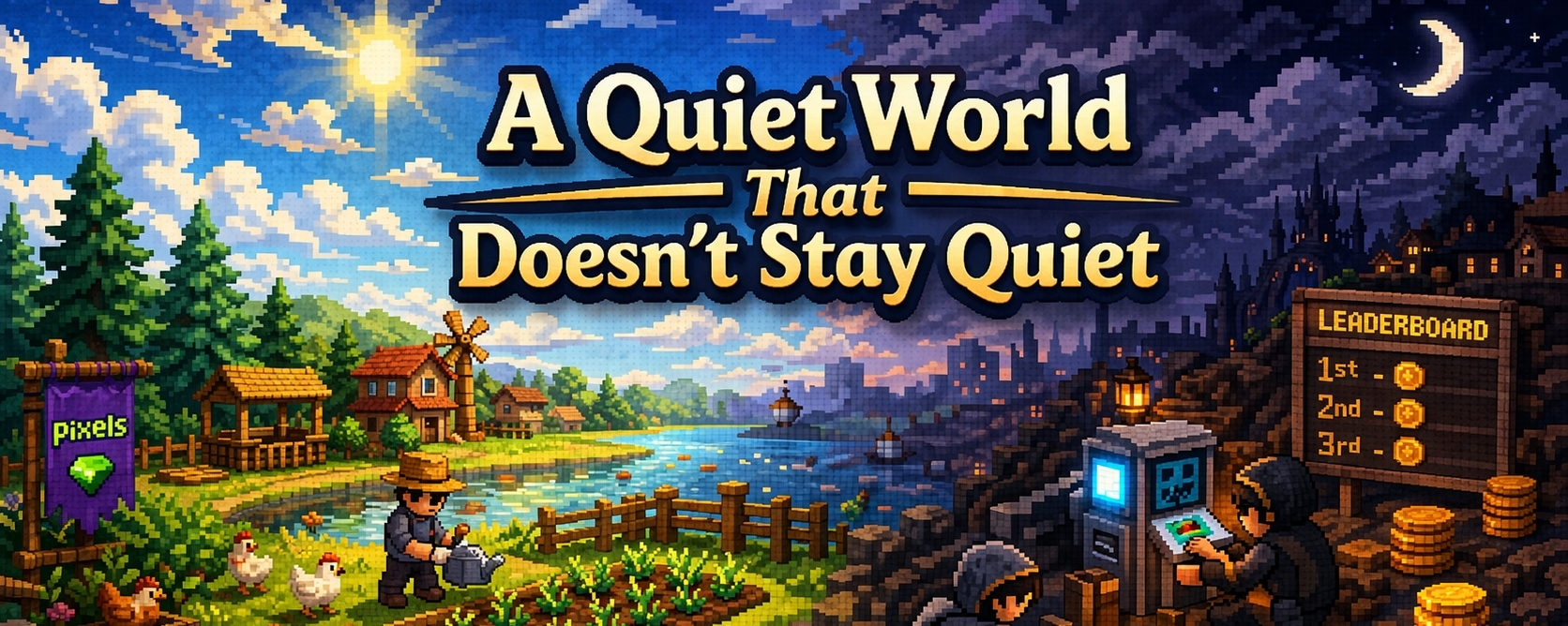
I didn’t take it seriously at first. A farming game, soft colors, people wandering around tending land it felt like something I’d seen before, just placed onchain this time. And I’ve learned to be careful with anything that looks simple in this space. Simple rarely stays simple once incentives creep in.
So I approached Pixels the same way I approach most things now — a bit detached, expecting the usual arc. Early charm, growing attention, then the slow shift where behavior starts to harden around whatever can be extracted.
At the beginning, though, it doesn’t feel like that. You move slowly. There’s no immediate pressure to optimize anything. You can spend time doing things that don’t clearly matter, and for a moment, that feels… almost unfamiliar. Like the system isn’t asking anything from you yet.
But “yet” tends to carry a lot of weight.
I keep coming back to how these environments change once people settle in. Not because the rules change, but because the interpretation of them does. What starts as a shared space gradually becomes a field of positions. Land, time, even presence — they begin to mean something slightly different once there’s a sense that they can be measured.
And they always end up being measured.
Pixels doesn’t push that aggressively, which is probably why it works at all. It lets the world breathe a bit. But underneath that, there’s still a structure keeping track of things — who shows up, who does what, who accumulates over time. And once that structure exists, people adapt to it, even if the game itself doesn’t explicitly demand it.
That’s where things start to feel uncomfortable.
Not because anything is broken, but because it isn’t. It functions. People participate. The world feels alive enough. But the reasons for being there begin to shift in small, almost unnoticeable ways.
I’ve seen this pattern repeat across cycles. Systems that rely on presence eventually have to deal with what that presence is motivated by. At first, it’s curiosity. Then routine. Then, slowly, strategy. And once strategy takes hold, everything else starts to reorganize around it.
Even something as soft as farming becomes directional.
I wonder how durable that kind of world really is. Not in terms of uptime or infrastructure — Ronin smooths a lot of that out, makes it easy to stay. But durability in terms of meaning. What keeps people there when the novelty fades, when the small rewards fluctuate, when attention drifts somewhere else?
Because attention always drifts.
And when it does, these systems don’t collapse immediately. They thin out. The world is still there, but it feels different. Less like a place, more like a framework waiting to be used again. Or exploited, depending on who returns.
Maybe that’s too cynical. There are still moments that feel unstructured, even now. People doing things without a clear reason, interacting in ways that don’t seem tied to outcomes. Those moments matter more than they appear to. They’re probably the only thing holding the whole thing together.
But they’re also the hardest to sustain.
I keep circling back to that tension — between a world that wants to feel casual, and a system that quietly records, rewards, and reshapes behavior over time. Pixels sits right in the middle of that, not fully collapsing into either side.
And maybe that’s why I haven’t dismissed it.
Not because I’m convinced it works, but because I’m not entirely sure how it fails. It doesn’t break in obvious ways. It just shifts, slowly, as people do what they always do — adapt, optimize, reinterpret.
I’m still watching it, trying to catch where that shift becomes irreversible.
Haven’t seen it yet. Or maybe I have, and it just didn’t look like much at the time.
