
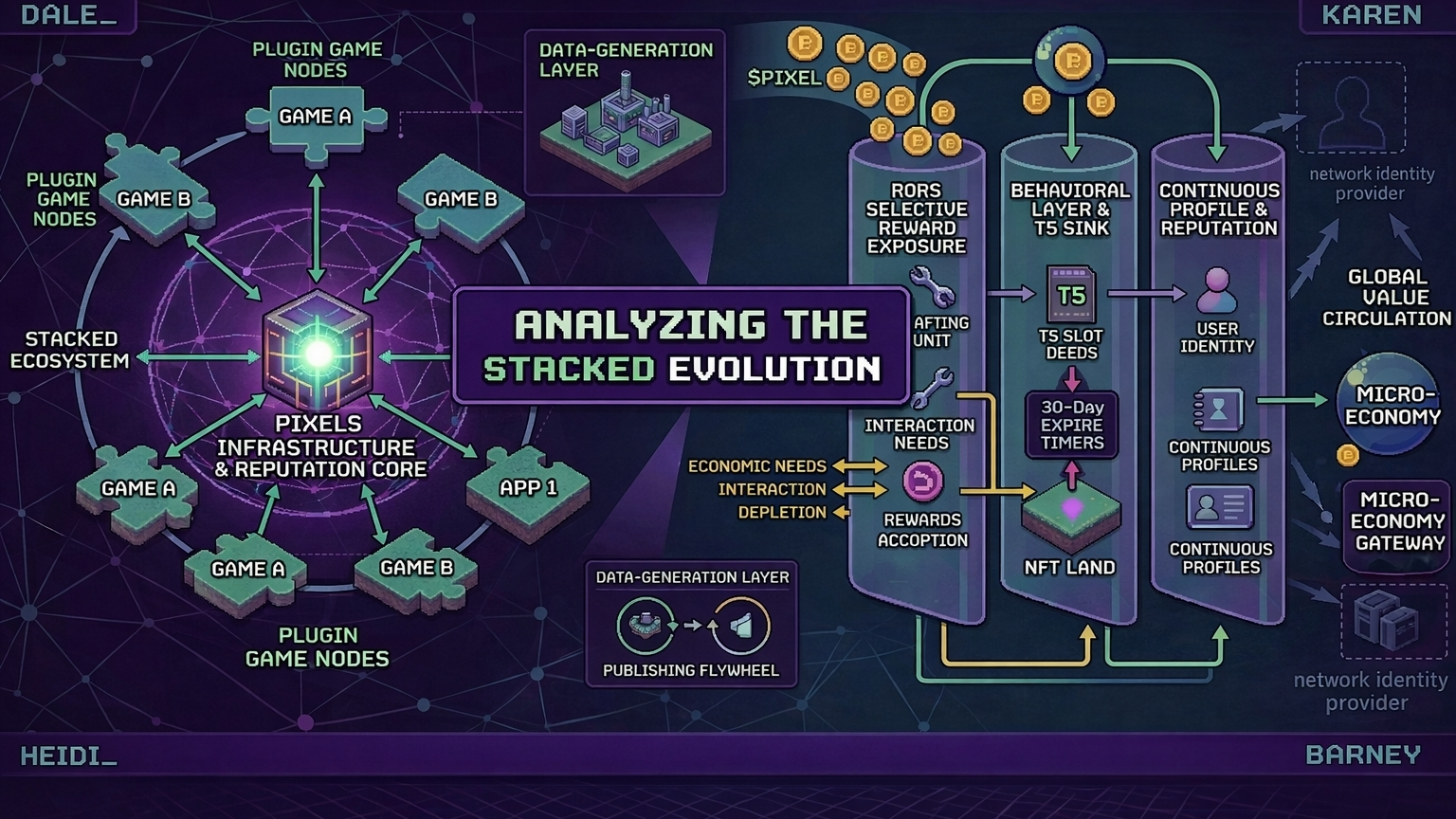
The Web3 gaming landscape is a graveyard of "Play-to-Earn" projects that prioritized token emissions over genuine player engagement. We’ve seen the cycle a dozen times: hype, hyper-inflation, and the inevitable death spiral. However, as we peel back the layers of Pixels and its burgeoning "Stacked" ecosystem, it’s becoming clear that we aren't just looking at another farming sim. We are witnessing a sophisticated, live-market attempt to solve the "extraction problem" once and for all.
The Philosophy of Controlled Emissions
One of the most disruptive elements of the PIXEL economy is the Reward Budget System, or RORS. In the "old" world of GameFi, rewards were a vending machine: you perform Action A and receive Reward B. It was predictable, which made it exploitable.
Pixels has replaced the vending machine with a Central Bank. Through "Selective Reward Exposure," the system dynamically evaluates the health of the economy. Does the market need more crafting? Is there too much raw resource sitting in wallets? The system routes PIXEL rewards based on these needs. It’s a behavioral nudge that ensures players aren't just mindlessly extracting value, but are instead providing the specific type of liquidity or labor the economy requires at that exact moment.
Tier 5 and the Barrier to Entry
The introduction of Tier 5 (T5) mechanics is where the "game" starts to look like a digital business. By requiring slot deeds that expire every 30 days and limiting high-tier production strictly to NFT lands, Pixels is implementing a "psychological timer."
In previous iterations of Web3 gaming, you could "park" an asset and let it print money. T5 kills the passive extractor. It forces active participation and constant reinvestment. If you want the high-margin yields of T5 industries, you must manage your land like a real-world enterprise. This creates a massive "sink mechanism" for the token. Liquidity isn't just being bridged out to an exchange; it’s being cycled back into the game to maintain operational status. You don't just own the land; you work it.
Is Gameplay Secondary to System Design?
The most ambitious part of the roadmap is the "Stacked" evolution. This isn't just about one game on the Ronin Network; it’s about creating an infrastructure where other developers can plug in. Under this framework, your farm’s history, your reputation, and your PIXEL holdings transform into a "Continuous Profile Economy."
This suggests that the act of farming is actually a data-generation layer. Every seed planted and every trade made contributes to a digital reputation that carries over into the broader "Stacked" network. Pixels isn't just a game creator; they are positioning themselves as a network identity provider. The "game" is the hook, but the "flywheel" is the publishing and identity layer that lives underneath it.
Conclusion: The Brave New World of PIXEL
We are moving toward a reality where "playing" remains open to everyone, but "extracting" value is conditional. It is a meritocracy based on contribution to the system's stability. While some critics argue that this level of centralized economic control is restrictive, it may be the only vaccine against the inflation that killed the first generation of GameFi.
Pixels is no longer just building a game; they are building a framework for how digital value will circulate in the next decade. The question is no longer whether the game is fun, but whether the system is sustainable. By shifting the focus from "earning" to "production," Pixels is writing a new playbook for the entire industry. Is the system becoming too dominant, or is this exactly the "pulse" that Web3 gaming needs to finally grow up?
#pixel $PIXEL @Pixels #GameFi #CryptoEconomy #BinanceSquare $BTC

