
Habibies, one thing surprised me almost immediately: I didn’t realize how much Tier 4 had been quietly preparing me until I stepped into Tier 5 and suddenly felt uncertain again, as if the game intentionally reset my confidence.
That’s what makes Pixels Tier 5 interesting.
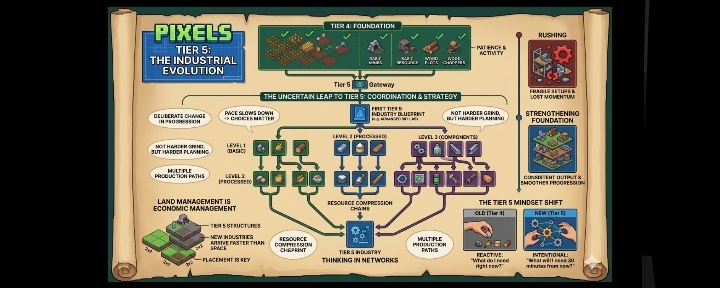
At first glance, it looks like a normal expansion — more industries, more than 100 new recipes, and deeper resource chains. But underneath, it feels like a deliberate change in progression. The pace slows down just enough that every choice starts feeling important again.
When I first checked the requirements for a Tier 5 industry, the numbers didn’t seem overwhelming. A few extra materials, some refined outputs, maybe a couple of additional crafting steps.
But once you follow the chain, everything changes.
One ingredient depends on multiple earlier industries. Those industries rely on upgraded land. And suddenly those “100+ recipes” stop looking like extra content and start feeling like a system that wants you to think in networks instead of single actions.
That changes how you build your first Tier 5 industry.
The visible process is simple: unlock the blueprint, gather the resources, then craft the structure.
But beneath that, the real mechanic is resource compression.
Materials that once felt common begin moving upward into tighter loops. Basic resources become processed goods, processed goods become industrial components, and those components eventually support one output that actually matters.
That’s why some players struggle early.
It often isn’t because the grind is harder. It’s because the planning becomes harder.
For example, if your first Tier 5 industry needs three new materials, and each material requires two sub-recipes, that can quickly become six separate production paths. Even if each chain only takes ten minutes to stabilize, you can spend nearly an hour creating flow before you generate real output.
And the game never explains that directly.
It lets you discover it through friction.
What stood out to me most is how strongly Tier 5 rewards players who think one step ahead. If your Tier 4 setup is organized, Tier 5 feels like progression. If it isn’t, Tier 5 feels like resistance.
That difference matters.
Earlier tiers mainly tested patience. Tier 5 starts testing coordination.
You can have enough time, enough land, and enough materials — but if your production chain is misaligned, progress slows anyway.
That creates a different kind of advantage.
Not just for grinders. Not just for whales.
But for players who know how to organize.
And that reflects a bigger pattern across Web3 gaming. Older systems rewarded activity. Newer systems are beginning to reward efficiency.
Tier 5 feels like part of that shift.
The obvious steps are easy to understand: choose the industry, gather the inputs, then build.
But the deeper challenge is sequencing.
You don’t really begin with the Tier 5 structure. You begin by making sure everything beneath it can support it.
That means asking one important question first:
Can your current industries produce consistently without constant attention?
If the answer is no, Tier 5 can feel slow. If the answer is yes, Tier 5 can feel like a multiplier.
There’s also a pacing choice hidden inside the system.
Do you rush into your first Tier 5 build? Or do you strengthen the foundation first?
From what I’ve seen, rushing can create fragile setups. One missing ingredient can freeze the whole chain. But players who build supporting industries first usually create smoother long-term output.
And in Tier 5, consistency matters more than speed.
Land management also becomes more important.
New industries arrive faster than usable space does, which means every tile starts carrying more value. Placement stops being cosmetic and becomes part of the economy itself.
So your first Tier 5 industry is not only about resources.
It is also about space.
I’ve seen players underestimate that and waste time rebuilding their layouts halfway through. The cost isn’t always visible in materials — sometimes it shows up in lost momentum.
The market side becomes more interesting too.
As supply chains grow longer, lower-tier materials can suddenly regain value. Resources that felt cheap in Tier 4 can become bottlenecks in Tier 5 because they now sit underneath multiple advanced recipes.
That creates opportunity.
Some players may profit more by supporting Tier 5 rather than rushing into it — producing key inputs, filling shortages, and supplying demand when others need it most.
That alone says something important.
Tier 5 doesn’t just add content. It tests whether the ecosystem can support a layered economy.
There is risk, though.
Too much complexity can overwhelm players who simply want to relax and progress. If the system becomes too demanding, some people may step away.
But if the balance stays right, Tier 5 could become something rare: a deeper system that rewards thought without making the game feel like work.
Right now, it feels like it’s trying to find that balance.
And the biggest change happens quietly.
At some point, you stop asking:
“What do I need right now?”
And start asking:
“What will I need 30 minutes from now?”
That’s where progression really changes.
Because once that happens, your industries stop feeling separate. They start feeling connected.
Your decisions stop being reactive. They become intentional.
And the game slowly begins to feel less like farming — and more like managing a living system.
That’s what stayed with me most.
Tier 5 doesn’t just give players more to do.
It makes what was already there matter more.
And once that shift happens, you stop simply playing the economy.
You start thinking inside it.
