

I’ve covered blockchain games long enough that I don’t really get excited by the word “ecosystem” anymore. It usually means someone is about to explain ten layers of complexity that nobody outside a Discord server asked for.
Pixels is interesting because it tries to avoid that. Not perfectly. Not cleanly. But you can see the effort.
And that alone already puts it in a smaller club than most Web3 games I’ve reviewed.
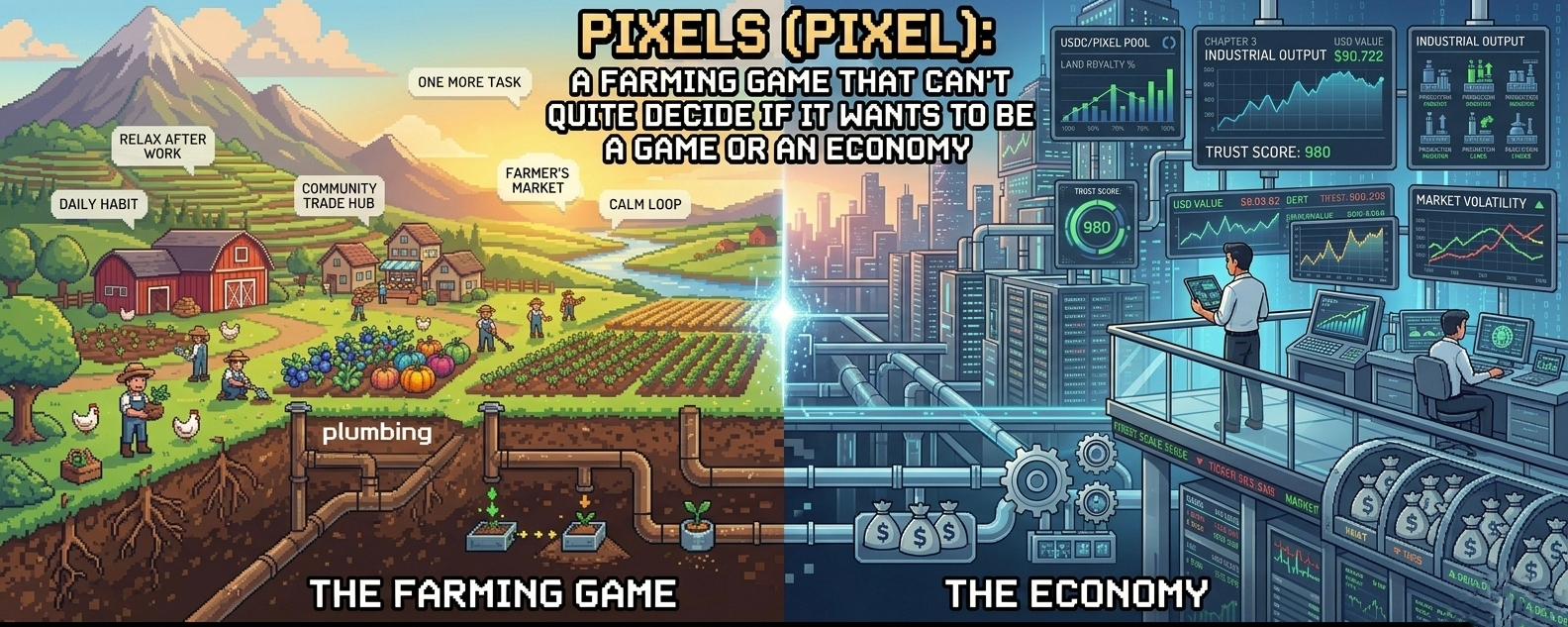
If I explain Pixels to a non-crypto friend—someone who just wants to relax after work—I don’t start with Ronin or tokens or anything like that. I say: it’s a farming game. You plant things, you gather stuff, you upgrade your land. And if you care, some of that digital stuff can be traded.
That’s it. That’s the hook.
Everything else is just plumbing.
And honestly, nobody outside this space has ever cared about the plumbing. I’ve never once had a normal conversation where someone said, “but what’s the finality time?” They ask: does it feel good, or does it feel like work?
Pixels runs on Ronin, which in practice just means it doesn’t constantly break when you click buttons. That might sound like a low bar, but I still remember early blockchain games where just opening an inventory felt like waiting for a bus that might not arrive. Axie Infinity had similar growing pains in its early days too—clunky UX, delayed interactions, friction everywhere. Ronin exists because of that exact failure history.
Pixels benefits from that lesson.
Most of the time, it just gets out of the way.
And I think that’s underrated.
Because the best tech isn’t the one you notice. It’s the one you forget.
On the surface, Pixels is almost suspiciously calm. You log in, tend your farm, harvest resources, maybe upgrade a tool, maybe wander around a bit. It has that “one more task before bed” energy. I’ve actually caught myself thinking, I’ll just quickly collect this, and then five minutes later I’m still clicking through crops like I’m in some mild trance.
It’s comfortable. Almost too comfortable.
But then you peel it back a bit.
And the second layer shows up.
Resources aren’t just for progression anymore. They start to matter economically. Items get traded. Land has different productivity levels depending on ownership. Suddenly you’re not just playing a farming sim—you’re inside a system where efficiency starts to matter if you care about rewards.
That’s where the player base quietly splits.
I’ve seen this movie before. Multiple times.
There are the players who want to relax and grow their little digital farm. And then there are the ones treating it like a spreadsheet with animations—optimizing routes, timing harvests, tracking outputs. It’s almost like watching someone turn Stardew Valley into a logistics job.
And I don’t say that as a compliment.
Or an insult, really. Just… observation.
The tension between those two groups is always there in games like this. And keeping them both happy? That’s where most projects eventually trip.
Pixels at least doesn’t force you into the economic layer immediately. You can play without owning anything expensive. You can ignore the trading side entirely. That decision probably saved it from collapsing into pure speculative chaos early on—something I saw happen with more than one “play-to-earn” wave around 2021 and 2022. Those ecosystems burned bright and then just… thinned out when incentives changed.
But the tension doesn’t disappear just because it’s optional.
It just sits in the background.
Let’s talk about land ownership for a second, because this is where things get slightly uncomfortable.
Some players own upgraded plots. They produce more. They scale faster. Others don’t. And even if it’s not aggressive or exploitative on the surface, you can feel the hierarchy forming. Quietly. Naturally.
And here’s where my skepticism kicks in.
Because I’ve watched enough of these systems evolve to know what usually happens next. They start balanced enough. Then optimization creeps in. Then efficiency becomes king. And before long, the “fun” parts of the game start getting overshadowed by the “optimal” parts.
It’s not malicious.
It’s just math meeting human behavior.
Vision is never the problem in this industry. Execution is.
And I’ve lost count of how many “next big things” I’ve seen fade not because they were broken, but because the incentives slowly drifted away from the gameplay.
Pixels hasn’t hit that point yet. But it hasn’t proven it won’t either.
Right now, what keeps it alive is actually something very basic: the daily loop works.
You log in, you do a few things, you feel a small sense of progress, and you log out. No overwhelm. No chaos. Just rhythm.
And that’s harder to build than it looks.
People in Web3 love talking about economies and ownership, but I’ve always thought retention comes down to something far more boring: does it feel good to come back on a random Tuesday when you’re tired and not thinking about crypto at all?
That’s the real test.
Not the whitepaper.
The Tuesday test.
Socially, Pixels does something subtle that a lot of games miss. You’re not alone in your instance. Other players drift through the same spaces, trading, chatting, occasionally cooperating. It doesn’t scream “MMO social hub” at you. It just quietly exists in the background, like a town you pass through rather than a stage you’re forced onto.
That helps it feel alive without feeling loud.
But I won’t sugarcoat the weak points.
The economy still reacts too strongly to external sentiment. When incentives are high, activity spikes. When they drop, things cool off quickly. I’ve seen this dependency pattern in multiple Web3 projects, and it’s always a warning sign. It means the game is still partially anchored to financial conditions outside its control.
And when that happens, gameplay stability becomes fragile.
Another uncomfortable truth: if someone is joining Pixels expecting steady income, they’re probably going to be disappointed. I’ve watched that expectation burn people before. Earnings fluctuate. Systems change. Meta shifts. Nothing stays locked in place for long.
That’s not unique to Pixels—it’s just how these incentive-heavy games behave.
The healthiest way to approach it is still the simplest: treat it like a game first. Anything beyond that is optional, and should be treated like volatility, not certainty.
From a design perspective, Pixels is actually closer to old-school persistent games than most people realize. Short loops. Daily habits. Slow accumulation. That design philosophy existed long before blockchain entered the conversation. World of Warcraft guild economies, early RuneScape trading hubs—those systems already proved that players will build economies around fun systems if you let them.
The difference now is ownership is baked in from the start.
Whether that improves things or just complicates them is still not settled.
Personally, I’m split on it. I like the idea of players owning pieces of a world they spend time in. I also think ownership tends to pull design decisions in directions that aren’t always healthy for gameplay purity.
Those two thoughts sit next to each other without conflict.
That’s just where I am after years of watching this space.
So where does Pixels land?
Right now, it’s a surprisingly calm farming game wrapped around a more complicated economic engine that not everyone needs to engage with. It doesn’t scream for attention. It doesn’t try to overwhelm you with jargon. That alone already separates it from a lot of louder, more fragile projects.
But it’s not settled.
It’s still being shaped—by players, by incentives, by whatever direction the economy drifts next.
And I’ve learned to be cautious in that phase. That’s usually where things either stabilize into something genuinely durable… or slowly lose coherence without anyone noticing until it’s too late.
My honest read is this:
Pixels works best when you stop thinking about it as a financial system wearing a game skin.
The more you just play it, the more it behaves like what it wants to be.
And after a decade of watching blockchain games come and go, I’ll leave it with this thought.
The projects that actually last aren’t the ones shouting about ownership or economies the loudest.
They’re the ones that eventually stop feeling like crypto at all.
They just feel like games people quietly return to.
Again.
And again.