
Most people open Pixels (PIXEL) thinking it’s just another farming game with a token attached. I had the same reaction at first. You log in, plant a few crops, walk around, maybe talk to someone, and then you pause for a second and wonder… is that it?
There’s no rush. No pressure to optimize. No flashing rewards trying to hook you in.
And that’s where it starts to feel different.
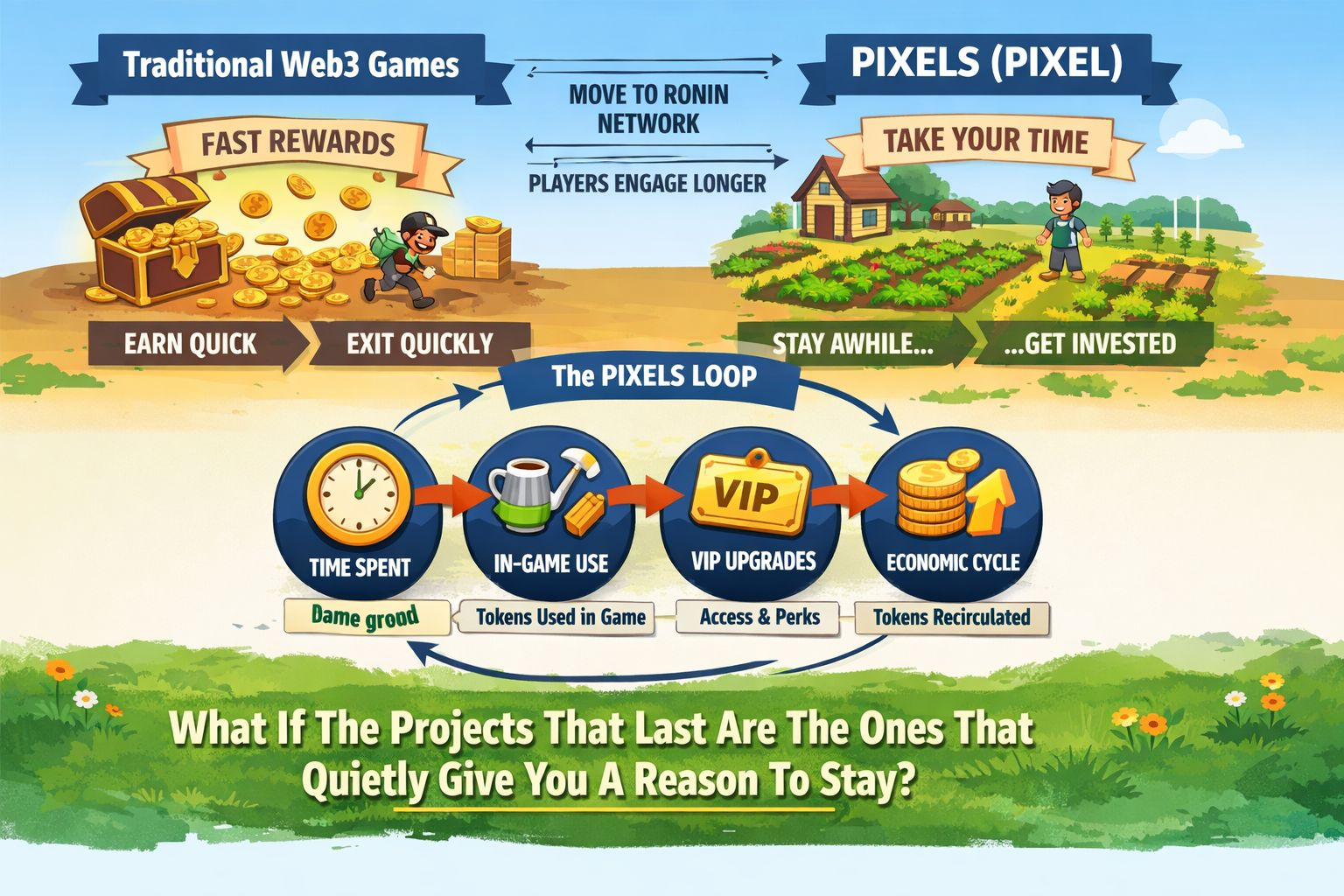
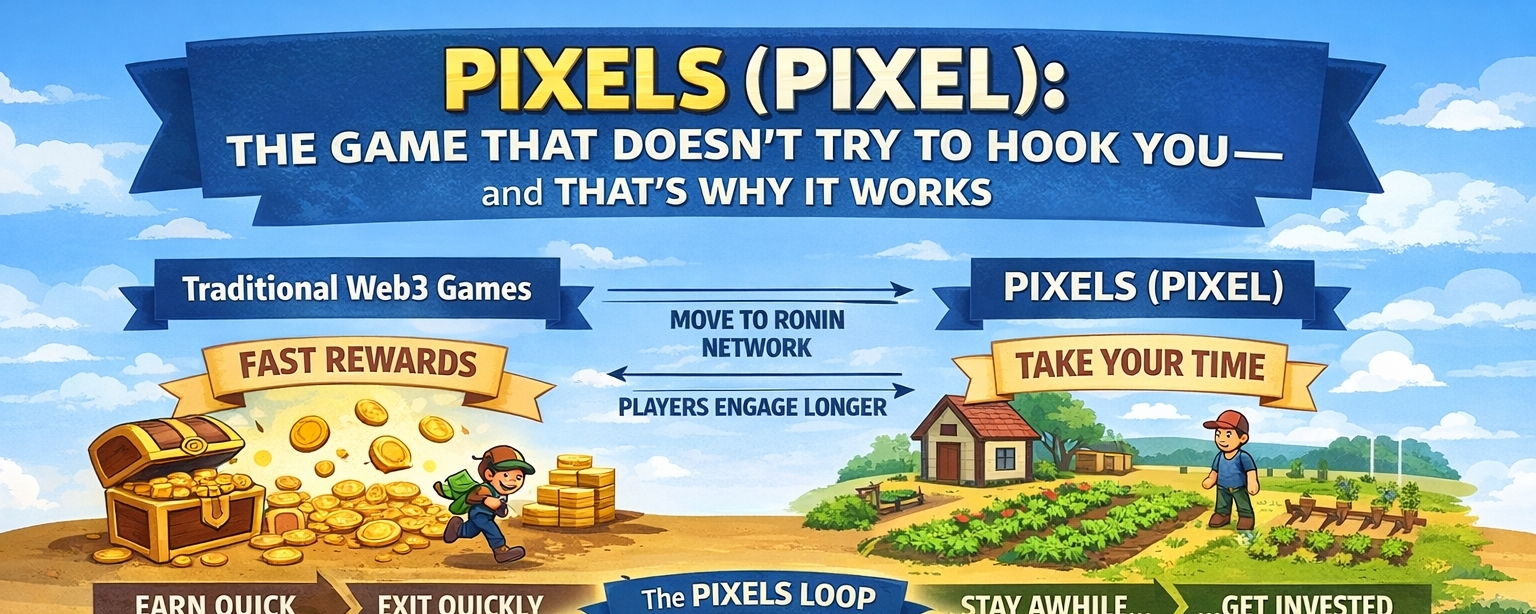
It almost feels like the game is waiting for you to decide if you’re staying, instead of trying to convince you. That’s a strange design choice in Web3, where most projects throw value at you immediately and hope you don’t leave too quickly. Pixels does the opposite. It holds back.
The longer I sat with it, the more it started to make sense. This isn’t really built around fast rewards. It’s built around time. It wants to see if you’ll come back tomorrow, and then the day after, before it starts layering in anything meaningful. It’s less “play to earn” and more “stay, then maybe earn.”
That shift sounds small, but it changes how the whole system behaves.
When Pixels moved over to the Ronin Network, things accelerated in a way that felt less like hype and more like alignment. Ronin already had people who understood game economies, so Pixels didn’t need to explain itself. It just dropped into an environment where players were already comfortable staying inside a loop. That’s when the numbers started to move — daily users climbing from a few thousand to hundreds of thousands, eventually pushing toward the million mark. Monthly activity followed the same pattern, growing into the millions.
But numbers alone don’t really tell the story. What matters more is what people are actually doing inside.
There are signals that feel more real than just “users joined.” Players are spending tokens, not just farming them. Millions of PIXEL have been used inside the game in short periods — especially on things like VIP access, progression boosts, and small advantages that make the experience smoother. That’s a very different pattern from most Web3 games, where tokens mostly flow out and rarely come back in.
Here, the loop feels more contained. You earn, but you also use.
Daily wallets have stayed relatively strong even after fluctuations, and total participation has crossed into the millions over time. It’s not perfect data, but it suggests people aren’t just touching the game once and leaving. Some of them are actually sticking around.
The token itself plays into that in a quiet way. It’s not screaming for attention. It’s just there, woven into the system. If you want to move faster, access certain features, or upgrade your experience, you’ll probably need it. If you don’t, you can still exist without it. That balance makes it feel less forced.
Recent updates, especially around VIP tiers and structured rewards, push this a bit further. They give players reasons to use the token beyond just holding or selling it. At the same time, there’s still ongoing distribution happening, which means supply keeps entering the system. That creates a tension that hasn’t fully resolved yet — tokens coming in versus tokens being absorbed by actual usage.
And that’s where things get a little more real.
There was a moment where activity dropped pretty sharply before recovering. It exposed something that most Web3 games eventually run into: not every “user” is really a user. Some are just there to extract value as efficiently as possible. Pixels has been adjusting its mechanics to make that harder, but it’s still a constant battle.
The more interesting metric, at least to me, isn’t how many players there are. It’s how many are spending versus how many are just taking. If people keep using the token inside the game, the system starts to feel like an economy. If they stop, it turns into another short-lived cycle.
What’s also interesting is how Pixels spills over into the larger Ronin ecosystem. A lot of the network’s activity seems to trace back to what’s happening inside this one game. It’s almost acting like a front door, pulling people in and keeping them engaged long enough to explore other things. That’s not something most games manage to do.
Still, it’s not all smooth.
The slow pace can turn people away early. Some players don’t have the patience to sit in a system that doesn’t reward them instantly. The ongoing token emissions add pressure that needs to be balanced somehow. And like every Web3 game, it depends heavily on people continuing to show up, which is never guaranteed.
But I think the more interesting way to look at Pixels isn’t through price or quick returns. It’s through behavior.
It’s trying to turn time into something valuable. Not by forcing it, but by letting it build naturally. You spend time, you get familiar, you start to care a little, and only then does the economic layer start to matter.
That’s a very different approach from most of the space.
And I keep coming back to one simple thought while watching it play out…
What if the projects that last aren’t the ones that reward you the fastest, but the ones that quietly give you a reason to stay without noticing it at first?