

I’m going to say something that doesn’t tie up cleanly.
Pixels feels original.
But it also feels… inherited.
Not copied. More like assembled from ideas that already proved they work somewhere else.
Most people talking about $PIXEL focus on what it’s doing right — accessibility, social loops, consistent activity. But that framing skips a harder question.
How much of this is truly its own?
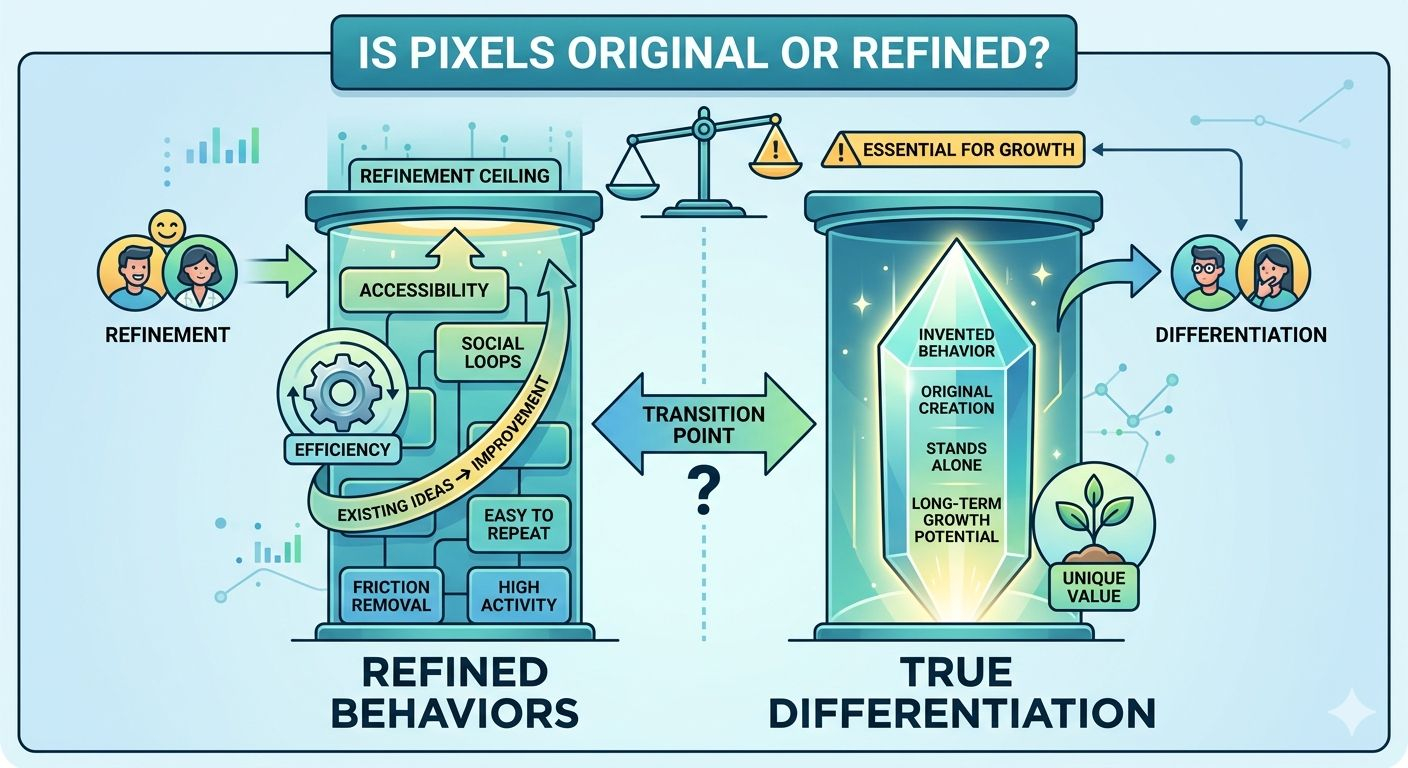
Pixels doesn’t feel like it invented a new behavior.
It feels like it refined an existing one.
There’s something subtle in that approach — this idea that you don’t need to create something entirely new to succeed. You just need to remove enough friction from what already works and make it easier to repeat.
It’s a practical strategy.
But strategies like that come with a ceiling.
Because refinement only carries weight until differentiation is required.
That’s the part I keep circling back to.
If Pixels succeeds, it won’t just be because it executes well. It will be because it eventually defines something that feels uniquely its own — not just smoother, but different in a way that can’t be easily replaced.
That moment hasn’t fully arrived yet.
At least not in a way that separates it from the broader category it sits in.
So again, we’re in that familiar middle phase.
The system works.
The players engage.
The loops hold.
But the identity is still forming.
And without a clear identity, systems can scale… but they struggle to stick.
I’ve seen this pattern before — projects that gain traction by doing things better, faster, cleaner… but eventually run into a question they can’t avoid:
Why this one?
That’s the risk here.
Still, there are signals worth noticing.
Pixels isn’t trying to overextend itself. It leans into what users already understand instead of forcing them to learn something new. That lowers resistance and accelerates adoption — which is exactly what early-stage systems need.
But familiarity is a double-edged sword.
Because what feels easy to enter is often easy to replace.
Another layer that feels unresolved is how uniqueness emerges over time.
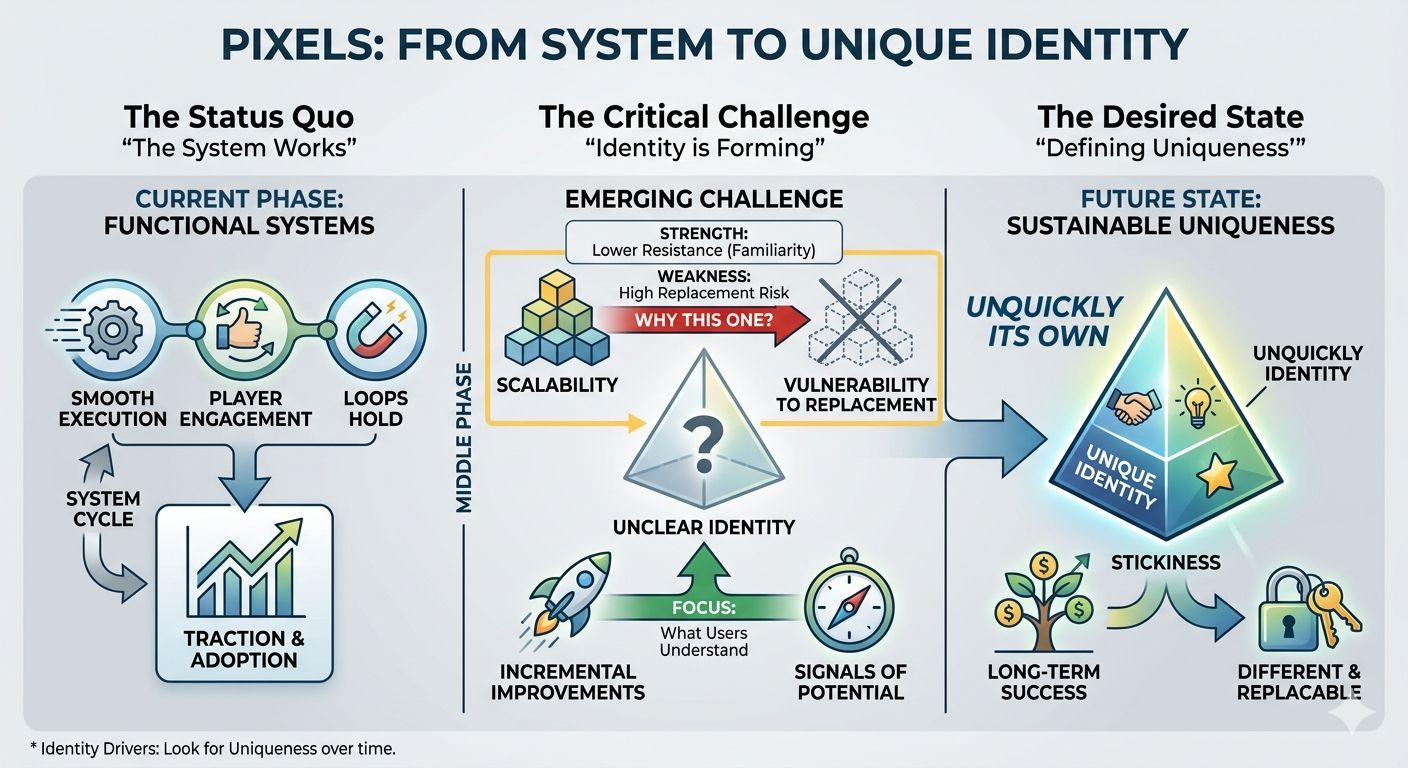
Right now, $PIXEL is tied closely to activity and participation. But long-term systems usually develop something harder to replicate — culture, status, history, emotional attachment.
We’re not fully seeing that yet.
So most of the current momentum feels slightly conditional.
Not fragile. Just dependent on what comes next.
And “what comes next” is where a lot of projects lose clarity.
Because it’s one thing to refine what exists.
It’s another to define what doesn’t.
I don’t see Pixels as lacking direction.
But I do see it approaching a threshold.
A point where execution alone won’t be enough.
Maybe it crosses that line.
Maybe it stays where it is.
Right now, it still feels like a system built from strong ideas…
but not yet defined by one.