
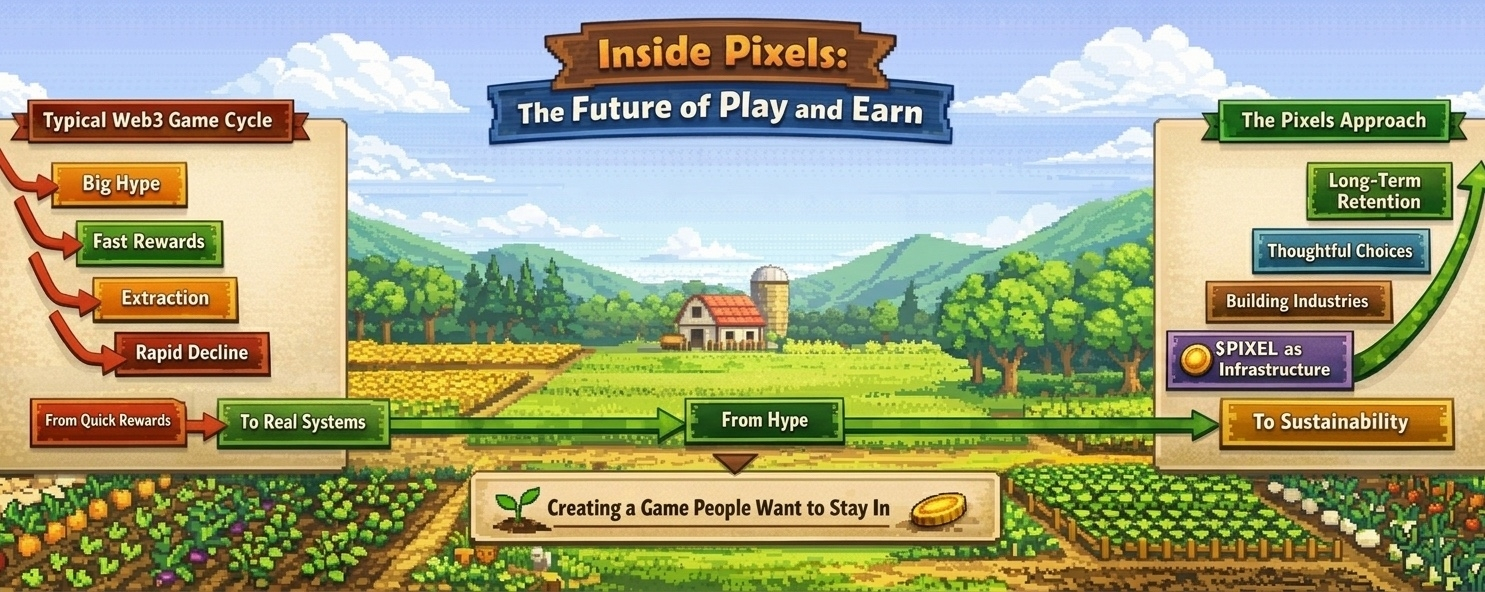
I didn’t open @Pixels thinking I’d sit here writing something this deep about it.
At first, it felt like something I’ve seen too many times. A soft farming game, simple loop, nothing loud, nothing trying too hard. In Web3, that almost feels suspicious. We’re used to projects screaming value at us in the first few minutes.
Pixels doesn’t do that.
You log in, plant a few things, move around, maybe check a couple of tasks, and log off. That’s it. No pressure, no urgency, no feeling like you’re missing something big.
Honestly, I almost underestimated it because of that.
But then, after spending more time inside, something started changing. Not the game. Me.
I began noticing small things. Decisions that didn’t look important at first started to matter. Where I spent time, what I chose to produce, when I acted versus when I waited. None of it was forced. The game never tells you to “play smart.” It just creates a space where you naturally start thinking that way.
That’s when it clicked for me.
This isn’t just a game loop. It’s a system.
Most play-to-earn games I’ve seen follow the same pattern.
They come in fast. Big rewards, fast onboarding, strong incentives. Everyone jumps in early, numbers look great, timelines are full of hype. For a moment, it feels like something real is happening.
Then the pressure shows up.
Too many rewards flowing out, not enough structure holding things together. People extract value faster than the system can handle. Slowly, things lose balance. Activity drops. And just like that, the whole thing fades.
We’ve all seen that cycle.
Pixels doesn’t feel like it’s trying to win that race.
It feels like it’s trying to avoid it.
The deeper you go, the more you realize it’s not about quick rewards here.
It’s about positioning.
That shift sounds small, but it changes everything.
Before, you could treat it casually. Log in, do some actions, leave. Now, you start thinking ahead. What should I focus on? What actually makes sense to build? Where is value moving?
And suddenly, you’re not just playing.
You’re operating inside something.
The introduction of industries and production layers made that even clearer for me.
You’re not just farming anymore. You’re managing capacity.
There’s a difference between producing something and producing the right thing at the right time. That’s where things start getting interesting.
Because now you’re thinking in terms of flow.
What’s coming in
What’s going out
Where things get stuck
Where opportunities open
That’s not typical “game thinking.” That’s closer to how real systems behave.
And then there’s $PIXEL.
At first, it just feels like a reward. Something you earn and maybe cash out.
But over time, it starts feeling different.
It moves through everything. Production, upgrades, interactions. It connects parts of the system instead of just sitting at the end of it.
That’s when it stopped feeling like a payout to me.
It started feeling like infrastructure.
And once you see that, you can’t really unsee it.
That said, I’m not looking at Pixels like it’s perfect.
It’s not.
Balancing an in-game economy is probably one of the hardest things to get right. There’s no fixed formula. Everything depends on player behavior, and player behavior is never stable.
If rewards are too high, things inflate.
If sinks are too aggressive, players feel drained.
And the tricky part is that this balance keeps shifting. What works today might not work next month.
Pixels is still figuring that out.
But what stands out to me is that it actually feels aware of the problem.
Recent changes don’t look random. They feel like adjustments. Tightening things, slowing things down, adding more depth.
It doesn’t feel like they’re chasing hype.
It feels like they’re trying to build something that holds.
Another thing I can’t ignore is how it feels to actually be inside the game.
It doesn’t feel like a “crypto product.”
It just feels like a game.
That might sound basic, but it’s rare here. Most projects build economies first and try to add gameplay later. Pixels seems to be doing the opposite.
And that matters.
Because if people don’t enjoy being there, no token model is going to fix that. But if they stay because they want to, then everything else has a real foundation.
The more time I spend in Pixels, the more I feel like it’s not trying to impress you instantly.
It’s trying to reveal itself slowly.
And I think that’s why a lot of people either don’t get it at first… or they leave too early.
Because the shift doesn’t happen immediately.
It happens later.
But once it does, the whole thing starts making sense in a different way.
If they keep moving in this direction, Pixels might actually break out of the usual Web3 cycle.
Not by doing something flashy.
But by doing something most projects ignored.
Building something people stay in, not just something people arrive at.
For me, that’s the real signal here.
It’s not about how much you can earn in a day.
It’s about whether the system makes you want to come back tomorrow.
Pixels is still early. A lot can change. A lot still needs to be proven.
But for once, it feels like I’m not just looking at another short-term loop.
It feels like I’m watching something slowly turn into an actual economy.
And honestly, that’s what makes me keep going back.
