
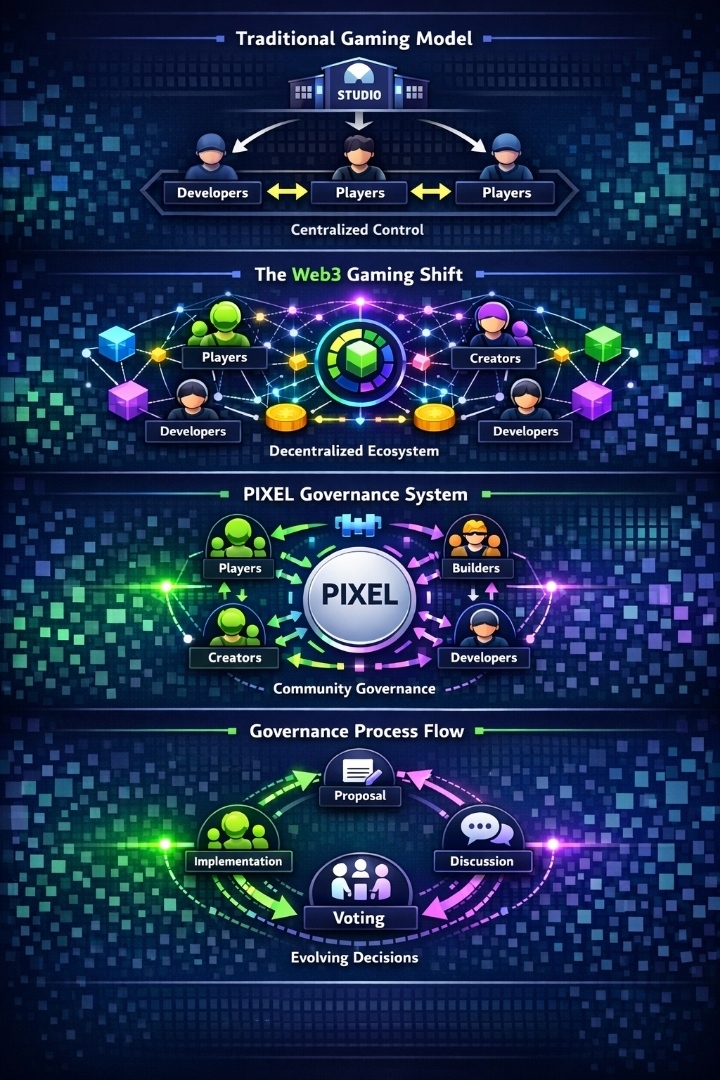
“In traditional gaming, players help build the value of the game. In Web3 gaming, players can also influence how that value evolves.”
The gaming industry is undergoing a quiet transformation. For decades, most games operated under a centralized model, where developers controlled every aspect of the game economy—from reward systems to gameplay updates.
While players contributed time, skill, and community engagement, they rarely had any influence over the decisions shaping the ecosystem.
Web3 gaming introduces a new model.
Within the ecosystem of , governance supported by the token represents an important step toward community-influenced digital economies.
Understanding how governance works in this context helps explain why many Web3 projects are exploring more collaborative models for managing game ecosystems.
The Governance Challenge in Traditional Game Economies
Most traditional games operate with centralized decision-making structures.
Game studios design the rules, control the reward systems, and determine how in-game economies evolve over time. While this structure allows developers to maintain consistency and control, it also means that player communities have limited influence on long-term decisions.
“Players contribute to the growth of gaming ecosystems, but historically they have had little control over how those ecosystems evolve.”
This limitation has become more noticeable as gaming communities grow larger and more economically active.
Web3 technology introduces mechanisms that allow communities to participate more directly in governance.
The Role of PIXEL in the Pixels Ecosystem
In the Pixels ecosystem, the PIXEL token functions as a key element supporting participation and coordination among players, creators, and stakeholders.
Governance connected to PIXEL creates opportunities for the community to contribute to ecosystem decisions.
While governance structures can vary between projects, they often allow token holders to participate in areas such as:
Community proposals related to ecosystem improvements
Discussions about economic adjustments within the game
Decisions that influence reward systems or incentives
Feedback on future development directions
This approach helps create greater alignment between developers and the community.
How Governance Systems Typically Work in Web3
Governance in Web3 ecosystems usually follows a structured process that balances community participation with practical implementation.
The process generally includes several key stages.
1. Proposal Creation
Members of the community or project contributors introduce proposals suggesting changes or improvements to the ecosystem.
These proposals may involve gameplay mechanics, economic policies, or ecosystem initiatives.
2. Community Discussion
Before voting occurs, proposals are typically discussed in community forums, governance platforms, or social channels. This stage allows ideas to be refined through feedback and debate.
3. Token-Based Voting
Token holders may participate in voting to determine whether a proposal should be approved.
In governance systems connected to PIXEL, the token can help coordinate community input on ecosystem decisions.
4. Implementation
If a proposal receives sufficient support, the development team or governance executors can implement the approved changes.
“Community participation helps ensure that evolving game economies reflect the interests of the players who sustain them.”
Why Governance Matters for Web3 Gaming
Governance plays an important role in the long-term sustainability of Web3 ecosystems.
By allowing communities to participate in discussions and decisions, governance systems can help create
Stronger alignment between players and developers
More transparent decision-making processes
Resilient digital economies
Greater community engagement
For gaming ecosystems, these dynamics can support long-term growth and stability.
The Broader Shift Toward Community-Guided Economies
The emergence of governance in Web3 gaming reflects a broader shift occurring across blockchain ecosystems.
Instead of relying entirely on centralized control, many projects are experimenting with community-guided decision-making models.
Within ecosystems like Pixels, governance supported by the PIXEL token represents one example of how projects are exploring ways to balance developer leadership with community participati