
There’s a moment most people recognize from real life.
You stand in a queue, thinking the system is simple — first come, first served. But slowly, you realize something else is at play. Some people move faster, some get preferred treatment, and suddenly it’s not about fairness anymore… it’s about understanding how the system actually works.
That’s exactly the feeling Pixels (game) is starting to create.
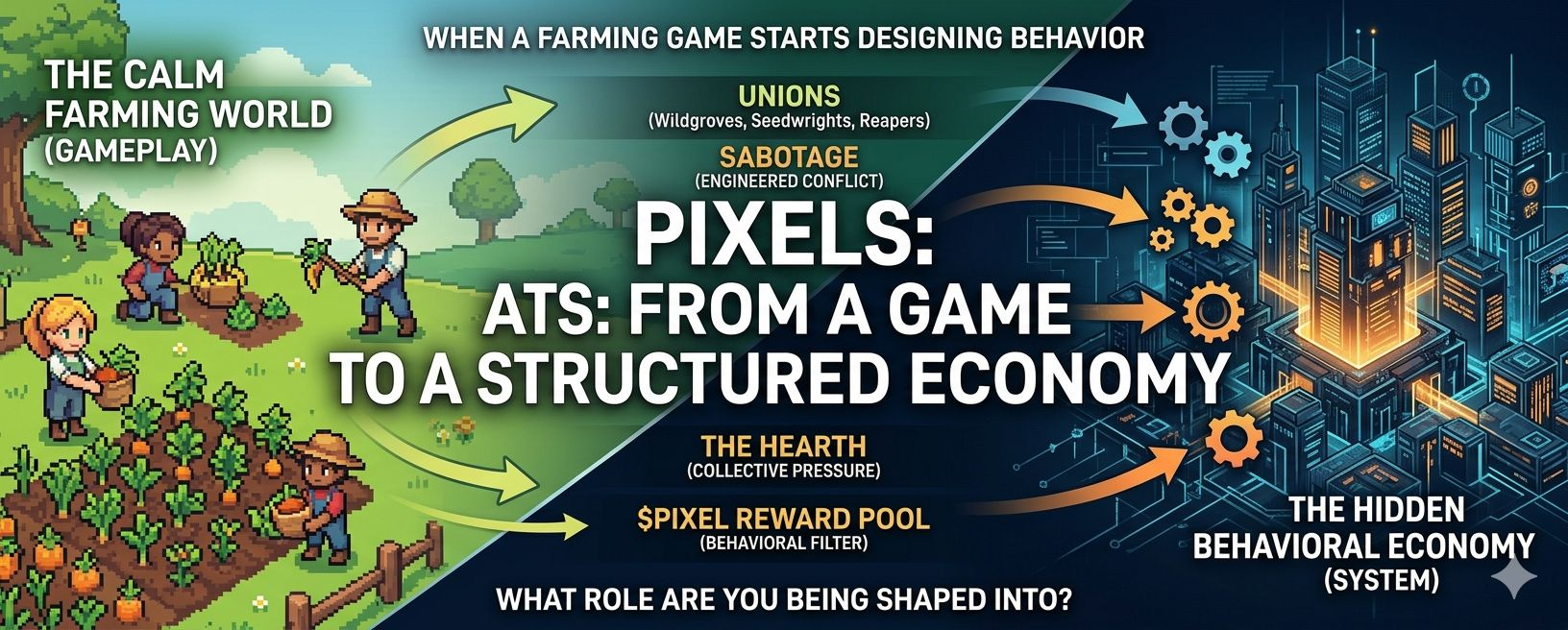
At first glance, it’s still the same calm, predictable farming world — plant, water, harvest, repeat. But with the Chapter 3: Bountyfall update (April 2026), something fundamental has shifted.
This is no longer just a game of effort.
It’s becoming a game of positioning.
---
From Gameplay to Alignment: The Rise of Structured Behavior
The introduction of three unions — Wildgroves, Seedwrights, and Reapers — looks like a simple faction system on the surface.
But it’s not.
This is where the game quietly changes its language.
You’re no longer just choosing a team.
You’re choosing a behavioral identity.
How you earn
How you collaborate
Who benefits from your actions
Who loses because of them
Your gameplay is no longer isolated. It becomes interdependent.
And that’s where the system starts to feel less like a game… and more like an economy.
---
The Sabotage Mechanic: Designed Conflict, Not Accidental Chaos
Games usually reward cooperation or competition.
Pixels now engineers both — simultaneously.
The sabotage mechanic introduces something far more complex than PvP. It creates intentional friction.
One union can directly disrupt another’s progress.
This raises an uncomfortable but important question:
> Is this about making the game more exciting…
or about deliberately manufacturing tension to control player behavior?
Because when progress depends not only on your effort — but on someone else’s failure — the system begins to resemble a competitive market, not a peaceful farming loop.
And markets don’t reward effort equally.
They reward strategy, timing, and positioning.
---
The Hearth System: Where Individual Play Disappears
Then comes the Hearth.
A shared center that each union must build and defend.
At first, it feels like a collaborative feature. But structurally, it does something deeper:
It blurs the line between individual reward and collective performance.
You can no longer fully separate:
“What I did”
from
“What my group achieved”
This creates a powerful shift:
> Your success is no longer entirely yours.
And that’s where systems become controlling rather than just interactive.
Because now the game doesn’t just track what you do —
it evaluates how well you fit into a larger structure.
---
The $50,000 Reward Pool: Incentive or Filter?
A $50,000 $PIXEL reward pool sounds like a strong motivator.
But incentives in systems like this are rarely neutral.
They act as filters.
Not everyone playing will benefit equally. So the real question isn’t:
> “How big is the reward?”
It’s:
> “What kind of behavior does the system reward?”
Is it time spent?
Strategic coordination?
Loyalty to a union?
Or simply being on the winning side?
Because if rewards are tied to structured behavior rather than pure effort, then the system isn’t just distributing value…
It’s shaping player psychology.
---
The Quiet Transformation: Game → Economic System
This is where everything connects.
What we’re seeing isn’t just a feature update.
It’s a design evolution.
Pixels is moving from:
A play-to-earn loop
to
A behavior-driven economy
Where:
Actions are no longer neutral
Choices have systemic consequences
Players become participants in a controlled structure
And most importantly:
> The game starts deciding how you should play, not just what you can do.
---
So… Is This Good or Bad?
That’s not an easy answer.
On one hand:
It adds depth
It creates meaningful interaction
It builds a living, breathing system
On the other:
It reduces individual autonomy
It introduces controlled competition
It risks turning play into obligation
And maybe that’s the real tension here.
Not whether it’s good or bad —
but whether it still feels like a game.
---
Final Thought
What started as a simple farming experience is no longer simple.
And maybe it was never meant to stay that way.
Because once a game starts designing behavior instead of just experiences, it stops being just entertainment.
It becomes a system.
And in systems like these, the most important question is no longer:
> “How do I play?”
It becomes:
> “What role am I being shaped into?”
And whether players realize it or not…
that question changes everything.
