
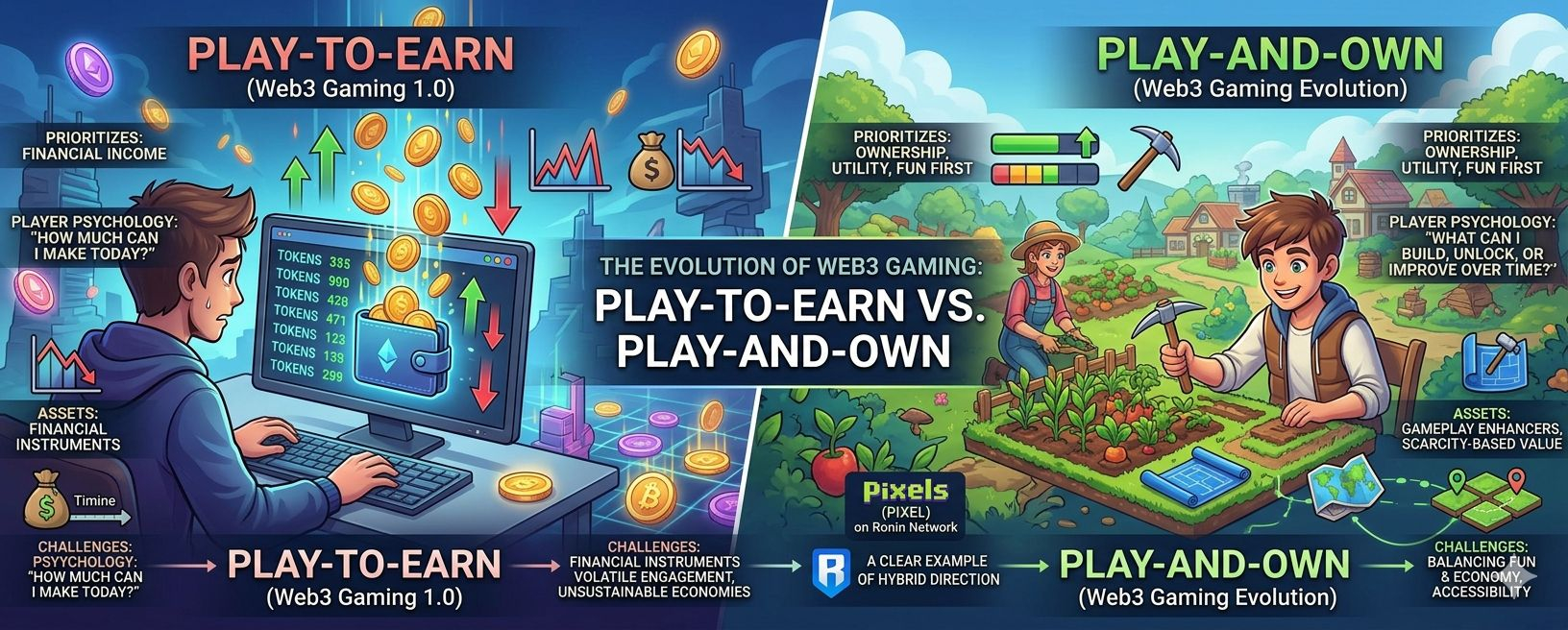
The rise of Web3 gaming has introduced two dominant economic philosophies that shape how players interact with digital worlds: “play-to-earn” and “play-and-own.” While they may sound similar on the surface, they represent fundamentally different approaches to game design, player motivation, and long-term sustainability. Understanding the distinction is essential for evaluating modern blockchain games such as Pixels (PIXEL) and the broader direction of the industry.
Play-to-earn emerged as the first widely recognized Web3 gaming model. Its core idea is straightforward: players are rewarded with tokens or digital assets for time spent in-game and achievements completed. In theory, this transforms gaming from pure entertainment into a form of income generation. Early ecosystems demonstrated how digital economies could provide real financial incentives, attracting massive user inflows in short periods.
However, the play-to-earn model carries structural weaknesses that became evident over time. When rewards are heavily tied to new user participation or continuous token emissions, the system can begin to resemble a closed financial loop rather than a sustainable game economy. In many cases, players were incentivized more by earnings than by gameplay itself. This created volatility in user retention: when token value declined or reward rates dropped, engagement often collapsed. As a result, many play-to-earn ecosystems struggled to maintain long-term balance between enjoyment and economic output.
In contrast, the play-and-own model represents a more recent evolution in Web3 game design. Instead of focusing on direct earnings, it emphasizes ownership, progression, and utility. Players are not primarily rewarded for playing; rather, they accumulate assets, influence, and value over time through engagement within a living ecosystem. The economic benefit becomes a secondary outcome of participation, not the primary motivation.
This shift is subtle but significant. In play-and-own systems, the core experience is designed first as a game. The economy exists to support and extend gameplay, not dominate it. Digital assets such as characters, land, or items are owned by players through blockchain infrastructure, but their value is tied more to utility and scarcity within the game world than to immediate cash flow. This structure tends to reduce speculative behavior while encouraging longer retention cycles.
Pixels (PIXEL) on the Ronin Network is a clear example of this hybrid direction. While it retains tokenized rewards and blockchain-based ownership, its design prioritizes farming loops, exploration, crafting, and social interaction over pure earning mechanics. The player experience is structured around routine engagement, similar to traditional social simulation games. The economic layer, including the PIXEL token and NFT land systems, operates as an extension of gameplay rather than its foundation.
This distinction matters because it changes player psychology. In play-to-earn systems, players often ask, “How much can I make today?” In play-and-own systems, the question shifts to “What can I build, unlock, or improve over time?” The first creates short-term economic behavior; the second encourages long-term investment in progression and identity within the game world.
From an economic standpoint, play-and-own models also introduce more stable design constraints. Since rewards are not the sole driver of engagement, developers can implement tighter control over resource generation, energy systems, and progression pacing. This reduces inflationary pressure on in-game economies and allows for more predictable balancing. It also enables a broader player base, including those who are not motivated by financial returns but are interested in gameplay and social interaction.
Another important difference lies in asset utility. In play-to-earn systems, assets are often treated primarily as financial instruments. In play-and-own systems, assets gain meaning through usage. A piece of land, a crafted item, or a character upgrade is valuable not only because it can be traded, but because it enhances gameplay and unlocks new experiences. This dual identity—functional and economic—creates a more resilient in-game ecosystem.
However, play-and-own is not without challenges. Balancing fun and economic depth is complex. If ownership benefits become too influential, the game risks becoming inaccessible to new players. If they are too weak, blockchain integration becomes irrelevant. Successful implementation requires careful tuning of progression systems, reward distribution, and social dynamics.
In the broader context of Web3 gaming, the transition from play-to-earn to play-and-own reflects an industry maturation process. Early models prioritized financial experimentation and rapid user acquisition. Newer models are increasingly focused on sustainability, gameplay quality, and long-term ecosystem health. This shift suggests that the future of blockchain gaming will likely resemble traditional high-quality game design enhanced by digital ownership layers, rather than financial platforms disguised as games.
Ultimately, the comparison between play-to-earn and play-and-own is not just about economic design. It is about redefining the purpose of gaming in decentralized environments. One treats players as economic participants first; the other treats them as participants in a persistent world where value emerges naturally from engagement.
As Web3 gaming continues to evolve, the most successful ecosystems are likely to be those that strike a careful balance between these two philosophies—offering meaningful ownership and fair economic participation while keeping the core experience grounded in gameplay, creativity, and social connection.