
I’m going to say something that might not land comfortably.
Pixels feels active.
But it also feels… dependent.
Not dependent in an obvious way. More like a system that leans on external energy to keep itself convincing.
Most people discussing $PIXEL focus on what’s happening inside — the gameplay, the economy, the loops. But that framing ignores something just as important.
Where is the energy actually coming from?
Pixels doesn’t feel fully self-sustaining.
It feels like it’s being sustained.
There’s something subtle in that dynamic — this idea that activity can be amplified through incentives, attention cycles, and ecosystem support, creating the appearance of organic growth even when parts of it are still being reinforced from the outside.
It’s not unusual.
But it matters.
Because systems like this only become durable when they generate their own gravity.
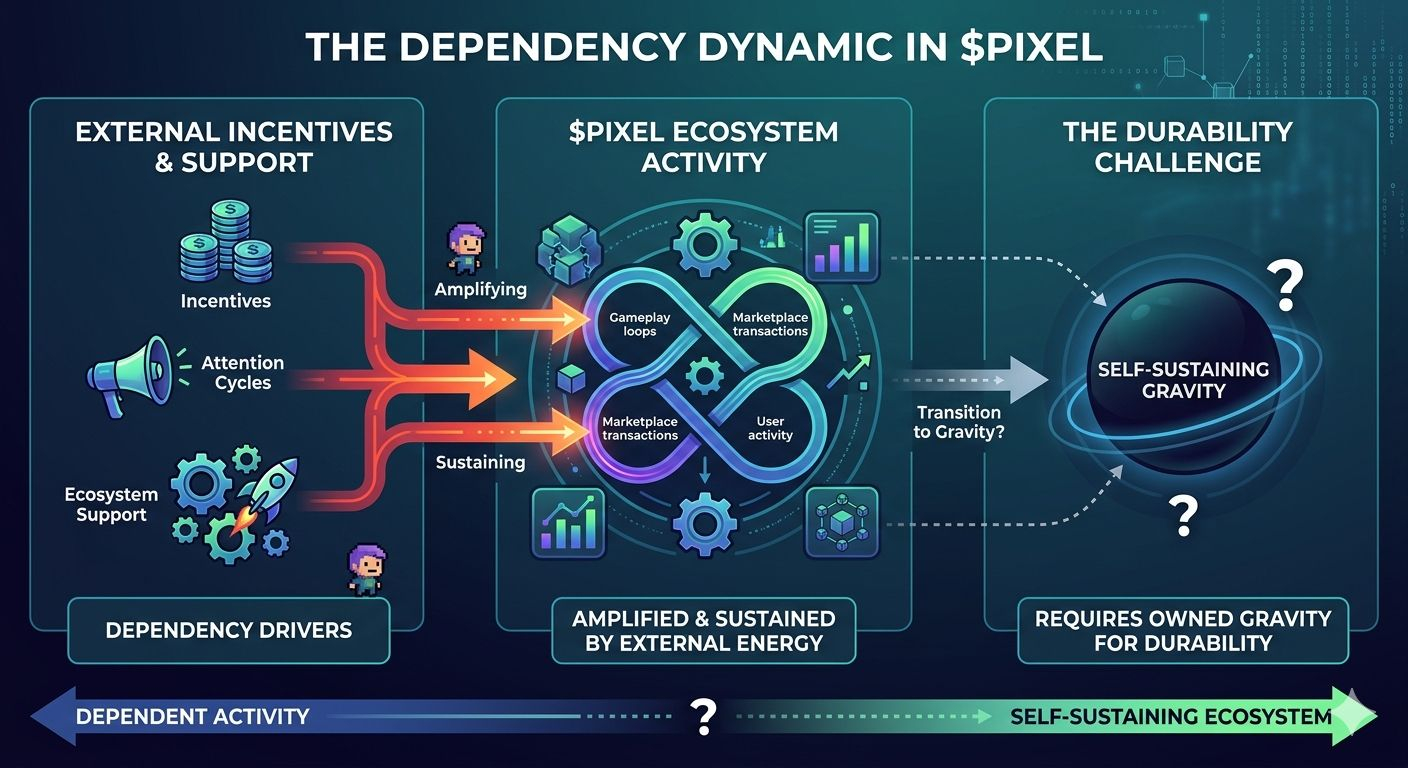
That’s the part I’m unsure about.
If Pixels succeeds, it won’t be because it can attract users. It will be because it can keep them without needing to constantly re-attract them.
That’s a harder transition.
And it hasn’t fully happened yet.
At least not in a way that proves independence from external momentum.
So again, we’re in this middle phase.
The engagement is there.
The visibility is strong.
The participation looks real.
But the source of that participation still feels partially external.
And without internal pull, systems drift when the push fades.
I’ve seen this before — projects that look vibrant as long as attention is flowing toward them… but struggle to maintain that same energy once the spotlight shifts.
That’s the risk here.
Still, there are signals that keep it interesting.
Pixels understands how to attract and onboard users better than most. It reduces friction, creates immediate feedback loops, and gives participants a reason to stay — at least in the short term.
That’s not accidental.
But short-term retention isn’t the same as long-term dependency reversal.
Another layer that feels unresolved is where true attachment forms.
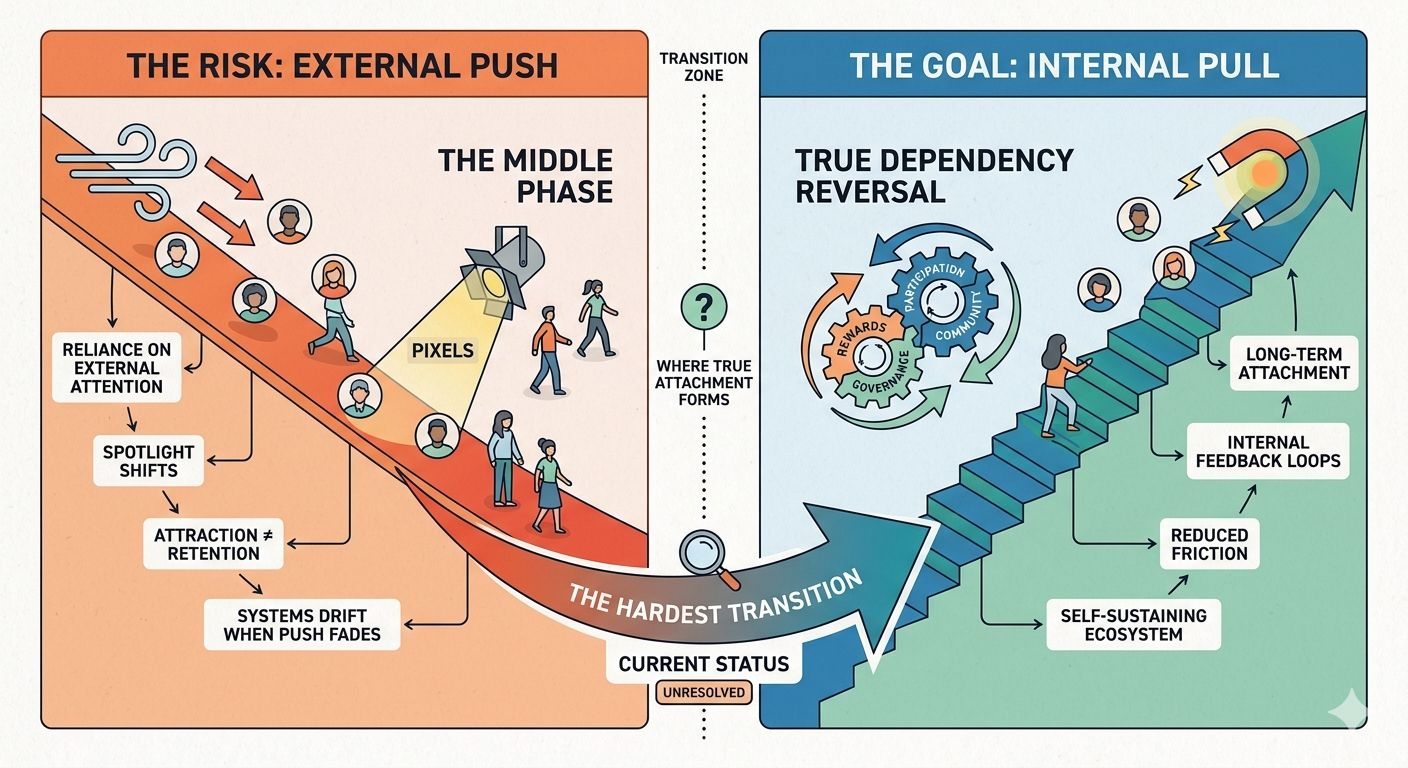
Right now, $PIXEL moves through systems that reward presence. But over time, presence isn’t enough. Systems need identity, ownership, and reasons to return that aren’t tied to incentives alone.
We’re not fully there yet.
So most of the current momentum feels slightly conditional.
Not artificial. Just supported.
And supported systems eventually face a test:
What happens when the support is removed?
That’s the uncomfortable question.
I don’t see Pixels as weak.
But I do see it as reliant.
Maybe that reliance fades as the system matures.
Maybe it doesn’t.
Right now, it still feels like something being held up…
not something standing entirely on its own.
