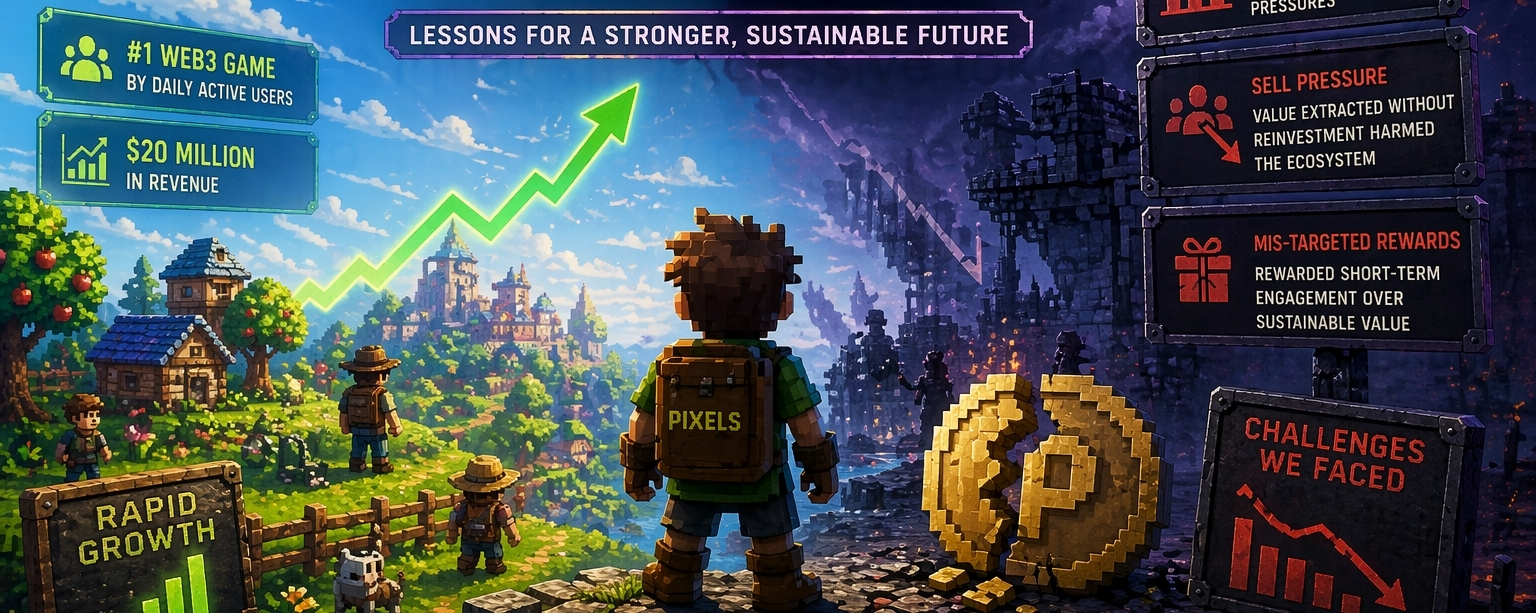


There’s a difference between growth that looks impressive and growth that actually holds together under pressure, and when I reflect on Pixels in 2024, that difference becomes impossible to ignore. On the surface, everything pointed to success. The game reached the top in daily active users, generated over $20 million in revenue, and became one of the most talked-about names in web3 gaming. But the more I think about it, the more I realize that this kind of growth didn’t just reveal strength, it exposed a deeper structural truth about how GameFi economies behave at scale.
What really happened wasn’t just expansion, it was acceleration powered by incentives. Tokens brought users in, activity surged, and the ecosystem felt alive in a way most projects struggle to achieve. But incentives are a double-edged mechanism. They can bootstrap an economy, but they can’t sustain it unless they are carefully aligned with real value creation. And this is where the tension started to show. $PIXEL
The issue wasn’t simply token inflation on its own, it was how emissions interacted with player behavior. When too many tokens are introduced without enough meaningful sinks, the system begins to lose balance. Value doesn’t collapse instantly, but it starts to spread thin across the ecosystem. You can feel it in weakening price support, in shorter player retention cycles, and in the gradual shift from participation to extraction. The economy is still moving, but it is no longer compounding, it is dispersing.
And this leads to the part that I think matters most. Incentives began to shape intent. A growing number of players were no longer engaging because they enjoyed the game or believed in its long-term potential, but because the system allowed them to extract value efficiently. From an individual perspective, this behavior is rational. From an ecosystem perspective, it is corrosive. Because when the dominant strategy becomes “take more than you give,” the loop stops reinforcing itself.
What amplified this effect was the lack of precision in reward distribution. Not all activity creates value, but when rewards treat all activity equally, they unintentionally promote the least meaningful actions. This is where the system quietly shifts. Instead of encouraging depth, it rewards repetition. Instead of building commitment, it builds short-term cycles. And over time, the culture of the game begins to reflect that. Players optimize for rewards, not for contribution.
So the real problem wasn’t just inflation, or sell pressure, or even misaligned incentives in isolation. It was the feedback loop they created together. Excess emissions increased the need to extract. Extraction behavior increased sell pressure. Poorly targeted rewards made that behavior easier and more profitable. And suddenly, growth itself became dependent on continuously feeding the system rather than strengthening it.
What makes this interesting, and honestly valuable, is that Pixels didn’t hide from this reality. It reached a scale where these weaknesses became visible, and that visibility is what allows evolution. Because once you recognize that not all growth is equal, the focus naturally shifts from expansion to efficiency. From acquiring users to retaining meaningful participants. From distributing rewards to engineering demand.
Sustainable game economies are not built on how much they give away, but on how effectively they circulate value. Tokens should not just flow outward, they should move through the system in ways that create reasons to stay, to spend, and to reinvest. The strongest economies are not faucets, they are loops. And loops only work when every participant adds something that others actually care about.
This is where precision becomes the real lever. Rewards need to be intentional, tied to actions that strengthen the ecosystem rather than inflate metrics. It means rewarding contribution over activity, commitment over convenience, and long-term behavior over short-term spikes. It may slow down visible growth at first, but it builds something far more important, which is resilience.
Because in the end, fast growth without structure is just temporary momentum. What actually lasts is an economy where players are not just earning from the system, but actively shaping it. Where value is not extracted and forgotten, but reinvested and expanded. Where participation feels meaningful even without constant incentives.
When I think about Pixels through this lens, I don’t just see a game that grew quickly. I see a system that pushed itself to the limits of its own design and, in doing so, revealed what real GameFi sustainability actually requires. And if there is one idea that stays with me, it is this: the future of web3 gaming will not be defined by how many players you can attract, but by how many players you can turn into contributors to a living, breathing economy.
#StrategyBTCPurchase #WhatNextForUSIranConflict #JointEscapeHatchforAaveETHLenders