
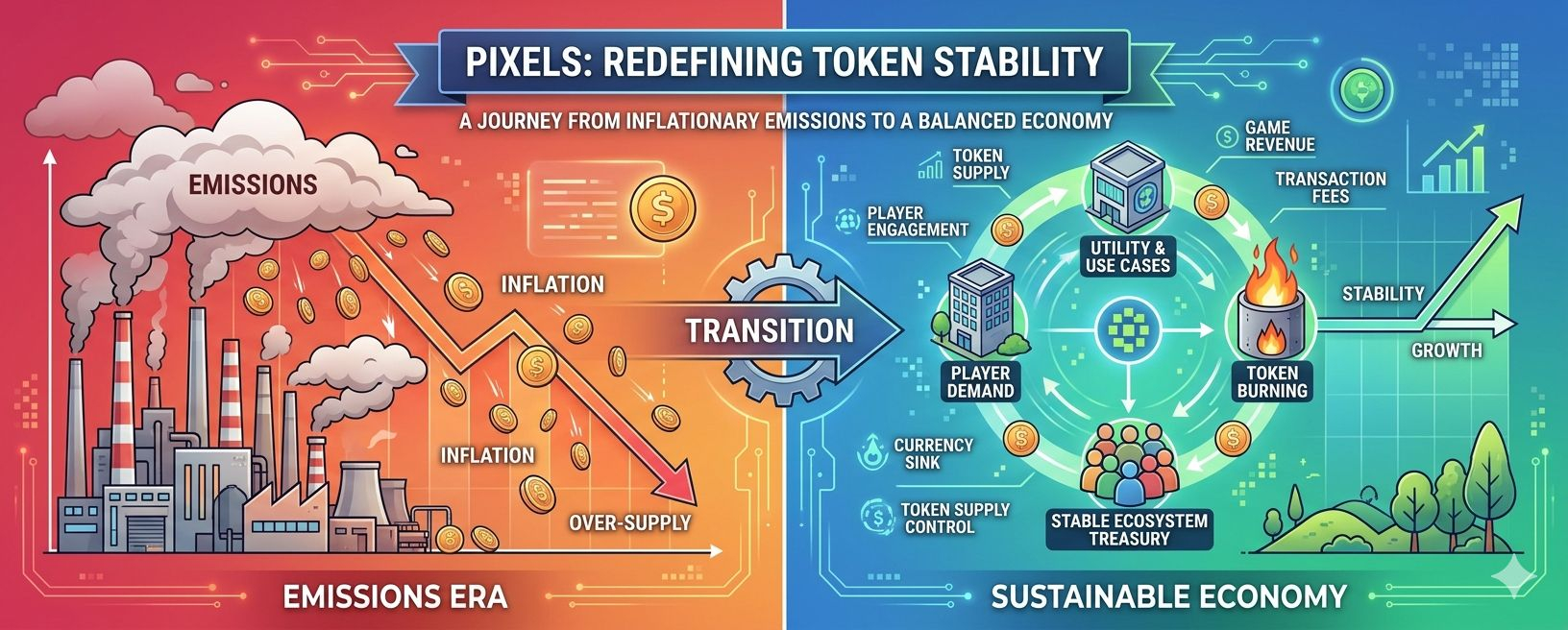
There’s a moment in every token-driven system that rarely gets announced, but fundamentally changes how the entire structure behaves. It’s not a marketing milestone. It’s not a partnership. It’s something quieter—when the system starts relying less on expectations, and more on its own internal logic.
That’s the phase Pixels seems to be entering in 2026.
From the outside, nothing looks dramatically different. The loops are familiar—farming, crafting, social play. But beneath that surface, the structure that supports $PIXEL is shifting in a way that’s easy to overlook if you’re only watching price charts.
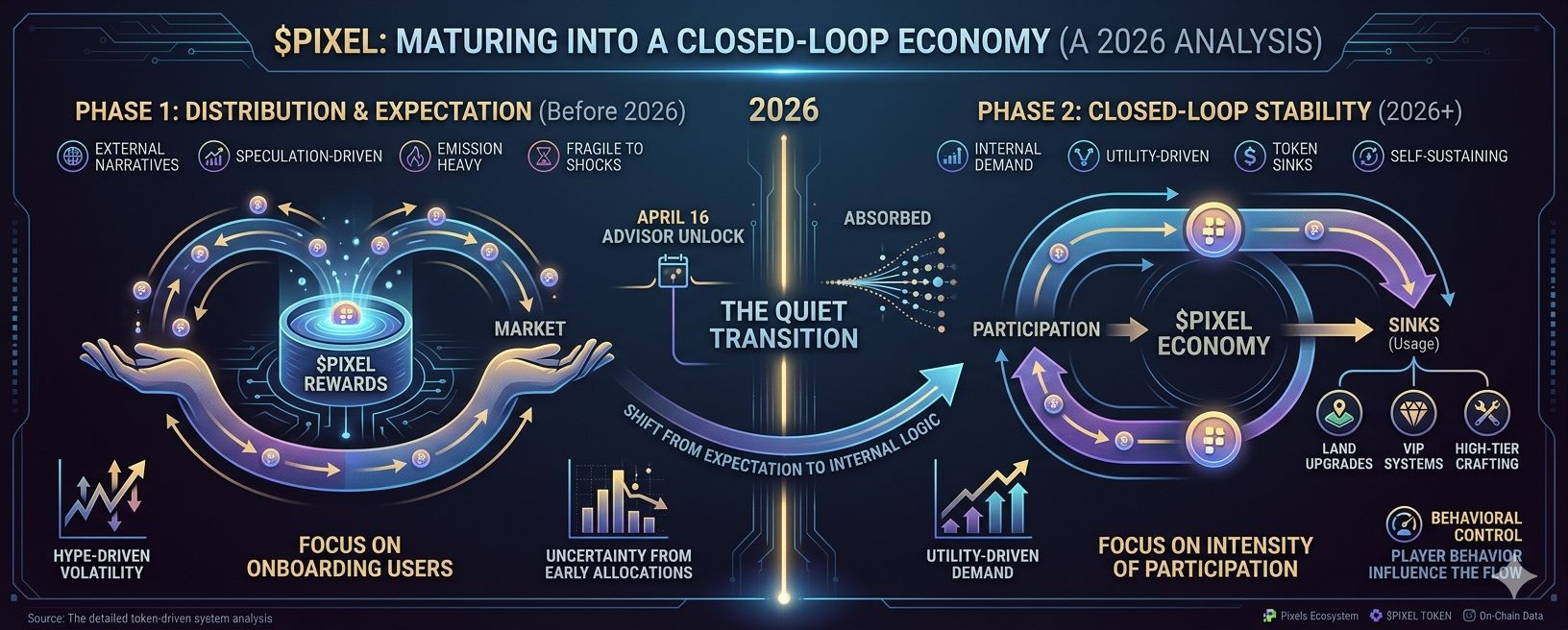
The circulating supply sitting around 66–68% is not just a statistic. It represents a transition in control. When a majority of tokens are already in the market, the system becomes less vulnerable to sudden structural shocks from early allocations. The April 16 advisor unlock could have been one of those moments—historically, these events introduce uncertainty. But here, something different happened.
The market absorbed it.
No sharp dislocation. No visible panic. Just continuation.
That kind of absorption doesn’t happen in fragile systems. It suggests that liquidity, distribution, and participant behavior have reached a level where isolated events no longer dictate direction. In other words, the system is beginning to stabilize—not because volatility disappears, but because it becomes less reactive to single-point pressures.
But supply distribution alone doesn’t create stability. It only removes one layer of risk. What replaces it is far more important: internal demand.
And this is where the shift becomes more meaningful.
What used to be a token primarily flowing outward—through rewards, emissions, and incentives—is now being redirected inward. Land upgrades, VIP systems, and high-tier crafting aren’t just gameplay features. They are sinks. Mechanisms designed to continuously pull tokens back into the system.
This introduces a feedback loop.
Tokens enter circulation through participation. They leave circulation through usage.
The balance between those two flows starts to define the economy more than any external narrative. Inflation is no longer just controlled by emission schedules—it’s influenced by player behavior. By how often users choose to upgrade, access, and invest within the world itself.
That’s a different kind of control layer. And it’s harder to fake.
Because unlike hype cycles, utility-driven demand doesn’t spike—it builds. Quietly. Gradually. And often invisibly until it reaches a threshold where the system starts behaving differently.
We’re beginning to see early signs of that threshold.
Price movement, while still influenced by broader market conditions, is no longer purely narrative-driven. Activity matters more. Engagement matters more. The depth of participation inside the ecosystem is starting to shape demand in a way that external speculation alone cannot sustain.
This doesn’t mean the system is “safe” or “complete.” No digital economy ever is. But it does suggest that the foundation is shifting from distribution-phase dynamics to usage-phase dynamics.
And that’s a structural change.
Because once a system reaches that point, growth is no longer about onboarding users alone—it becomes about increasing the intensity of their participation. Not just how many players exist, but how deeply they interact with the economy.
That’s where real sustainability begins to emerge.
Calling $PIXEL just a game token at this stage misses what’s actually forming underneath. What’s taking shape is a closed-loop economy—one where supply, sinks, and user behavior continuously interact to create balance.
Not perfectly. Not permanently. But increasingly organically.
And maybe that’s the most interesting part.
This doesn’t feel like an experiment anymore.
It feels like a system that is slowly learning how to sustain itself.
