
There’s a strange moment that happens in modern systems… not just in games, but in everyday life too.
You open an app thinking you’re in control — choosing what to watch, what to buy, what to do next. But slowly, almost invisibly, the options begin to feel… guided. Not forced, not obvious… just shaped. Like the system already knows the path you’re most likely to take — and quietly lays it out in front of you.
That same feeling is starting to emerge inside Pixels.
At first glance, it still wears the identity of a familiar play-and-earn farming world. Crops, crafting, exploration — everything looks simple, even nostalgic. But that simplicity doesn’t hold for long. Because underneath the surface, something far more structured is unfolding.
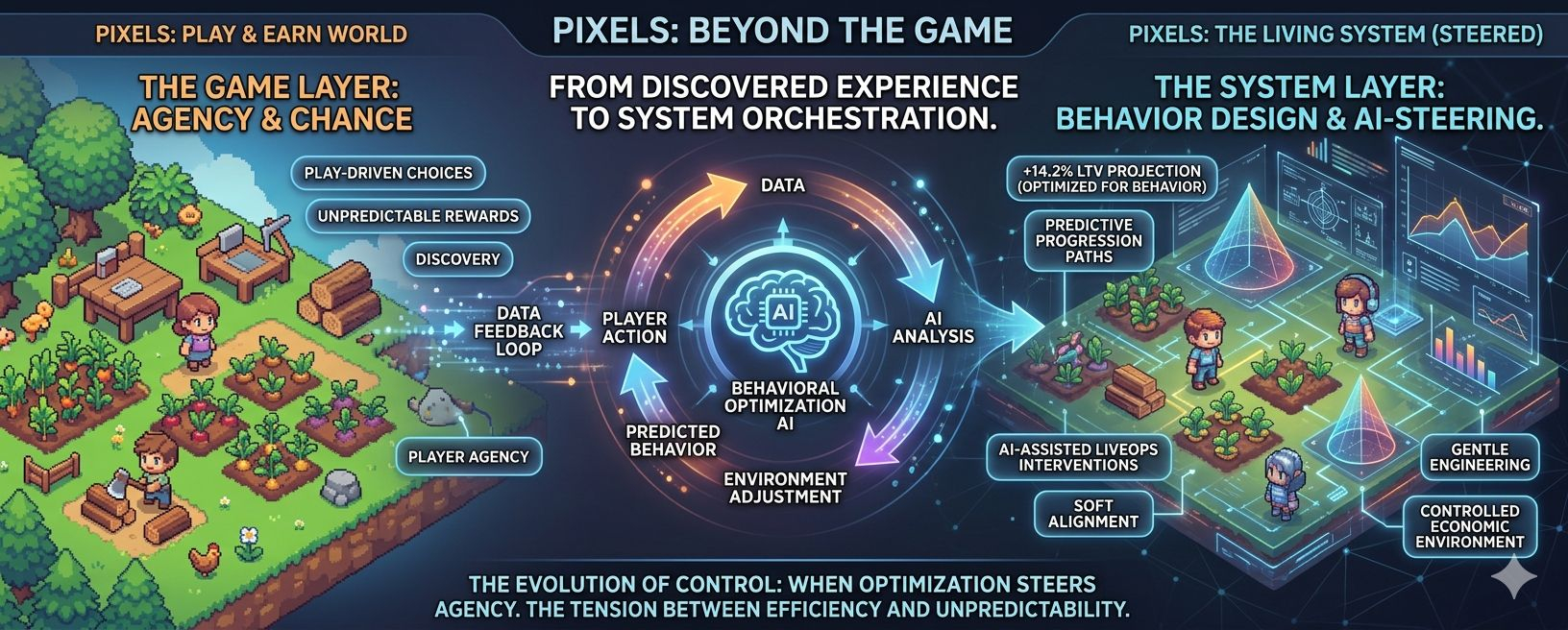
Pixels is no longer behaving like a traditional game loop. It’s behaving like a living system.
A system where every player action isn’t just an action — it’s a data point. Movement, engagement time, drop-offs, reward responses — all of it flows into a continuous feedback loop. It starts to resemble something closer to urban traffic control than game design. Not metaphorically, but functionally. The system is observing patterns in real time, identifying friction, predicting behavior shifts, and adjusting the environment accordingly.
And this is where things begin to shift from “game design” to “behavior design.”
The introduction of AI-assisted LiveOps layers changes the role of the system entirely. It’s no longer reacting after outcomes — it’s intervening during them. When a high-value player shows signs of disengagement, the system doesn’t wait. It calculates. It predicts. It responds with incentives like guild rewards or adjusted progression paths. Not randomly — but based on projected long-term value.
That +14.2% LTV projection you mentioned isn’t just a performance metric. It’s a signal.
It means the system is no longer optimizing for fun alone — it’s optimizing for expected behavioral return.
And that creates a subtle but important shift.
Because when rewards, retention loops, and progression curves are continuously optimized by predictive models, the nature of “choice” inside the game starts to evolve. The player still feels agency — nothing is being taken away. But the environment itself becomes increasingly pre-shaped. The “best” decision is no longer discovered — it’s gently engineered.
This is not manipulation in the obvious sense. It’s something quieter.
A form of soft alignment between player behavior and system goals.
And here’s where the tension begins.
Games, at their core, have always thrived on a degree of unpredictability. Small inefficiencies, unexpected outcomes, even imbalance — these are not flaws, they’re part of what creates emotional texture. Chaos isn’t just noise… it’s engagement.
But optimization, by design, reduces chaos.
The more precise the system becomes, the more it eliminates variance. And the more variance disappears, the more experiences begin to converge into predictable paths. Efficient, smooth… but potentially less alive.
So the real question isn’t whether Pixels is evolving — it clearly is.
The deeper question is: what is it evolving into?
Because what we’re seeing is not just a better game loop. It’s the emergence of a controlled economic environment, where gameplay, rewards, and behavior are tightly interconnected and continuously adjusted by intelligence layers.
A system where: players act…
data reacts…
and the system adapts…
in a loop that never really stops.
And in that loop, something subtle happens.
The player is still playing — but the boundaries of that play are becoming increasingly defined in advance.
Not rigidly. Not visibly. But statistically.
So maybe the real shift isn’t from “game” to “economy.”
It’s from experience to system orchestration.
And that’s why the discomfort you’re feeling isn’t misplaced.
It’s not a flaw — it’s a signal that we’re entering a different design era. One where games are no longer just designed… they are continuously steered.
Whether that leads to deeper engagement or quieter control probably depends on one thing:
How much unpredictability the system is willing to leave untouched.
Because if everything becomes optimized…
then nothing truly feels discovered anymore.
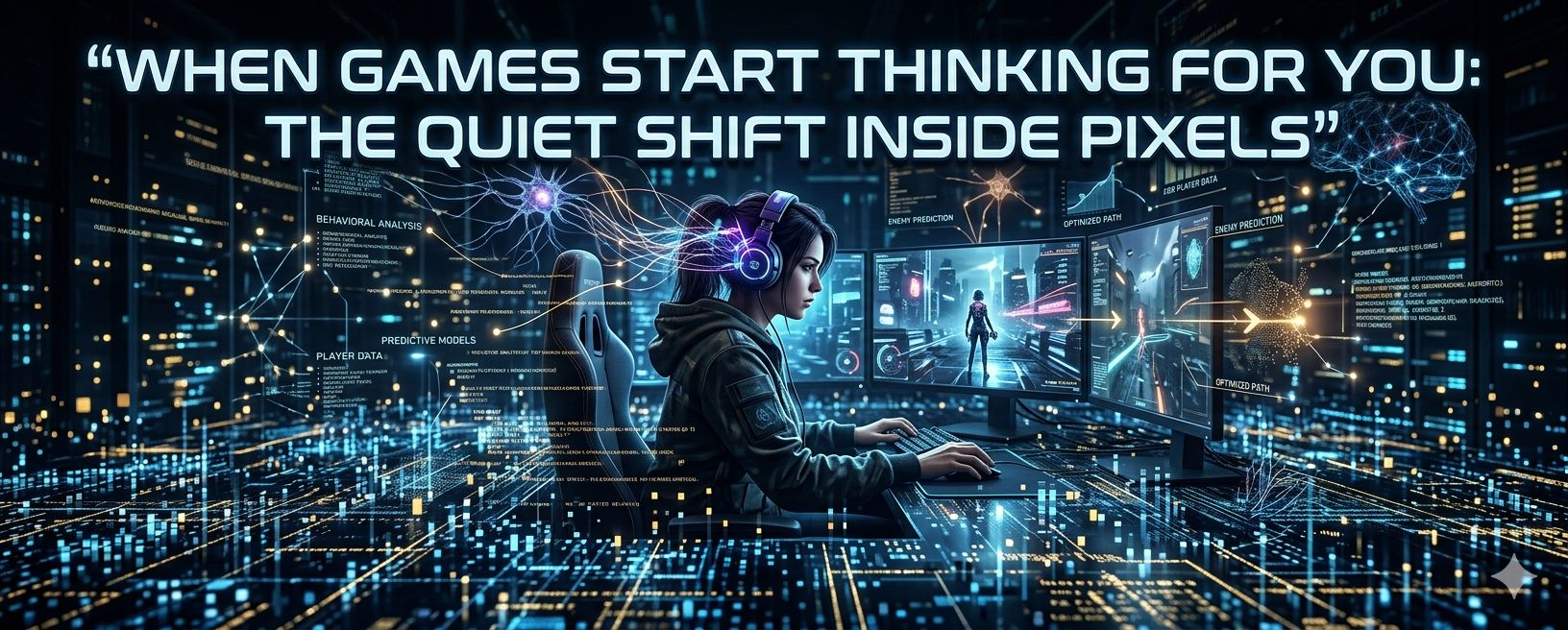
And maybe that’s the line Pixels — and systems like it — will have to learn not to cross.
