
I’m going to say something that doesn’t fully resolve.
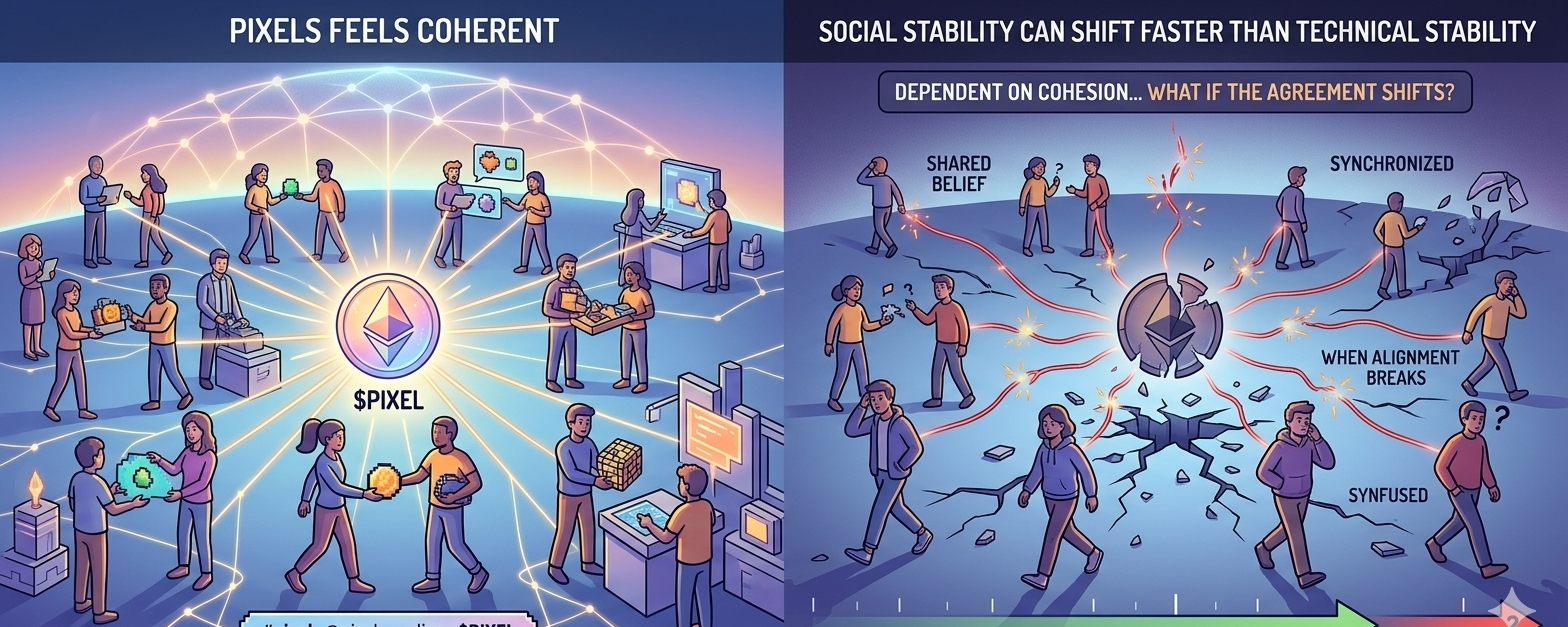
Pixels feels coherent.
But it also feels… agreed upon.
Not enforced. More like something that works because everyone is currently willing to treat it as working.
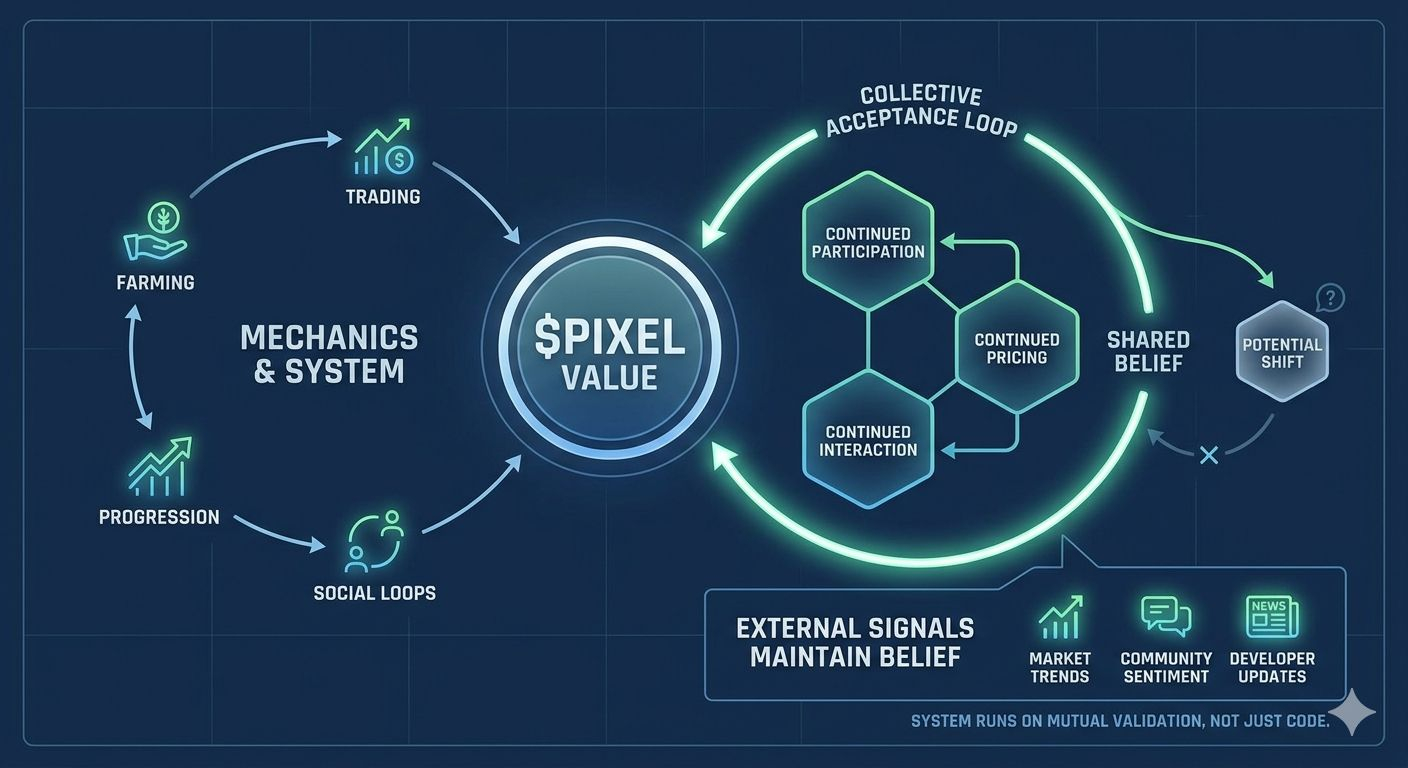
Most people discussing $PIXEL focus on mechanics — farming, trading, progression, social loops. But that framing misses a quieter layer.
What happens if that shared belief starts to shift?
Pixels doesn’t just run on code.
It runs on collective acceptance.
There’s something subtle in that structure — this idea that as long as participants behave as if the system has value, the system continues to function as if that value is stable.
It’s not unique to Pixels.
But it’s more visible here.
Because so much of the experience depends on continued participation, continued pricing, continued interaction — all reinforcing each other in a loop of mutual validation.
That’s the part I keep coming back to.
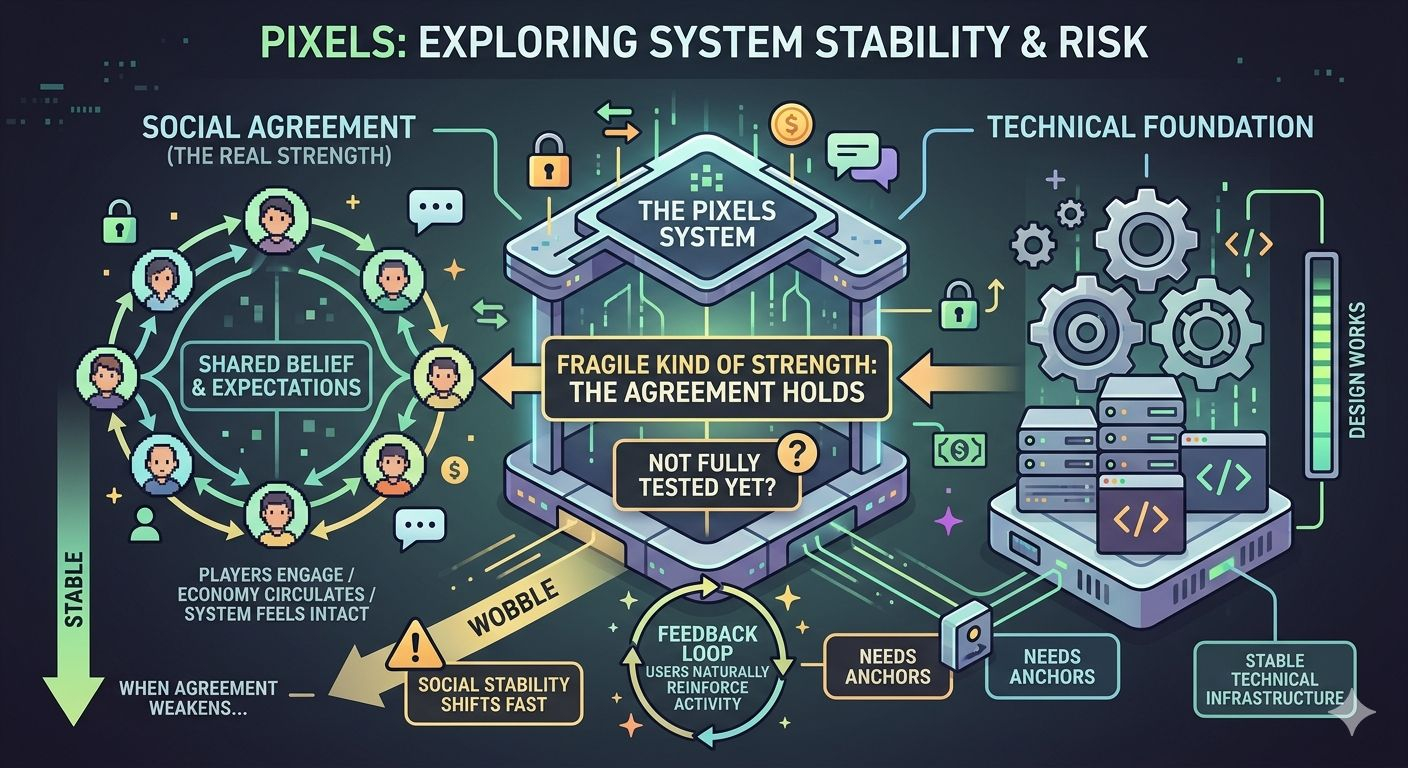
If Pixels succeeds, it won’t just be because the design works. It will be because the agreement holds — that enough people keep treating the system as meaningful at the same time.
That’s a fragile kind of strength.
And it hasn’t been fully tested yet.
At least not in a way that challenges that shared assumption.
So again, we’re in that middle phase.
The economy circulates.
The players engage.
The system feels intact.
But the stability feels… social.
And social stability can shift faster than technical stability.
I’ve seen this pattern before. Systems that feel solid while the collective narrative is aligned… but start to wobble when expectations diverge, even slightly.
That’s the risk here.
Still, there are signals that make this interesting.
Pixels has managed to create a space where users naturally reinforce each other’s activity. That kind of feedback loop isn’t easy to build — it requires timing, design, and a bit of luck.
But feedback loops need anchors.
Another layer that feels unresolved is what happens when agreement weakens.
Right now, $PIXEL moves within a system where behavior is relatively synchronized. But over time, participants begin to act differently — some extract value, some hold, some leave.
We’re not fully seeing that divergence yet.
So most of the current state feels… aligned.
Not guaranteed. Just synchronized.
And synchronized systems always face the same moment eventually:
When alignment breaks.
That’s the uncomfortable part.
I don’t see Pixels as unstable.
But I do see it as dependent on cohesion.
Maybe that cohesion strengthens over time.
Maybe it fragments.
Right now, it still feels like a system that works…
because everyone is, for now, choosing to move together.
