

According to CoinMarketCap data, the global cryptocurrency market cap now stands at $2.58T, up by 1.27% over the last 24 hours.
Bitcoin (BTC) traded between $75,876 and $77,500 over the past 24 hours. As of 09:30 AM (UTC) today, BTC is trading at $77,329, up by 1.40%.
Most major cryptocurrencies by market cap are trading mixed. Market outperformers include MEGA, QI, and NFP, up by 185%, 33%, and 29%, respectively.
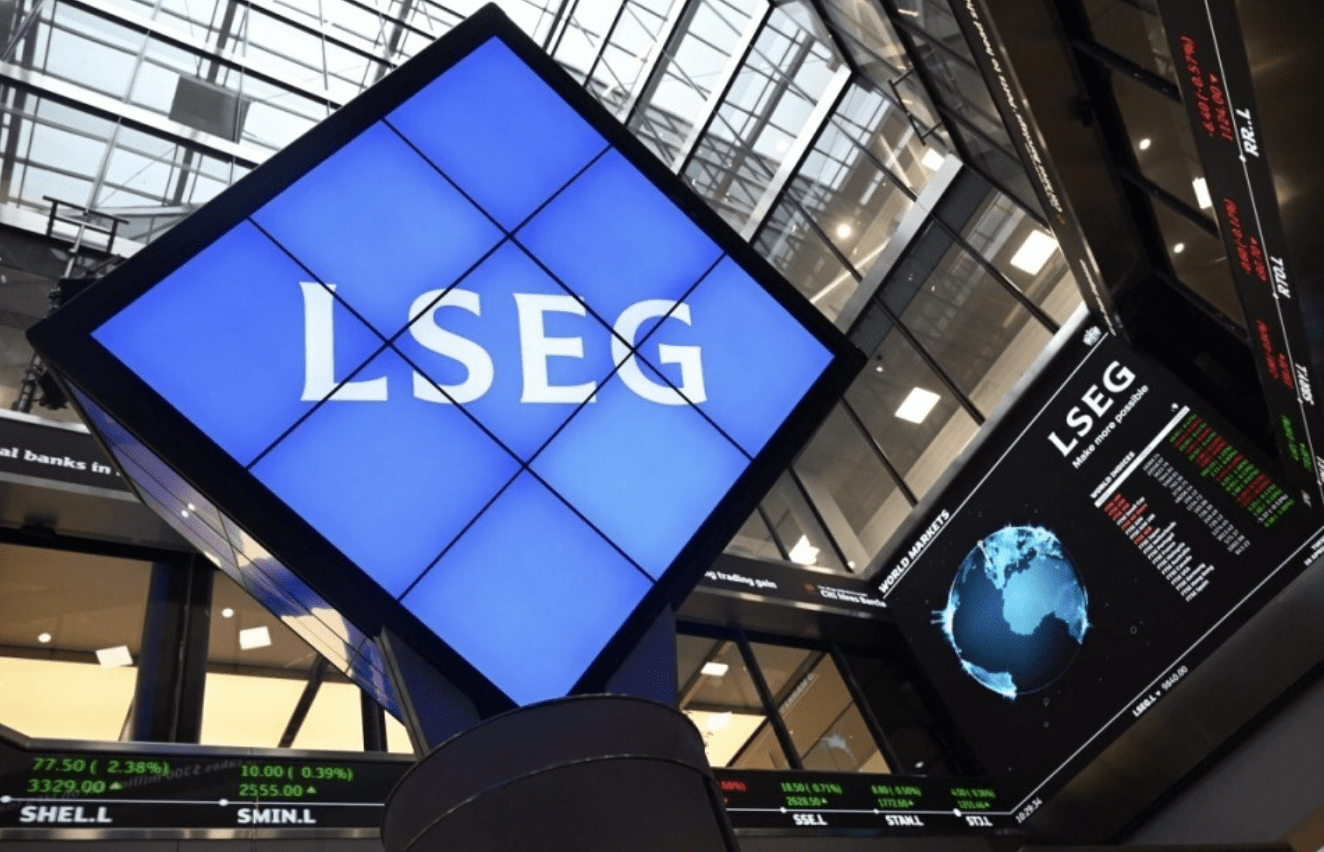
U. S.Stocks Hit All-Time Highs as Oil Whipsaws From $126 to $114 — But Bitcoin's On-Chain Signals Flash Caution and June Rate Cuts Are Off the Table
The S&P 500 and Nasdaq closed at record highs on strong earnings and 2.0% US GDP growth, while oil's dramatic intraday reversal from $126 to $114 gave risk assets temporary relief — yet Bitcoin remains stuck near $77K as short-term holders turn profitable for the first time in six months, historically a resistance signal rather than a springboard.
Markets have now priced a 94.9% probability of a June Fed hold, effectively pushing the next rate cut catalyst into the second half of 2026 — while the tokenized RWA market quietly hit $30B, up 420% since early 2025, signaling where the next wave of institutional capital may be flowing.
Key Takeaways:
S&P 500 gained 1% and Nasdaq added 0.9%, both reaching all-time highs on strong earnings and GDP beat
Brent crude spiked to $126 — a four-year high — on escalation fears before reversing 3.4% to close at $114.01
Alphabet surged 10% on AI-driven earnings; Meta fell 8.6% on heavy AI capex concerns; Apple beat forecasts, up 4.7% after hours
US Q1 2026 GDP grew at 2.0% annualized — defying slowdown fears, with AI investment a key driver and consumer spending cooling
Fed, ECB, and Bank of England all held rates; ECB warned war-related energy disruptions have "intensified" eurozone risks; eurozone GDP grew just 0.1% in Q1
Summary:
Equities delivered a split but ultimately bullish verdict on the earnings season — Alphabet's AI windfall and Apple's beat outweighed Meta's capex-driven selloff to push both major US indices to records. The oil whipsaw from $126 to $114 is a net positive for crypto and risk assets in the short term, easing inflation anxiety, though Brent remaining above $114 means the energy overhang hasn't gone away. The US-Europe growth divergence — 2.0% vs 0.1% — is widening in a way that keeps dollar strength and Fed-ECB policy divergence on the table.
Key Takeaways:
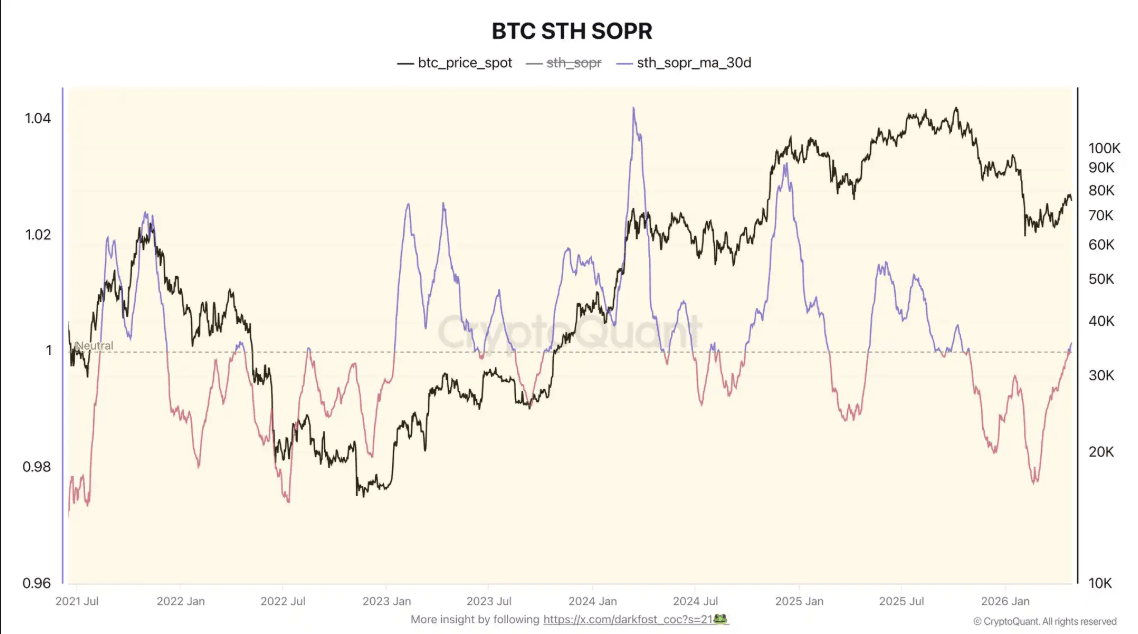
Bitcoin's Short-Term Holder SOPR 30-day MA has crossed above 1.0 for the first time in six months, per CryptoQuant analyst Darkfost
Historically, this level acts as resistance in bear markets — holders returning to breakeven tend to sell rather than hold for further upside
CryptoQuant's Bull Score Index fell from 50 to 40 in April despite the price increase — historically associated with continued weakness
April's rally was identified as futures-driven with contracting spot demand — a structure CryptoQuant compared to conditions at the start of the 2022 bear market
Bitcoin is trading near $77,000, having failed to hold above $79,000 on three separate attempts in two weeks
Summary:
Short-term holders going green for the first time in six months sounds like good news — but the on-chain history says otherwise. In bear market regimes, this is typically where relief becomes resistance: underwater holders finally seeing profit tend to exit, not add. Combined with a Bull Score Index at 40, a futures-led rally, and three failed attempts at $79,000, the on-chain picture is sending a consistent message that the $77,000–$79,000 zone is a ceiling, not a launchpad.
CME FedWatch Shows 94.9% Probability of Fed Rate Hold in June After Powell's Final Meeting
Key Takeaways:
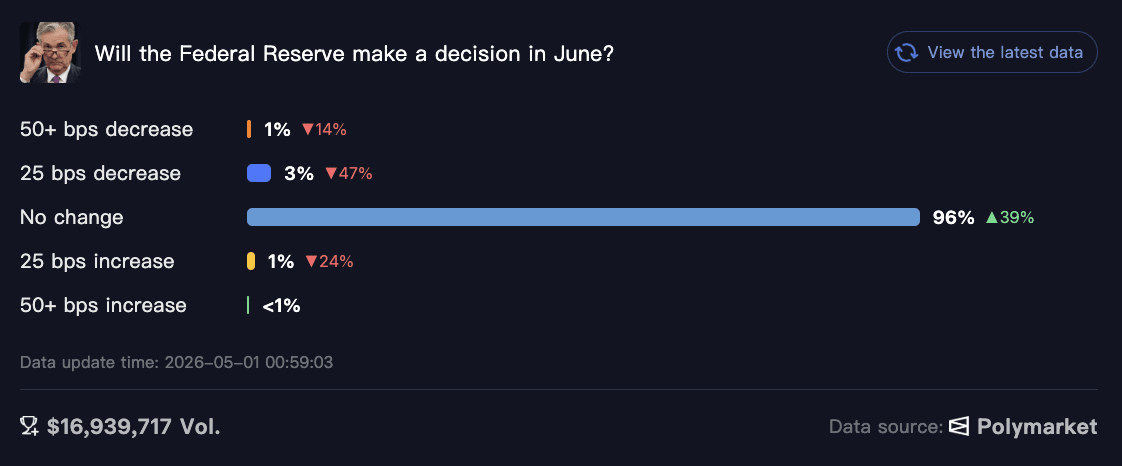
CME FedWatch now shows a 94.9% probability of rates holding unchanged at the June Fed meeting; a 25bps cut is priced at just 5.1%
The near-certain June hold follows the Fed's May decision to keep rates at 3.50%–3.75% amid elevated energy-driven inflation
Powell acknowledged at his final press conference that rising energy prices are pushing short-term inflation higher
The June meeting may see the Fed remove its accommodative bias — a signal that forward guidance could actually tighten rather than soften
For crypto, the next realistic rate cut catalyst has now shifted to the second half of 2026, contingent on inflation cooling and the Middle East energy shock subsiding
Summary:
A 94.9% June hold probability is as close to certainty as markets get. Bitcoin bulls counting on Fed easing as a near-term catalyst need to recalibrate — the next potential cut is now an H2 2026 story at the earliest, and only if the Hormuz situation resolves and energy prices retreat meaningfully. The possibility of the Fed removing its accommodative bias in June makes this even more consequential: the next meeting could shift the narrative from "cuts delayed" to "cuts derailed."
Tokenized Real-World Asset Market Surges Over 420% in 2025
Key Takeaways:
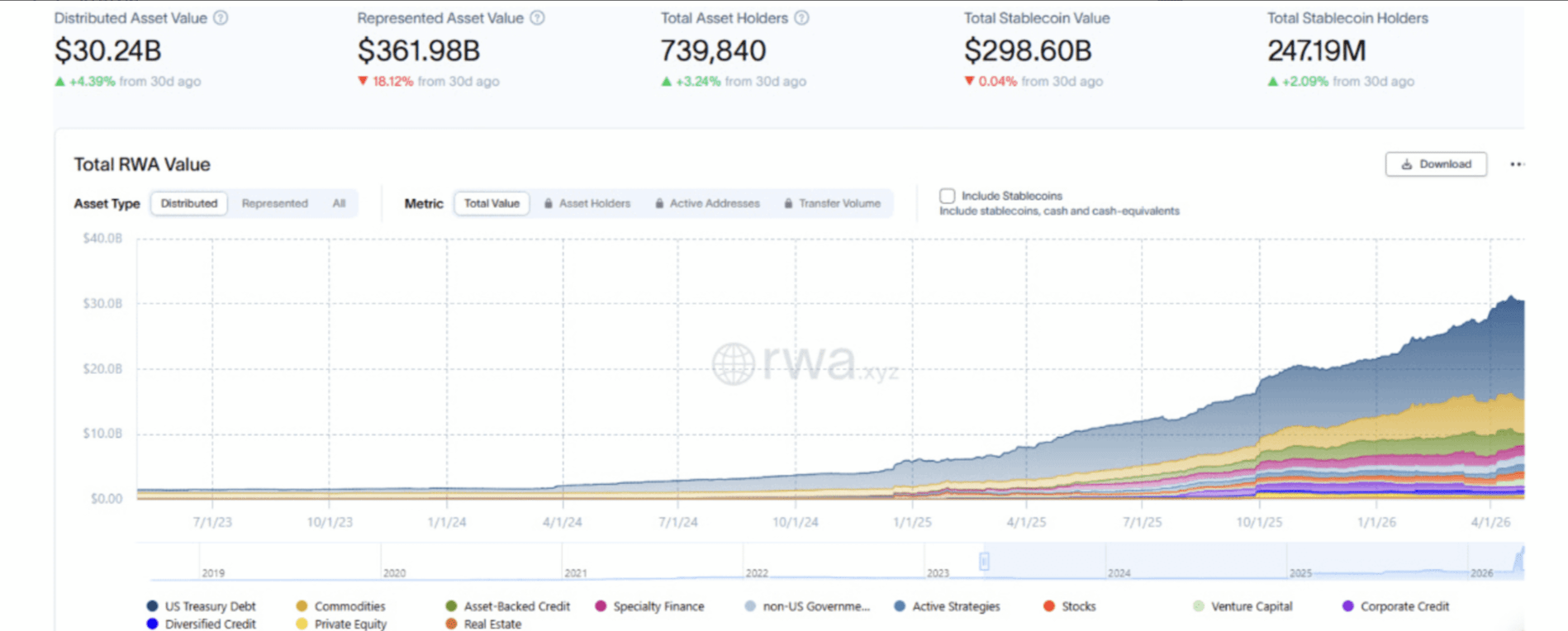
The tokenized RWA market has grown from $5.8B in January 2025 to over $30.2B — a 420%+ increase driven by regulatory clarity and improved market access
Tokenized US Treasurys led growth, rising from $3.9B to $15B+; tokenized commodities including gold also surged amid geopolitical uncertainty
BlackRock's BUIDL and Fidelity's FDIT have established institutional benchmarks for on-chain access to real-world yields
ARK Invest forecasts digital assets could reach $28T by 2030, with tokenized RWAs alongside Bitcoin, DeFi, and stablecoins as key drivers
Zeus Research analyst: growth may moderate as the easiest flows have been allocated — the next phase depends on scaling tokenized equities, funds, and private credit
Summary:
The tokenized RWA market's 420% growth since early 2025 is one of crypto's most structurally significant stories — it represents institutional capital choosing blockchain as a distribution layer for real-world yields, not speculation. Tokenized Treasurys doubling to $15B+ is the clearest proof of concept: regulated institutions are now comfortable holding on-chain instruments for yield. The next leg of growth hinges on whether tokenized equities and private credit can replicate what Treasurys have done.
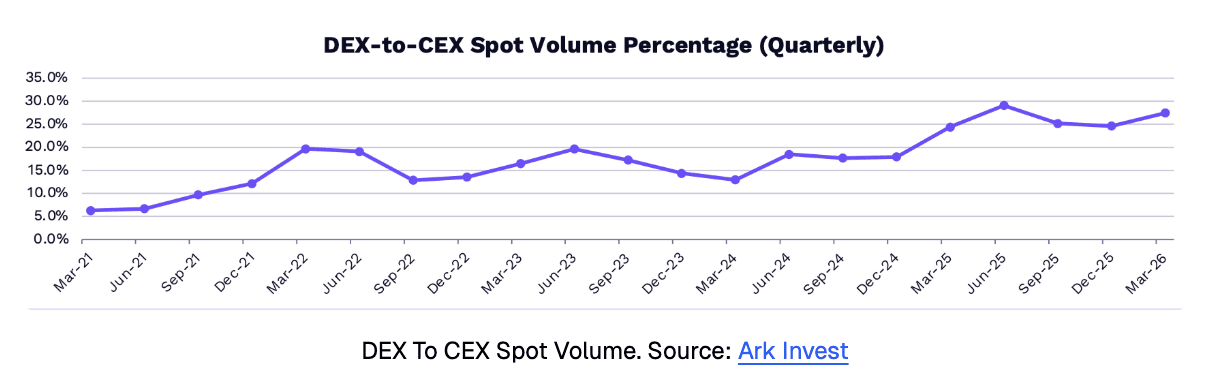
DEX-to-CEX Spot Ratio Rises Despite Decline in DEX Volume
Key Takeaways:
DEX-to-CEX spot trading ratio rose to ~27.4% in Q1 2026 despite a 26% decline in DEX spot volume to ~$832B, per ARK Invest
The shift occurred during a risk-off period with Bitcoin down 22%, per CoinGlass data
Stablecoin swap volume edged up 0.7% to ~$185B; tokenized asset swaps surged ~83% to ~$4.6B
Summary:
A rising DEX-to-CEX ratio during a period of falling overall volume signals that DEX market share is structurally growing even as the total pie shrinks in risk-off conditions. The 83% surge in tokenized asset swaps to $4.6B directly connects to the RWA boom in story four — on-chain infrastructure is increasingly being used to trade real-world assets, not just native crypto tokens. That's a meaningful compositional shift in what DEXs are actually being used for.
Market movers:
ETH: $2284.26 (+0.74%)
BNB: $617.39 (-0.11%)
XRP: $1.3763 (-0.06%)
SOL: $84.02 (+0.80%)
TRX: $0.3263 (+0.40%)
DOGE: $0.108 (+0.41%)
WBTC: $77152.62 (+1.49%)
U: $1.0002 (-0.01%)
XAUT: $4568.36 (-1.11%)
BCH: $443.3 (-0.74%)