
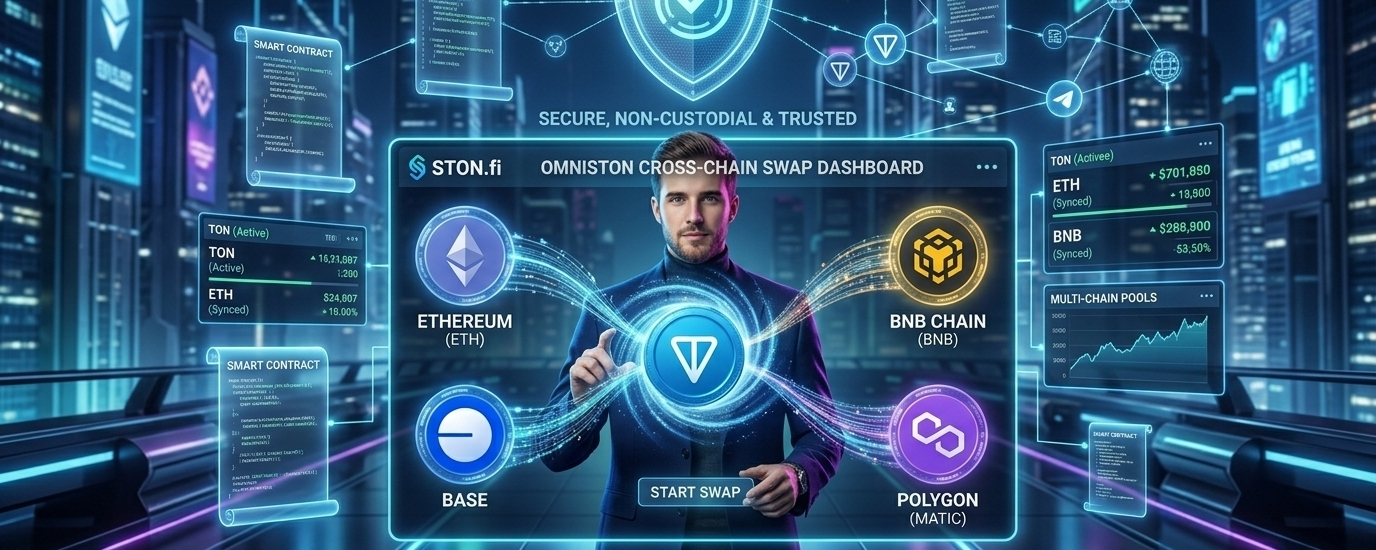
Cross-chain swaps are becoming more important in crypto as users move assets between different blockchains like TON, Ethereum, BNB Chain, Base, and Polygon.
Usually, moving assets between chains requires either a bridge or a centralized exchange. But both methods come with problems.
Traditional bridges often hold large amounts of funds in one place, making them common targets for hacks. Centralized exchanges require users to deposit funds and sometimes complete KYC before transferring assets.
STON.fi is building a different solution through its Omniston execution layer.
Instead of using wrapped tokens or storing user funds in one large pool, STON.fi uses smart contracts and atomic swap technology to complete cross-chain transactions.
Here’s the simple idea:
When a user starts a cross-chain swap, the asset on the first blockchain gets locked in a smart contract. At the same time, the matching asset is locked on the destination blockchain.
Both sides are connected by the same cryptographic condition.
If everything completes correctly, both sides release the assets.
If something fails, both sides automatically refund the funds.
This means the swap is “all or nothing.”
Either the transaction finishes successfully, or the user gets their funds back automatically.
Another important point is custody.
STON.fi never directly controls user funds during the process. The smart contracts handle everything, which keeps the system non-custodial and closer to the original idea of decentralized finance.
The system is also designed to help users move between ecosystems more easily.
For example:
- TON to Ethereum
- BNB Chain to TON
- Base to Polygon
- Ethereum to TON-native tokens
All without needing a centralized exchange in the middle.
This becomes more important as the TON ecosystem continues growing through Telegram integration and increasing DeFi activity.
STON.fi is not only building a DEX anymore.
It is building infrastructure for cross-chain execution.
One of the strongest parts of the system is automatic failure handling.
If the destination blockchain cannot complete the transaction before the time limit expires, the funds automatically return to the sender.
No manual recovery process.
No support tickets.
No waiting for an exchange.
STON.fi also uses Omniston to search for competitive liquidity routes before the swap begins, helping users get better execution across supported networks.
As DeFi becomes more multi-chain, systems that can move assets safely and efficiently between blockchains will become more important.
And STON.fi is working to become one of the major platforms solving that problem on TON.
#TON #STONfi #DeFi #Crypto