
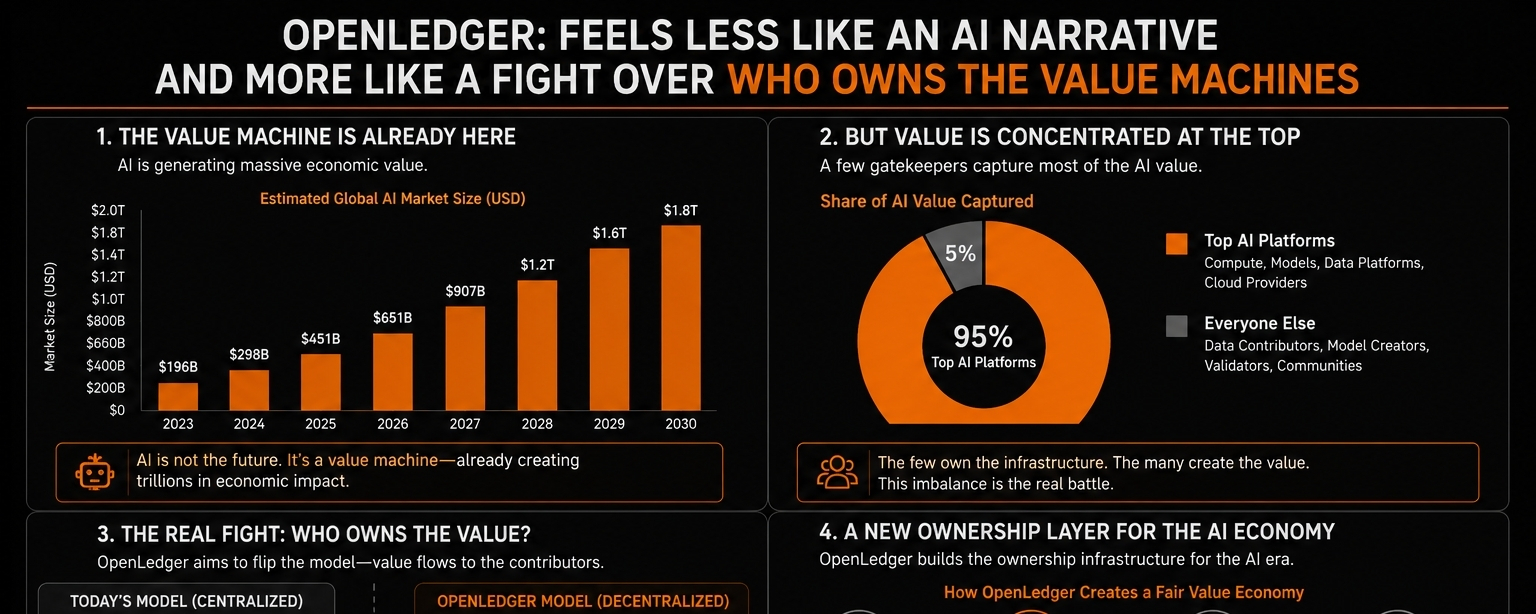

OpenLedger feels like one of those projects I should’ve ignored faster.
An AI blockchain monetizing data, models, and agents sounds exactly like the kind of sentence this market manufactures every few months before everyone quietly moves on to the next narrative. I’ve been around long enough to recognize the pattern immediately. Stack enough trending words together and people start treating possibility like inevitability.
Usually that’s my cue to leave.
But I kept watching this one longer than I expected to.
Not because I’m convinced. More because the problem underneath it refuses to sound fake once you sit with it for a while. AI systems are absorbing everything now. User behavior. Information. Patterns. Decisions. Entire industries are slowly reorganizing themselves around machine-generated outputs, and most people still act like the value distribution layer will somehow sort itself out naturally later.
It won’t.
That part already feels obvious.
The internet has always been good at turning human participation into invisible raw material. AI just accelerates the process. Every interaction becomes training input eventually. Every workflow becomes optimization fuel. Every useful behavior leaves behind value someone else learns how to package.
That’s where OpenLedger started feeling less like another hype product and more like an uncomfortable observation about where things are heading.
Still, crypto has ruined my ability to trust clean narratives.
I’ve watched too many “ownership economy” projects collapse under reality. The concepts always sound elegant early on. Reward contributors. Share value. Decentralize participation. Then real incentives arrive and the system starts mutating. Farmers appear. Spam spreads. Governance becomes theater. Quality turns difficult to measure. Suddenly the protocol spends more energy defending itself from its own users than building anything meaningful.
And honestly, AI probably makes that problem worse.
Because value attribution inside AI systems is messy by nature. Everybody says data matters, but most data is useless noise. Everybody says contributors should get rewarded, but nobody fully agrees on what meaningful contribution even looks like. A model improves through millions of invisible interactions happening simultaneously. Trying to attach precise economic ownership to that process feels structurally difficult no matter how sophisticated the system becomes.
That tension is probably why OpenLedger stayed in my head.
Not because they solved it already. I don’t think anyone has. More because they seem to understand that the fight over AI won’t only be about intelligence itself. It’ll be about who captures the economic value surrounding intelligence once these systems become embedded everywhere.
And that changes the conversation.
Most AI discussions still sound strangely detached from real market behavior. People talk about innovation while ignoring incentives completely. But incentives decide everything eventually. They decide who contributes. Who stays. Who extracts. Who disappears.
Crypto taught us that already.
The strange thing is the market usually claims it wants utility while rewarding spectacle instead. Useful infrastructure often gets ignored for long stretches because it isn’t emotionally exciting enough. Traders want movement. Communities want instant dominance. Nobody wants to hear that meaningful systems sometimes require slow adoption curves and ugly coordination problems before they start making sense.
OpenLedger feels trapped inside that exact contradiction.
If adoption comes slowly, people lose interest.
If adoption comes too quickly, speculation probably distorts the incentives before the ecosystem stabilizes.
There’s barely any comfortable middle ground for projects trying to coordinate actual economic behavior instead of pure attention cycles.
And maybe the market simply doesn’t care enough.
That possibility feels real too.
Convenience still beats ideals most of the time. Centralized AI systems may continue absorbing everything because users prioritize speed over ownership. Most people don’t wake up thinking about data rights or decentralized value distribution. They use whatever works fastest. History keeps proving that.
But at the same time, I can’t shake the feeling that the ownership layer around AI still looks unfinished. Too many systems are extracting value from collective behavior without clear mechanisms explaining where that value flows afterward. Eventually that tension becomes economic, not philosophical.
That’s the part I keep returning to.
Not the branding.
Not the token.
Not the roadmap language every project recycles anyway.
The tension.
Because even if OpenLedger fails completely, the underlying problem probably survives it. AI economies are forming whether people are prepared for them or not. Data is becoming infrastructure. Models are becoming leverage. Agents are slowly turning automation into its own marketplace. Somebody will build systems around that reality successfully eventually.
The question is whether open networks can compete before centralized platforms lock everything down permanently.
I honestly don’t know.
And that uncertainty makes this feel more real to me than the projects pretending they already understand exactly where all this goes. The older I get in crypto, the less I trust certainty. Markets punish certainty constantly. Especially in emerging systems where human behavior remains impossible to model cleanly.
So I’m still watching OpenLedger carefully.
Not with excitement.
Not with blind skepticism either.
More like the feeling you get when something sounds slightly uncomfortable because part of it might actually be true, and you’re not fully sure the market has noticed yet.