They see the chatbot.
The agent.
The answer on the screen.
The tool that saves time.
That is the visible part.
But the more you watch this space, the more you start noticing the back end of it. Not the technical back end only, but the value back end. The quiet layer where all the useful pieces come from before the final AI product appears.
And that part is still messy.
AI does not just “think” on its own. It is built from many small inputs that are easy to ignore once the final output looks smooth. A model needs training data. It needs feedback. It needs domain knowledge. It needs someone to shape it, test it, improve it, and keep it useful.
The strange thing is that most of these inputs do not have a clean economic life of their own.
They exist.
They create value.
But they are often hard to price, hard to track, and hard to reward.
That is where @OpenLedger starts to feel interesting.
Not as another loud AI story. More like an attempt to map the supply chain behind intelligence.
Because maybe that is what AI is slowly becoming.
A supply chain.
Not a physical one with factories and shipping containers, but a digital one made of data, models, agents, prompts, feedback loops, and usage history. Each layer depends on another layer. Each layer adds something. And yet, by the time the final AI product reaches the user, it is difficult to see who or what actually made it valuable.
You can usually tell a system is still early when value is being created in many places, but only captured in a few.
That has been happening with AI for a while.
A dataset can make a model better, but the dataset may remain buried.
A small model can serve a very specific use case, but may never get proper distribution.
An agent can perform useful work, but its value may be trapped inside one app or one platform.
A community can produce knowledge that improves AI, but that contribution often gets absorbed without much visibility.
After a while, the question changes.
It is no longer only, “How smart can AI get?”
It becomes, “Can the pieces that make AI useful have their own markets?”
That is a quieter question, but maybe a more important one.
#OpenLedger seems to be looking at this exact gap. It is built around the idea that data, models, and agents should not just sit still inside closed systems. They should be able to move, be used, be valued, and generate returns when they actually contribute something useful.
That does not mean every file, every model, or every agent suddenly becomes valuable.
Most probably will not.
And that is fine. Markets are not supposed to treat everything as equal. They are supposed to reveal what has demand.
A clean dataset for a real industry may have value.
A model trained for one narrow task may have value.
An agent that solves a repeated problem may have value.
A feedback loop from actual users may have value.
The hard part is creating a system where that value does not disappear the moment it enters the AI stack.
This is where blockchain makes sense in a more practical way.
Not because everything needs to be on-chain. That idea gets stretched too far sometimes. But because some parts of AI need traceability. Some parts need ownership records. Some parts need usage-based rewards. Some parts need a neutral place where different contributors can interact without relying completely on one closed platform. $US
OpenLedger’s role sits somewhere there.
It is not only about building AI. It is about building a layer where AI assets can be accounted for.
And that word, “accounted for,” matters.
Because once something can be accounted for, it can be priced.
Once it can be priced, it can be traded or licensed.
Once it can be used repeatedly, it can generate ongoing value.
Once contributors can see that value, they have a reason to keep improving what they build.
That is the part people may overlook.
AI progress is not only about better models. It is also about better incentives around the people and systems feeding those models.
If the incentives are weak, useful data stays locked. Good models stay isolated. Agents remain stuck inside narrow environments. Builders move on because there is no clear path to monetization.
But if those assets become easier to connect with demand, the whole AI economy starts to look different.
Slower, maybe. Less flashy. But more structured.
OpenLedger is trying to make that structure possible by treating data, models, and agents as assets with economic paths, not just background ingredients. $ESPORTS
And maybe that is the more grounded way to think about AI blockchain.
Not as a race to make AI sound more futuristic.
More like a way to answer a basic question:
When intelligence is built from many contributors, how does value flow back through the system?
That question will probably become more important as AI becomes more specialized. We may see fewer general stories and more narrow ones. Smaller models. Task-specific agents. Industry datasets. Private knowledge layers. Tools that do one thing very well.
In that kind of world, liquidity matters in a different way.
It is not only about token liquidity.
It is about whether useful intelligence can move.
Whether it can be discovered.
Whether it can be reused.
Whether the people behind it can benefit from that reuse.
OpenLedger is still part of a young category, so it is better not to pretend everything is already figured out.
But the direction is worth paying attention to.
Because the visible AI layer keeps getting easier to use.
The hidden value layer behind it is still being built.
@OpenLedger #OpenLedger $OPEN

Artículo
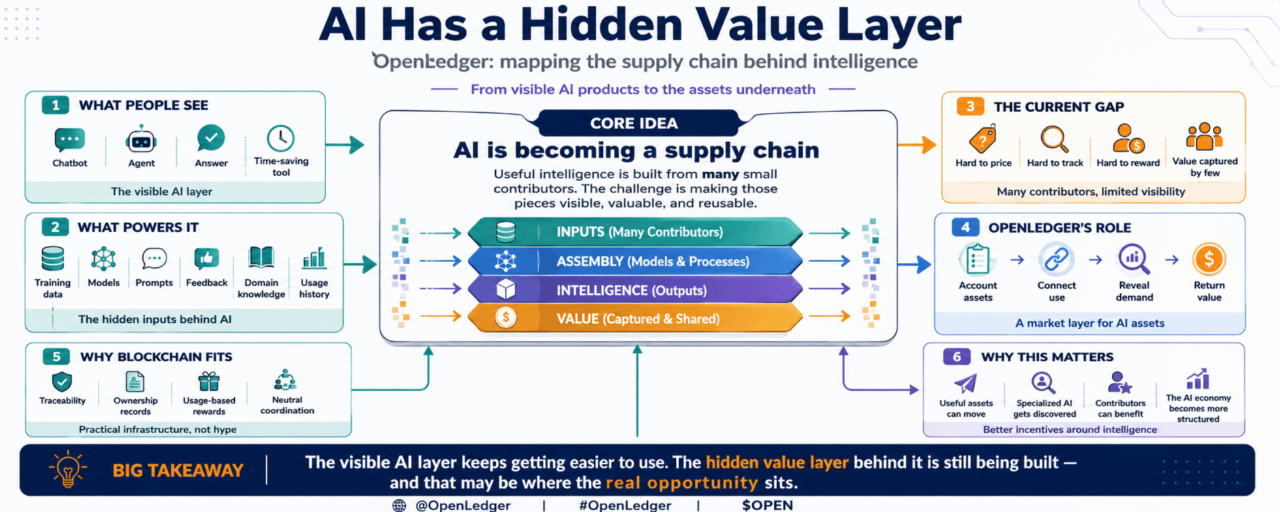
Most people look at AI from the front.
Aviso legal: Incluye opiniones de terceros. No debe interpretarse como asesoramiento. Binance AI puede usarse sin garantía. Lee los TyC.