
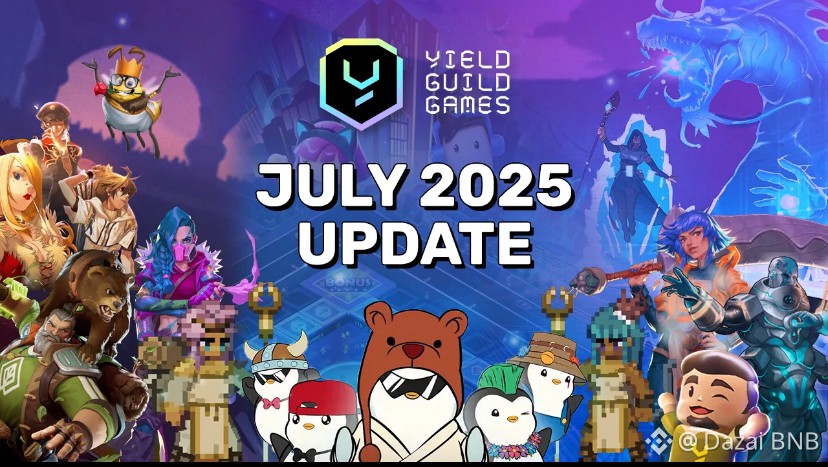
The gaming industry is quietly changing its heartbeat, and those paying attention can feel it. What happens when artificial intelligence stops being a background tool and starts shaping how players earn, think, and compete? Dazai sees Yield Guild Games stepping into this shift with rare timing. YGG is no longer just a guild or a token tied to play-to-earn history; it’s becoming an infrastructure layer for how intelligence, automation, and ownership can coexist inside gaming economies without breaking immersion or trust.
From Play-to-Earn to Play-with-Intelligence
YGG earned its name during the early play-to-earn wave, building one of the strongest global gaming communities across Web3. But the real story today is evolution. The YGG token is no longer defined only by scholarships or asset rentals; it now represents coordination, governance, and value flow across a growing ecosystem of games, tools, and regions. Dazai notices that as AI-driven systems enter gaming, YGG’s structure fits naturally, because guilds are essentially human coordination engines, and AI enhances coordination rather than replacing it.
AI in gaming isn’t just about smarter NPCs anymore. It’s about adaptive economies, personalized progression, fraud detection, and real-time balancing. YGG’s involvement sits right at this intersection. Through its subDAOs, regional hubs, and data-driven operations, the guild has been quietly aligning with the idea that future gamers won’t grind blindly; they’ll play in systems that learn from them
How AI Enhances YGG’s Ecosystem
Inside YGG’s expanding ecosystem, AI has practical implications. Guild analytics can optimize asset allocation, improve player onboarding, and help match gamers with roles that fit their skill sets. Dazai sees this as a shift from brute-force grinding to intelligent participation. The YGG token benefits here by acting as the governance and value anchor that connects these AI-assisted decisions back to the community rather than a centralized authority.
This matters because YGG has consistently emphasized decentralization and community ownership. AI, when paired with transparent governance, becomes a tool rather than a threat. Token holders remain the decision-makers, while AI handles complexity at scale. This balance is where YGG separates itself from traditional gaming publishers experimenting with AI behind closed doors.
The Token Narrative in an AI Gaming World
YGG as a token reflects more than speculation; it reflects participation in a living network. Recent developments around YGG have reinforced its role as a coordination token across multiple games and chains, especially as the market shifts toward sustainable gaming models. Dazai observes that as AI-driven gaming economies mature, tokens that enable governance, rewards, and interoperability gain relevance over single-game currencies.
Market behavior around YGG has mirrored broader crypto cycles, moving with Bitcoin sentiment while maintaining its own ecosystem-driven catalysts. What keeps YGG in conversation is not hype, but continuity. The team’s focus on long-term infrastructure, education programs, and regional expansion aligns well with AI adoption, which requires patience and iteration rather than instant results.
Why This Matters for the Future of Gaming
AI plus gaming is not a trend; it’s a structural change. YGG’s involvement places it in a position where players are not just consumers, but contributors to intelligent systems. Dazai finds this especially compelling because YGG has always prioritized emerging markets, where AI-powered optimization can reduce entry barriers and increase earning efficiency for players who rely on gaming as income.
As Binance Square audiences look for projects with narrative depth and real utility, YGG stands out by combining community scale, token governance, and forward-looking technology. There’s no promise of overnight transformation here, only steady integration of smarter systems into a proven guild model. That restraint is what gives the story credibility.
In the end, YGG’s role in AI and gaming innovation isn’t about flashy announcements. It’s about preparing a global player base for a future where games think, economies adapt, and ownership remains decentralized. Dazai sees YGG not chasing the future, but quietly assembling it—one intelligent move at a time.
