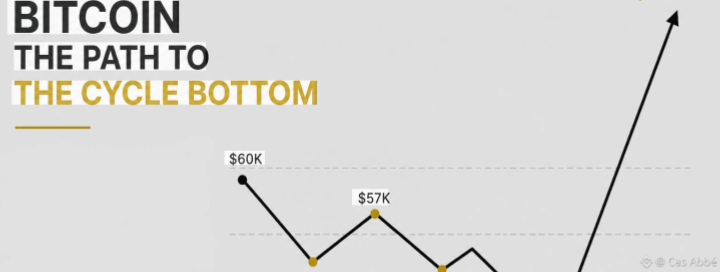
Bitcoin investors have seen this movie before. Just when confidence starts to return and market participants begin talking about new all-time highs, a sudden correction shakes the market. Prices fall faster than expected, social media turns bearish overnight, and weak hands rush to exit their positions. For newcomers, it feels like the start of another bear market. For experienced market participants, it often looks like something else entirely: a shakeout.
The idea of a "final shakeout" has become one of the most discussed concepts in Bitcoin market cycles. It refers to a period where prices experience a sharp decline or prolonged consolidation before a major upward move. While no one can predict the future with certainty, understanding how these phases have played out historically can help investors make more informed decisions rather than reacting emotionally to short-term volatility.
What Is a Shakeout in the Bitcoin Market?
A shakeout occurs when market conditions create enough fear to force leveraged traders and short-term holders out of their positions. During these periods, price declines trigger liquidations, stop-loss orders are hit, and investor sentiment deteriorates rapidly.
The result is often a transfer of Bitcoin from weaker hands to stronger hands. Long-term holders, institutions, and investors with conviction typically use these periods to accumulate while less experienced traders sell into fear.
Historically, Bitcoin has experienced multiple shakeouts before entering major bullish phases. These corrections often feel painful in real time, but they have repeatedly been part of Bitcoin's broader market structure.
Why Bitcoin Corrections Are Necessary
Many investors view corrections as negative events. In reality, healthy bull markets often require corrections to sustain long-term growth.
When Bitcoin rises too quickly:
Excessive leverage enters the market.
Speculative trading increases.
Unrealistic price expectations become common.
Market positioning becomes overcrowded.
A correction helps reset these conditions. It removes excessive speculation, reduces leverage, and creates a stronger foundation for future growth.
From a market psychology perspective, the strongest rallies often emerge when the majority of participants are uncertain rather than euphoric.
The Role of Market Psychology
Human psychology plays a bigger role in Bitcoin's price action than many investors realize.
During strong rallies, fear of missing out (FOMO) drives buying activity. Investors become increasingly confident that prices will continue rising indefinitely.
During corrections, the opposite happens:
Fear replaces optimism.
Investors focus on negative headlines.
Short-term price action dominates decision-making.
Many sell assets they were confident about only days earlier.
This emotional cycle has repeated throughout Bitcoin's history. Markets tend to move in ways that maximize emotional discomfort for the greatest number of participants.
That is why some of the strongest buying opportunities have historically appeared when sentiment is weak rather than when enthusiasm is high.
Institutional Demand Continues to Shape the Market
One of the biggest differences between previous cycles and today's market is institutional participation.
Large financial firms, investment funds, publicly traded companies, and regulated investment products have increased Bitcoin exposure over recent years. Their investment horizons are often measured in years rather than weeks.
Institutional investors generally focus on:
Long-term adoption trends.
Bitcoin's scarcity model.
Portfolio diversification.
Macroeconomic conditions.
Regulatory developments.
This growing institutional presence has added another layer of demand that did not exist during earlier market cycles.
While institutional involvement does not eliminate volatility, it has changed how many analysts evaluate Bitcoin's long-term outlook.
On-Chain Data and Long-Term Holders
Research from blockchain analytics firms has repeatedly shown that long-term holders often accumulate during periods of market weakness.
Several on-chain indicators commonly monitored by analysts include:
Long-term holder supply.
Exchange balances.
Realized profit and loss metrics.
Dormant coin movement.
Accumulation trends among large holders.
When long-term holders continue accumulating despite short-term volatility, many analysts interpret it as a sign of confidence in Bitcoin's future prospects.
However, no single metric guarantees future price performance. On-chain analysis should always be viewed as one component of a broader market assessment.
Could This Be the Final Shakeout?
The phrase "final shakeout" naturally attracts attention because it suggests a major move could follow. The reality is that no analyst, trader, or institution can know with certainty whether a particular correction represents the last pullback before a significant rally.
Several factors could support a bullish scenario:
Continued institutional adoption.
Expanding global awareness of Bitcoin.
Favorable macroeconomic conditions.
Increased participation through regulated investment products.
Ongoing long-term holder accumulation.
At the same time, investors should remain aware of potential risks:
Regulatory uncertainty.
Macroeconomic shocks.
Unexpected market events.
Liquidity changes.
Global economic slowdowns.
Balanced analysis requires acknowledging both opportunities and risks rather than focusing exclusively on one outcome.
Risk Management Matters More Than Predictions
One of the most common mistakes in cryptocurrency investing is becoming overly confident in any single forecast.
Whether analysts predict Bitcoin at $100,000, $200,000, or higher, the market ultimately determines the outcome.
Prudent investors often focus on:
Position sizing.
Diversification.
Long-term planning.
Risk management.
Emotional discipline.
These principles remain important regardless of market conditions.
Conclusion
Bitcoin's history shows that significant corrections have often occurred before major advances. These shakeouts test conviction, remove excessive leverage, and reset market sentiment. While some investors see panic, others see preparation for the next phase of the cycle.
Whether the current environment proves to be the final shakeout before Bitcoin's next parabolic run remains uncertain. What is clear is that Bitcoin continues to operate within a market driven by scarcity, adoption, institutional interest, and human psychology.
For investors, the challenge is not predicting every short-term move. It is maintaining a disciplined approach while understanding that volatility has always been part of Bitcoin's journey. As history has repeatedly demonstrated, the moments that feel the most uncomfortable often become the most important chapters in the market's long-term story.