
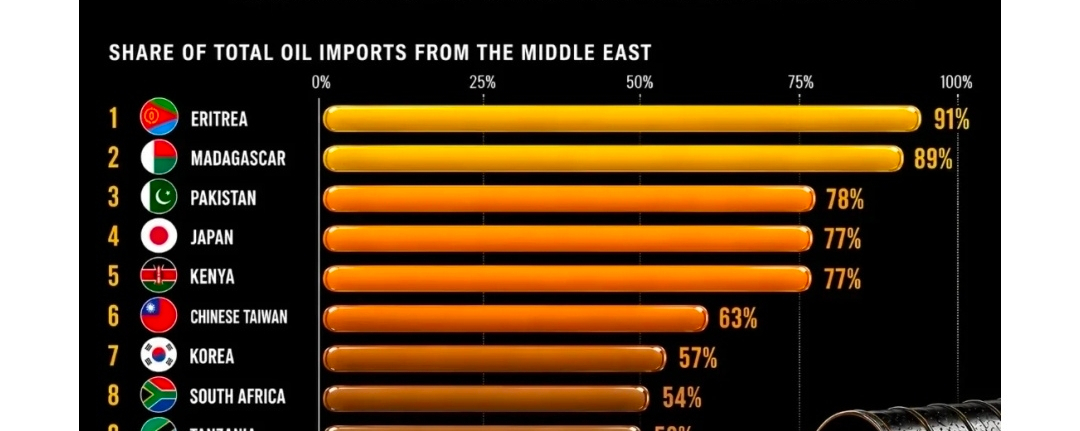
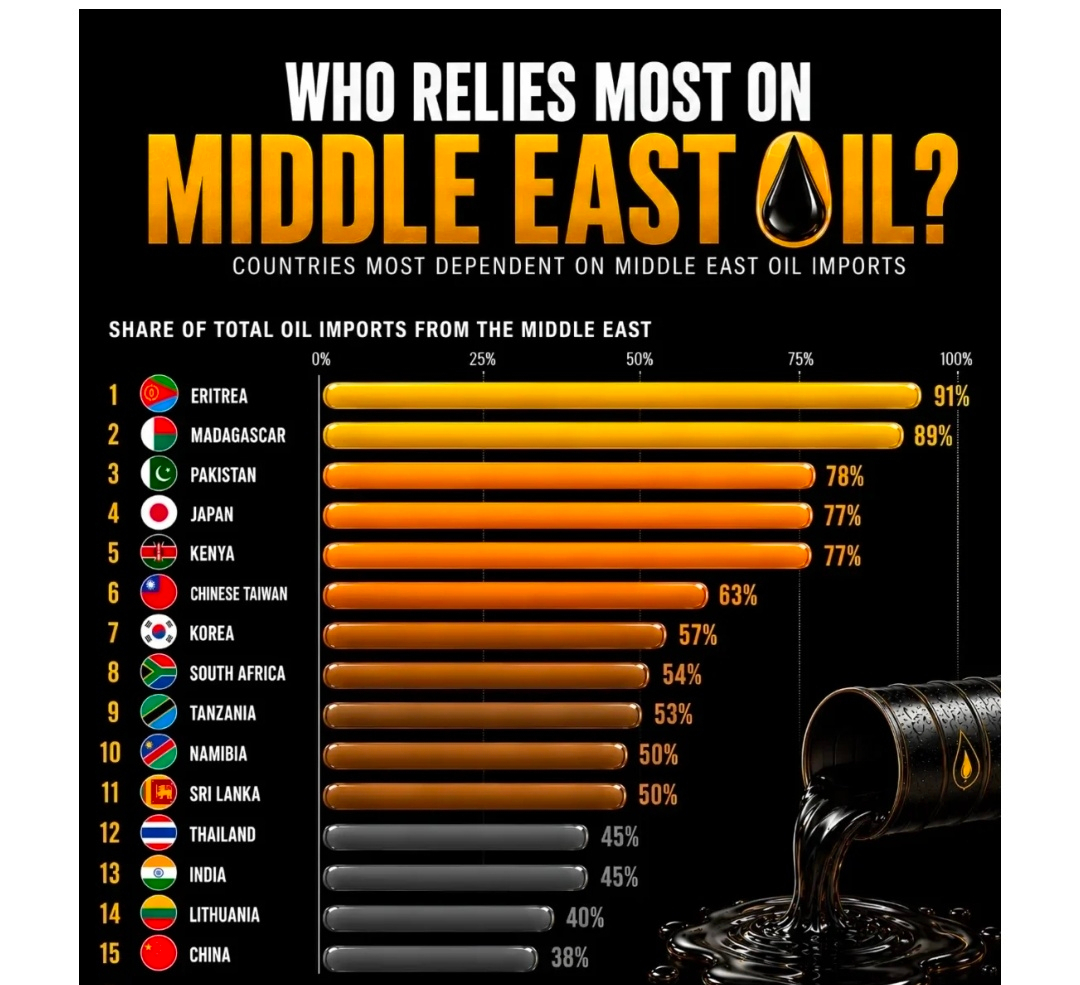
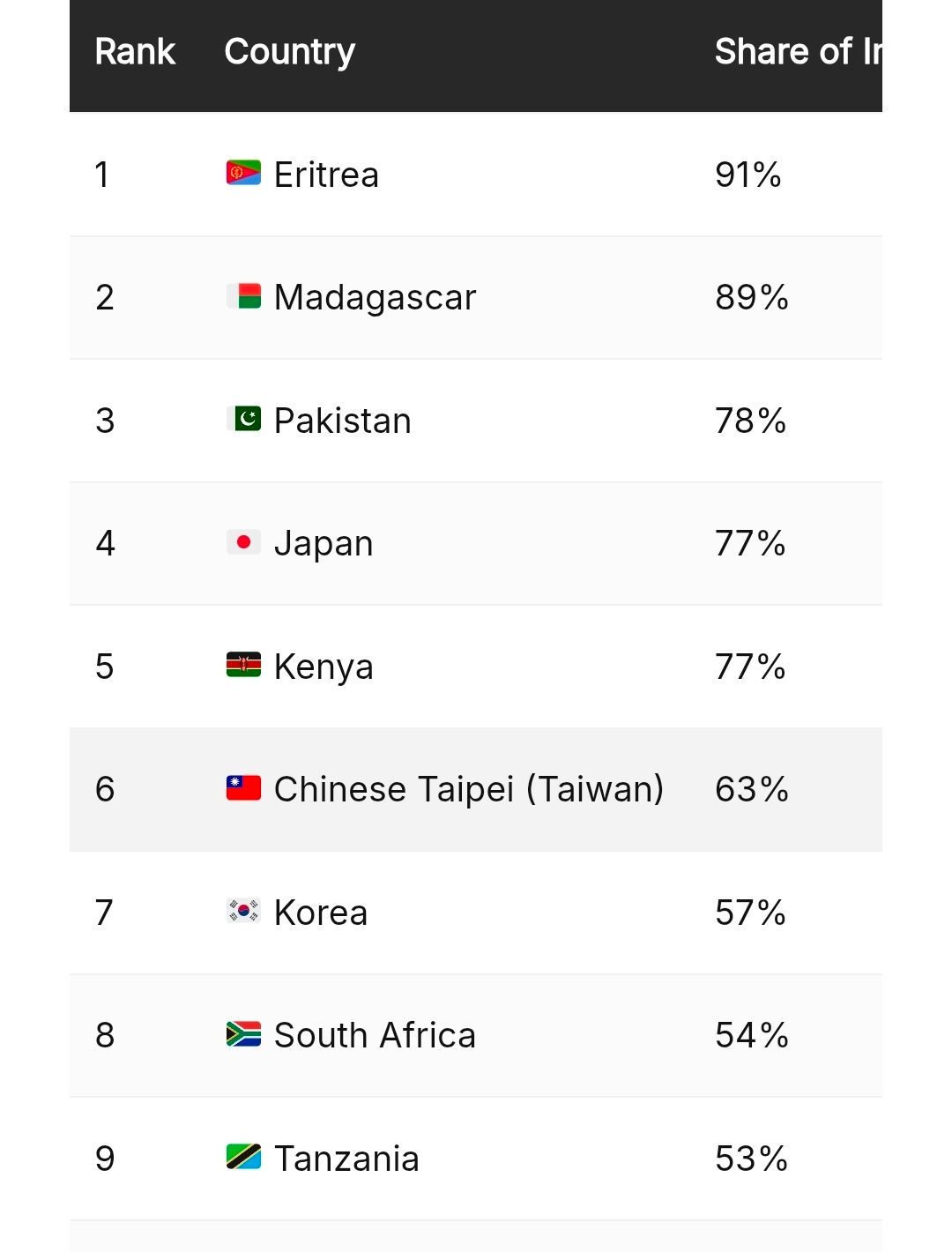
Nine of the fifteen most oil-dependent countries source more than half their entire fuel supply from the Middle East.
The world’s biggest manufacturing economies — Japan, South Korea, Taiwan, and China — run their factories, power grids, and export industries almost entirely on Gulf oil and gas.
🇯🇵Japan
Japan produces virtually no oil or gas of its own. Every barrel of crude it refines, every tanker of liquefied natural gas it burns to generate electricity — 77% of it originates in the Middle East. Saudi Arabia, the UAE, Kuwait, and Qatar are Japan’s energy backbone. Without that supply, Japanese industry does not run.
🇰🇷South Korea &🇹🇼 Taiwan
South Korea and Taiwan are world leaders in semiconductors, steel, electronics, and shipbuilding. All of it runs on energy. Korea sources 57% of its oil and gas from the Middle East. Taiwan is at 63%. The chips powering your phone and laptop were almost certainly made using electricity and fuel that originated in the Gulf.
🇵🇰Pakistan
Pakistan sits at 78%, the highest on the Asia-Pacific side. Unlike Japan or Korea, Pakistan is not a manufacturing giant — but it is a country of over 230 million people with enormous energy needs for heating, cooking, transport, and power generation. Its proximity to the Gulf and limited domestic production make it one of the most dependent nations on the list.
🇮🇳India & 🇨🇳China
Despite their scale and growing domestic energy output, India and China remain deeply tied to the region. India sources 45% of its oil and gas from the Middle East. Saudi Arabia alone is consistently India’s largest single oil supplier. China, despite years of deliberate diversification toward Russia, West Africa, and South America, still sits at 38% — meaning more than a third of the world’s largest energy consumer’s hydrocarbons flow from Gulf fields.