

There is a strange pattern in crypto that keeps repeating itself. We automate everything we can, from trading alerts to portfolio rebalancing, yet most of the decision making still depends on trust. Trust in code. Trust in data. Trust in whoever built the strategy running behind the screen.
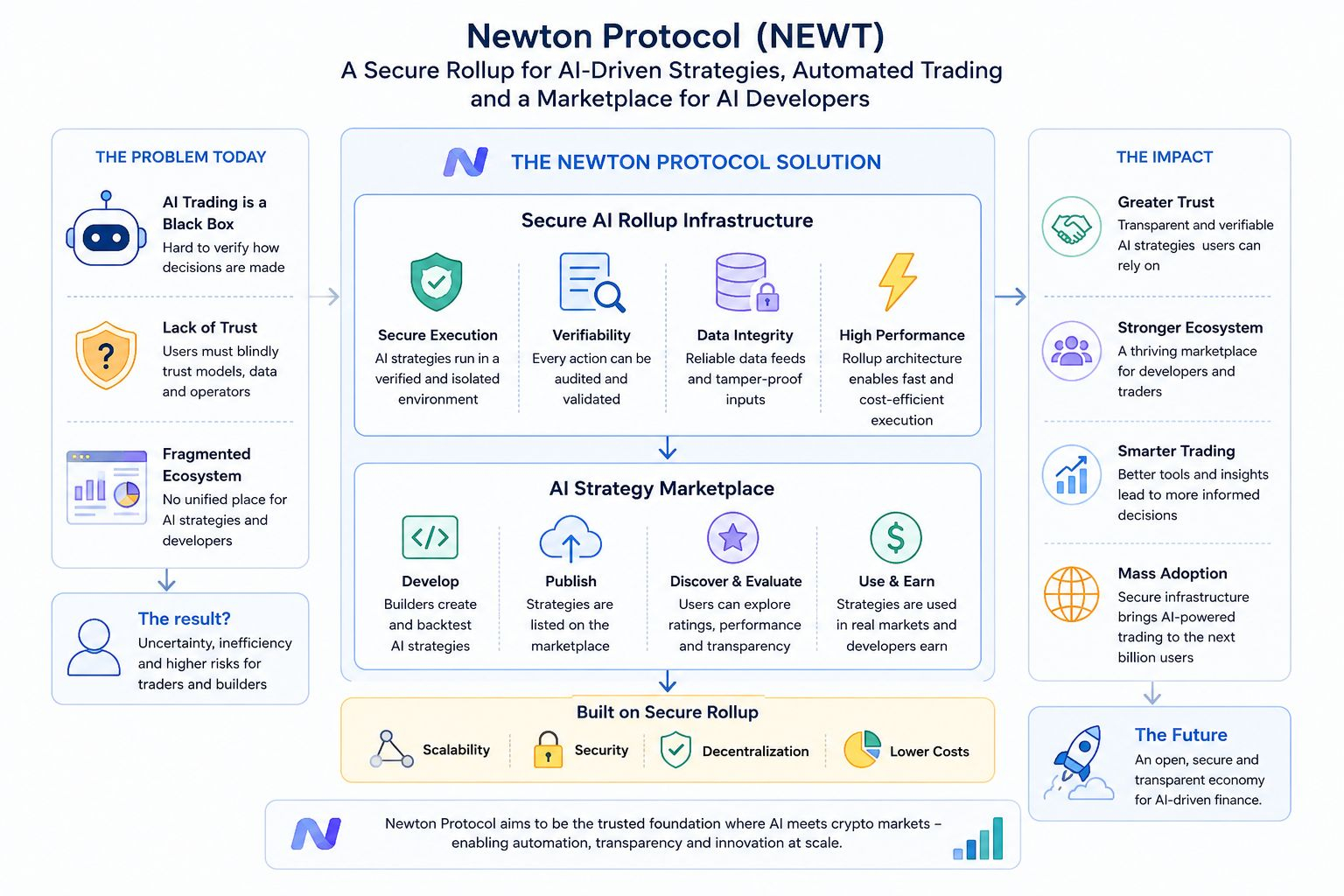
I remember when automated trading bots first became popular among retail users. The promise sounded simple enough. Let the algorithms do the work while you sleep. But after a while, it became obvious that automation without transparency creates its own problems. You know a strategy is generating returns, but you do not really know why. You know an AI model is making decisions, but you cannot easily verify how those decisions were reached.
That tension is partly why Newton Protocol caught my attention.
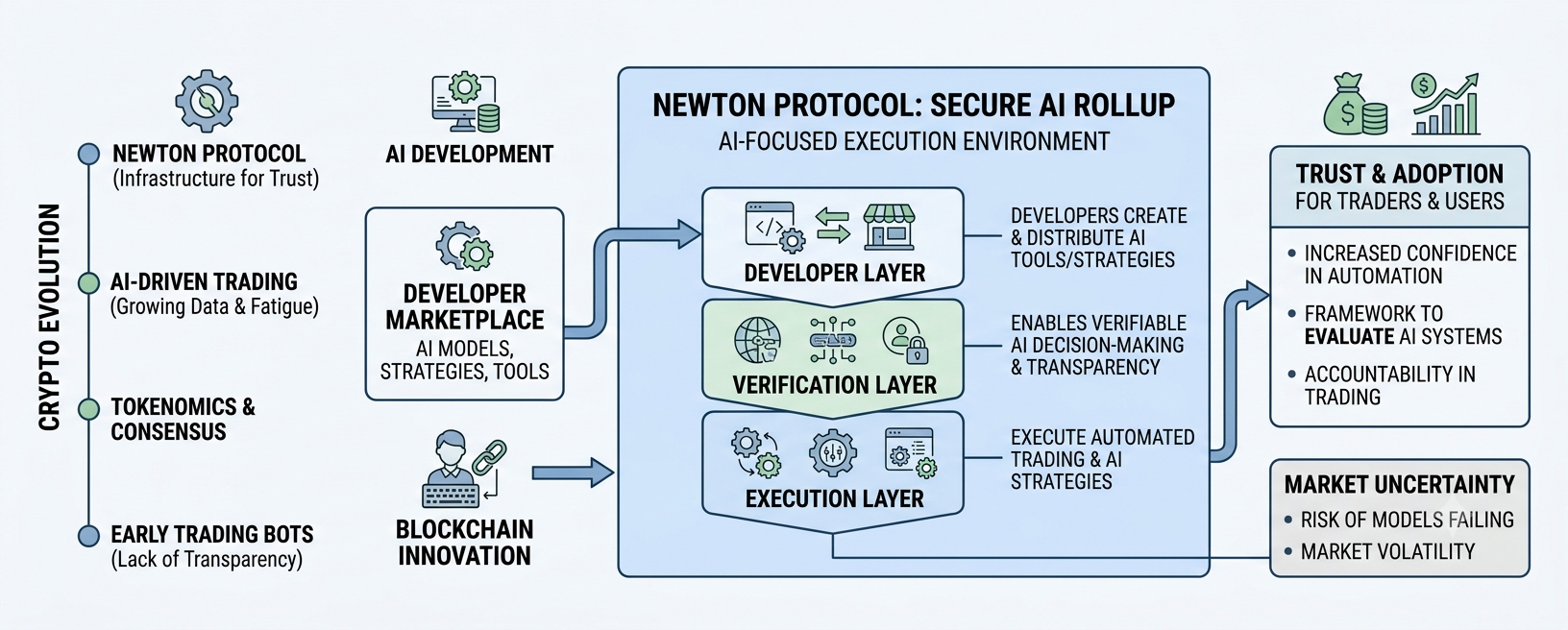
NEWT is positioning itself around a fairly specific idea. Building a secure rollup designed for AI powered strategies, automated trading systems, and an ecosystem where developers can create and distribute AI driven tools. It feels like an attempt to solve a problem that many traders have quietly accepted as normal.
The relationship between AI and crypto has always been interesting to watch. Both industries talk a lot about removing friction and increasing efficiency. Yet they operate under different assumptions. AI models often behave like black boxes. Blockchain networks were built around transparency and verification. Bringing those worlds together sounds appealing, but it also sounds difficult.
Maybe I am overthinking it, but infrastructure often matters more than the applications built on top of it. People usually notice trading interfaces, prediction tools, or autonomous agents. Very few pay attention to the layers underneath that determine whether these systems are actually trustworthy.
Newton Protocol seems to focus on that foundation.
A secure rollup dedicated to AI related activities raises some interesting possibilities. If automated strategies can execute in an environment designed for verification, users might gain more confidence in delegating decisions to machines. That does not eliminate risk. Markets remain unpredictable. Models fail. Assumptions break down. But perhaps transparency can reduce some of the uncertainty surrounding algorithmic decision making.
I have noticed that AI discussions in crypto often swing between two extremes. Either people believe autonomous agents will eventually handle everything, or they dismiss the entire category as another temporary narrative. Reality probably sits somewhere in between.
There is value in tools that save time.
There is also value in understanding what those tools are doing behind the scenes.
The developer marketplace aspect of Newton Protocol is another part that feels worth paying attention to. Over the past few years, we have seen marketplaces emerge for NFTs, data, computing power, and even prediction markets. A dedicated environment where developers can publish and monetize AI strategies feels like a natural extension of that progression.
At the same time, questions remain.
How will quality be evaluated? What mechanisms prevent low quality or misleading models from spreading across the ecosystem? Will traders prioritize transparency over performance if presented with both options? I genuinely do not know.
It felt strange at first seeing crypto discussions evolve from tokenomics and consensus mechanisms toward conversations about model verification and AI execution environments. Yet looking back, perhaps this evolution was inevitable. Financial markets generate enormous amounts of data, and participants are always searching for ways to process information faster than everyone else.
AI simply accelerates that trend.
I also think there is an overlooked psychological aspect here. People often want automation because decision fatigue is real. Watching charts all day is exhausting. Managing multiple positions becomes mentally draining after a while. Delegating certain tasks to algorithms can feel liberating. But giving up control completely remains uncomfortable for many users.
Trust becomes the missing ingredient.
That is where protocols attempting to provide secure infrastructure may find relevance. Not because they guarantee better returns, but because they create frameworks where participants can understand, verify, and evaluate automated systems more effectively.
Of course, building specialized infrastructure is one thing. Attracting developers, users, and meaningful activity is something else entirely. Crypto history is full of technically impressive projects that never reached sustained adoption. Technology alone rarely determines success.
Communities matter. Incentives matter. Timing matters.
I find myself increasingly interested in projects exploring these intersections between AI and blockchain because they touch on questions that extend beyond trading. How much autonomy are we comfortable handing over to algorithms? How do we balance efficiency with accountability? At what point does convenience outweigh transparency?
I do not have clear answers.
What I do know is that AI is becoming more integrated into how people interact with markets, whether they realize it or not. Protocols like Newton are emerging in response to that shift, attempting to provide structure around an area that still feels experimental.
Perhaps that is what makes this space fascinating. We are watching entirely new forms of digital coordination being tested in real time. Some ideas will disappear quietly. Others may become part of the infrastructure people use every day without thinking twice about it.
For now, Newton Protocol feels less like a finished destination and more like an open question. And honestly, those are usually the projects I end up revisiting months later, wondering whether they managed to turn curiosity into something durable.
