

Most crypto projects are trying to move money faster. Newton Protocol is trying to decide whether the money should move at all. That sounds small at first, but it’s actually a huge shift. If blockchain applications are going to handle real capital, real compliance, and real automation, then “execution” alone is not enough. You also need authorization. Newton is building exactly that layer.
At its core, Newton Protocol is an authorization layer for onchain transactions. In simple terms, it sits between transaction intent and final execution, checking rules before anything settles. The official docs describe it as a decentralized policy engine for onchain transaction authorization, built as an EigenLayer AVS, with policies for things like spend limits, sanctions screening, and fraud prevention. Its whitepaper says applications submit transaction intents to a decentralized operator network, which evaluates them against Rego policies and uses sandboxed WASM plugins plus BLS signatures to prove the result.
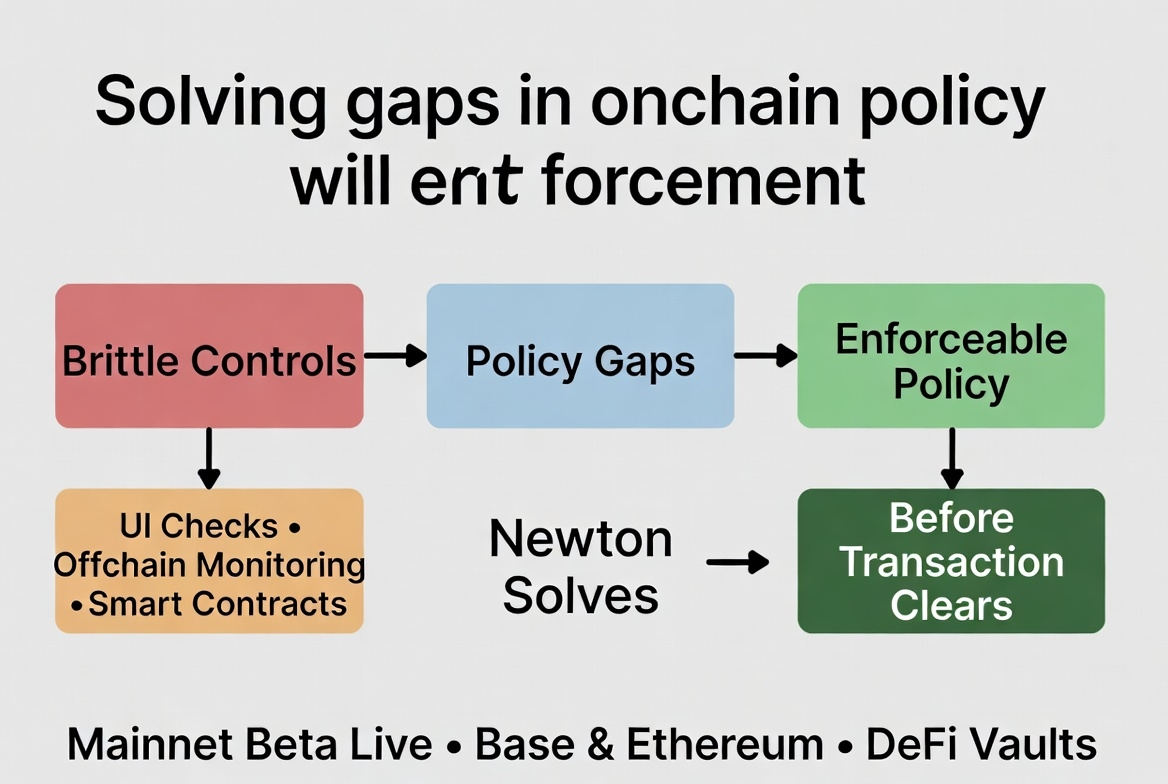
That matters because a lot of onchain systems still rely on brittle controls. UI checks can be bypassed. Offchain monitoring can be too late. Smart contracts alone are powerful, but they are not always the best place to express evolving policy. Newton is trying to solve that gap by making policy enforceable before the transaction clears.
Why is it trending now? Because Newton’s mainnet beta went live on June 23, 2026, and the project said it launched on Base and Ethereum, starting with DeFi vaults. Around the same time, Magic Labs highlighted the integration to more than 200K developers and 50M wallets, which gives the project a very real distribution angle, not just a whitepaper narrative.
My take is this: Newton is not really a “DeFi token story.” It’s closer to infrastructure for trust, and that’s a much bigger narrative if it works. A lot of projects focus on faster execution, cheaper execution, or prettier execution. Newton focuses on governed execution. That’s a very different wedge.
What most people are missing is that policy is becoming a first-class primitive. If agents, vaults, and institutions are going to operate onchain, they need programmable guardrails that can change without redeploying the whole stack. Newton’s own integration write-up says policies can be modular, composable, updatable, verifiable, and credibly neutral. That combination is exactly why the idea feels more durable than a lot of “next meta” coins.
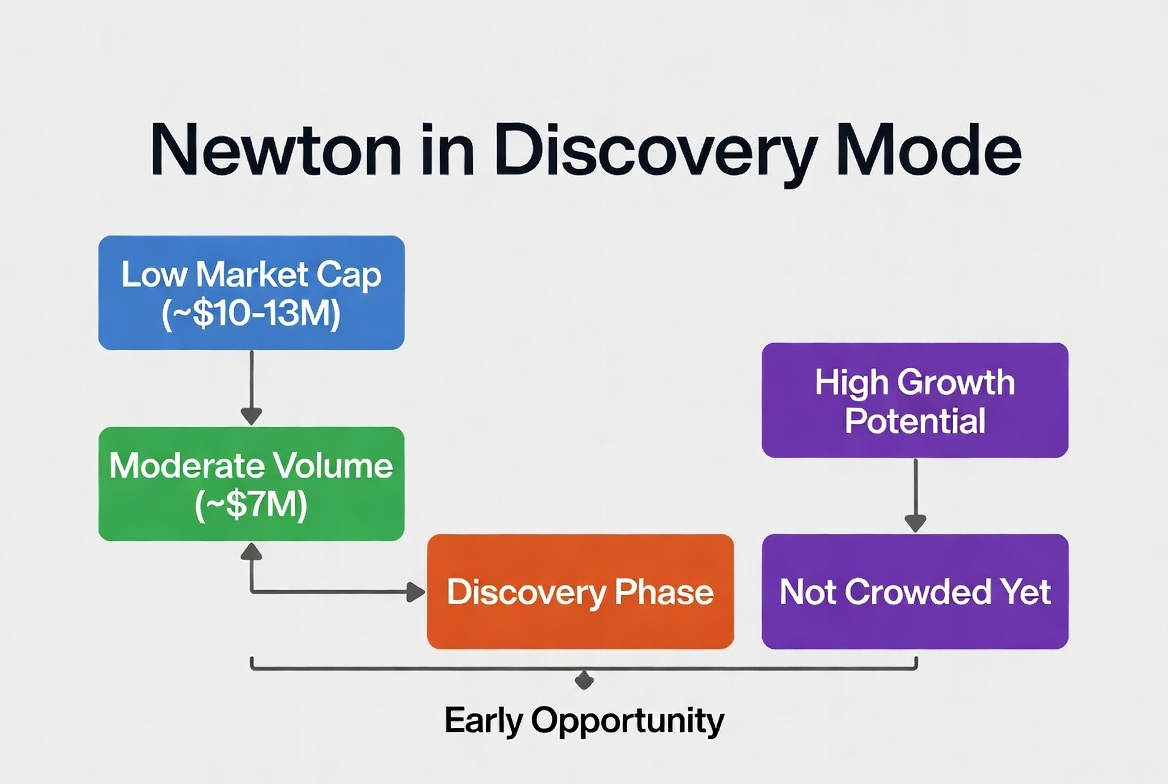
The market is not pricing Newton like a giant yet. CoinMarketCap shows NEWT around $0.047 with roughly $6.96M in 24-hour volume and about $13.2M market cap, while CoinGecko’s historical data around June 30, 2026 shows market cap near $10.48M and daily volume around $7.48M. That tells me this is still in discovery mode, not in crowded “everyone already owns it” mode.
The more interesting proof is narrative alignment. Newton is being framed around stablecoin transfer volume, tokenized RWAs, and annual compliance costs on its own website, which is smart because that’s where real demand lives. If you believe onchain finance keeps growing, then the need for a policy layer should grow with it.
I’m not calling this a blind moonshot. I’d treat Newton as a narrative trade with utility roots. The cleanest setup is usually when a project has a fresh catalyst, a clear category, and enough liquidity to attract attention without already being fully crowded. Newton checks those boxes better than most new launches because it has a live mainnet beta, strong distribution through Magic, and a story that fits current market concerns around security, compliance, and agentic automation.
If the market starts treating “authorization layers” the way it once treated “modular infrastructure” or “AI agent rails,” then NEWT could keep repricing upward in waves. But I’d still watch for confirmation, not just hype. When volume expands while price holds above key support zones, that usually tells you the market is rotating from curiosity into conviction. Right now, the project looks early enough that sentiment can still move it fast in either direction.
I’ve been watching projects in this corner of crypto for a while, and honestly, most of them fail because they try to sound too technical and forget the actual problem. Newton doesn’t feel like that. It feels practical.
I also like that this isn’t just another “AI agent” pitch. I’ve missed enough of those early pumps to know the difference between a slogan and a real product category. Newton feels more like a policy rail than a meme narrative, and that makes it easier for me to take seriously.
The biggest risk is simple: the idea can be good and still fail to get adoption. Authorization layers only matter if developers actually integrate them. There’s also execution risk around cross-chain support, user experience, and whether onchain teams are ready to adopt policy-based systems instead of custom rules.
Regulatory complexity is another double-edged sword. Newton’s value proposition is tied to compliance, but compliance itself changes across jurisdictions. That means the product has to stay flexible without becoming too centralized or too complicated for builders. And like any early-stage token, NEWT can still be volatile even if the thesis is strong.
My bottom line: Newton Protocol is one of the more interesting infrastructure ideas in crypto right now because it solves a problem that gets bigger as the market matures. Execution is easy to sell. Authorization is harder, but maybe far more important.
Do you think the next big blockchain primitive is faster execution, or smarter permissioning?