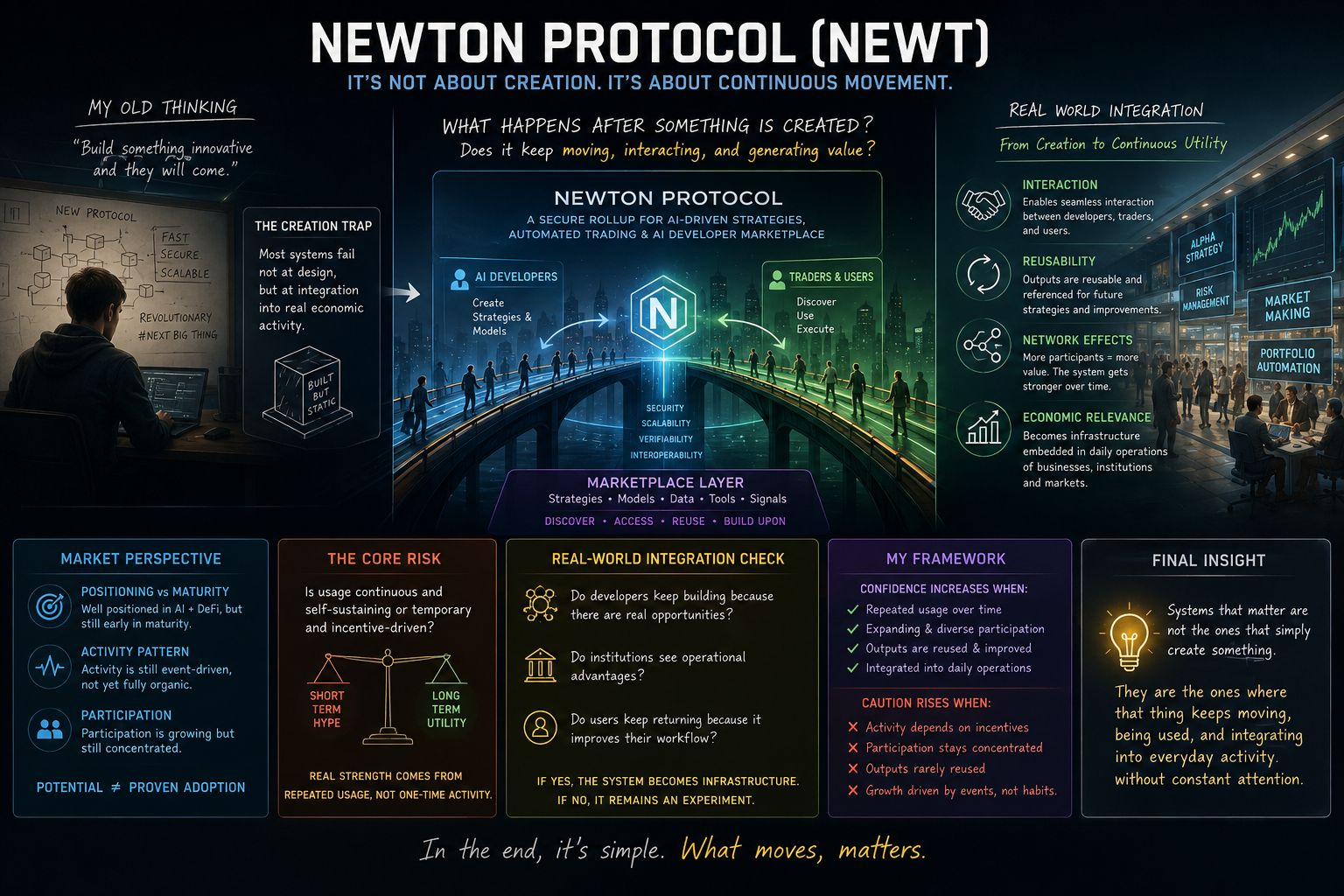
There was a time when I believed that building something impressive was enough. If a project introduced a clever architecture, an ambitious roadmap, or a convincing vision, I assumed the hard part was already done. Oh, it felt logical back then. Create a better system, launch it, attract attention, and everything else would naturally follow. But the more I watched different technologies come and go, the more I realized that I had been focusing on the beginning of the story instead of what came after.
That shift changed the way I look at projects like Newton Protocol (NEWT). I no longer start by asking what a protocol claims to build. Instead, I ask a much simpler question that turns out to be much harder to answer. Okay, what happens after something is created?
That question sounds almost too simple, yet it separates interesting ideas from lasting infrastructure.
Think about a road. Nobody builds a road because concrete is valuable by itself. The road matters because people keep traveling across it every day. Goods move, businesses operate, communities grow, and over time the road becomes part of everyday life. If nobody uses it, then even the most perfectly engineered highway is just expensive concrete.
I have started viewing digital systems the same way.
The gap between creation and usage is where most projects quietly struggle. Designing a protocol is one challenge. Making it part of real economic activity is a completely different one. That is where excitement fades and reality begins.
Looking at Newton Protocol through that lens makes the conversation much more practical. The idea is not simply to create another blockchain network. It aims to establish a secure rollup for AI-driven strategies, automated trading, and a marketplace where AI developers can build, share, and interact. Yeah, those ideas sound ambitious, but ambition alone has never guaranteed relevance.
What interests me more is how the structure is supposed to keep participants interacting instead of operating in isolation.
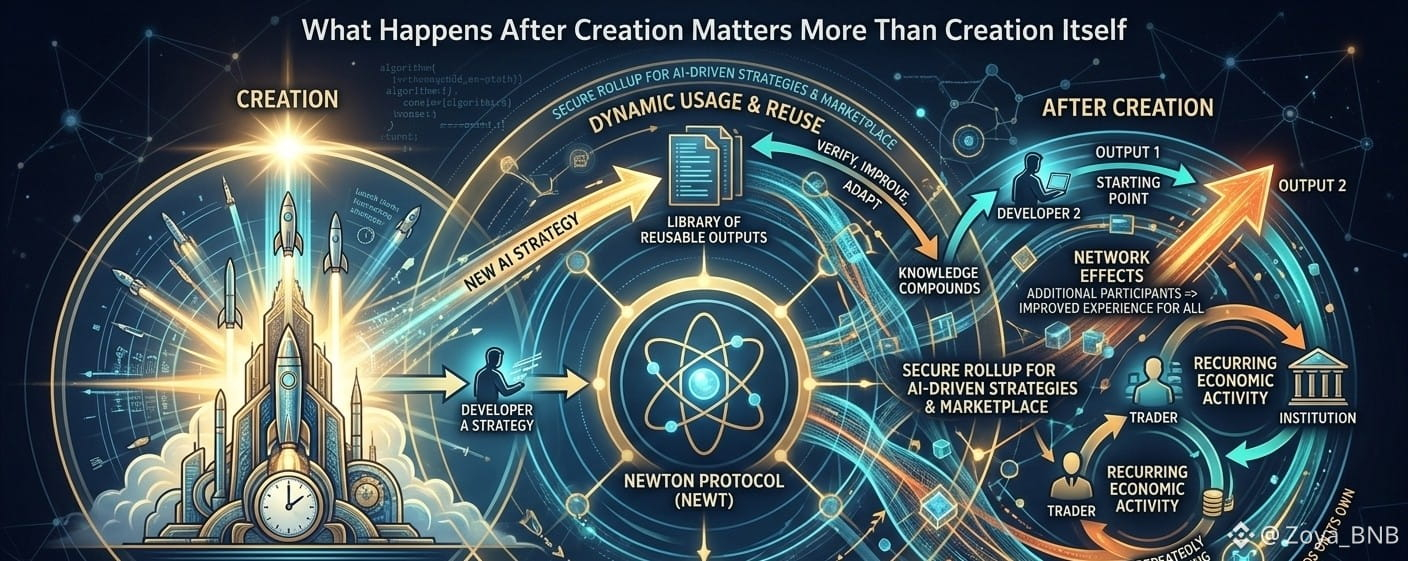
If developers create AI strategies that other users can access, improve, or build upon, then the output does not disappear after creation. It continues moving through the system. One person's work becomes another person's starting point. Instead of every participant rebuilding everything from scratch, previous work becomes reusable. That reminds me less of selling a finished product and more of adding another book to a growing library. Every new book increases the value of the library because future readers have more to learn from.
That continuous reuse is where network effects begin to appear.
A marketplace without participants is simply a website. A marketplace where developers, traders, and users repeatedly exchange ideas, strategies, and services becomes something much more valuable. Every additional participant has the potential to improve the experience for everyone else. The network grows because interaction itself creates value, not because people are temporarily rewarded to show up.
That distinction matters more than I used to think.
I also find myself asking whether outputs inside Newton Protocol can become references for future activity rather than isolated transactions. If an AI strategy performs well, can others verify it, improve it, adapt it, or combine it with different tools? If the answer is yes, then knowledge compounds instead of resetting with every new participant. Systems become stronger when information keeps circulating instead of constantly being recreated.
This is also where the broader economic question becomes interesting.
Can Newton Protocol become infrastructure rather than simply another application?
Infrastructure usually becomes invisible. Businesses stop thinking about electricity every minute because they simply expect it to work. Companies rely on payment systems without constantly discussing the technology underneath. Markets depend on logistics networks without celebrating every delivery truck. The strongest infrastructure quietly supports everyday activity.
That is the standard I increasingly compare projects against.
Right now, I think Newton Protocol occupies an interesting position. Its vision touches several growing areas at once, including AI, automation, and decentralized coordination. From a positioning perspective, that places it in a relevant conversation. But positioning is not the same thing as maturity.
A project can sit in the right market while still proving very little.
That is why I try to separate potential from demonstrated adoption.
Potential comes from architecture, partnerships, and technical design. Proven adoption comes from consistent usage that continues long after announcements disappear from social media. They are completely different things.
I also pay attention to the pattern of activity.
Is participation steady because people genuinely depend on the system, or does activity mainly appear around launches, incentives, and promotional events? Those two patterns often look similar for short periods, but over time they become very different stories.
Another question I keep asking is whether participation continues expanding or remains concentrated among a relatively small group of early contributors. Real infrastructure usually broadens its user base over time because different groups discover independent reasons to keep using it. If growth depends on the same limited participants, then the network may be growing in numbers without truly expanding in function.
For me, the biggest risk is not whether Newton Protocol works technically. The bigger uncertainty is whether usage becomes continuous and self-sustaining or whether it depends on temporary incentives. History has shown that people will interact with almost any platform while rewards are flowing. The real test begins after those rewards become less important.
That is when genuine utility has to stand on its own.
If developers continue building because the marketplace creates real opportunities, if institutions discover operational advantages, if automated strategies solve practical problems, and if users repeatedly return because the system genuinely improves their workflow, then confidence naturally grows. Not because someone promised adoption, but because behavior demonstrates it.
On the other hand, I become cautious if activity slows every time incentives disappear, if outputs rarely get reused, if developers stop contributing, or if the network depends more on marketing than on recurring participation. Those signals suggest that attention is supporting the system more than utility is.
So my framework has become much simpler than it used to be.
My confidence increases when I see repeated usage, expanding participation, reusable outputs, and integration into everyday operations across developers, businesses, institutions, or markets. I become more cautious when growth depends on events instead of habits, when activity remains concentrated, or when value stops circulating after creation.
In the end, I keep coming back to the same thought. Systems that truly matter are rarely the ones that simply create something. They are the ones where what gets created keeps moving, keeps being used, keeps being referenced, and quietly becomes part of everyday economic activity without constantly demanding attention. That, more than any headline or announcement, is what tells me a system is becoming real.