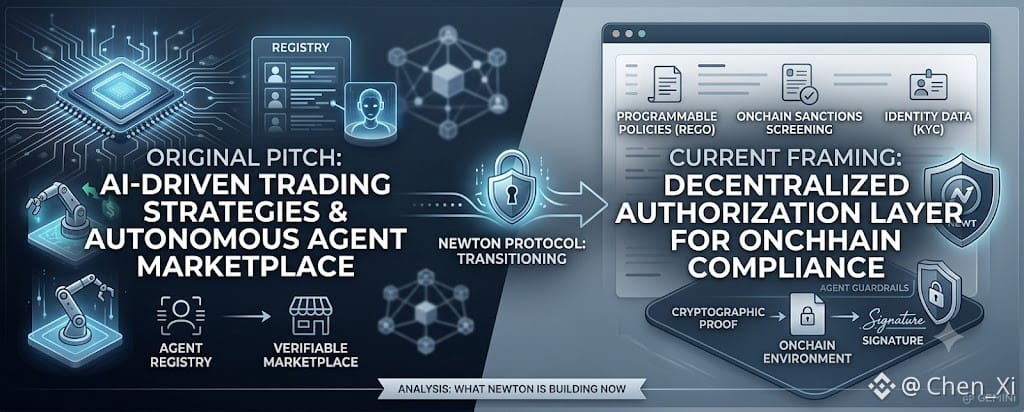
#Newt $NEWT @NewtonProtocol A few months ago, if you searched for Newton Protocol, you would have landed on a fairly clear pitch: a dedicated rollup for AI-driven trading strategies, a registry where developers could publish autonomous agents, and a marketplace meant to turn "set it and forget it" finance into something verifiable onchain. Go searching for the same project today, and the language has shifted. Newton now describes itself primarily as a decentralized authorization layer for onchain compliance. Same token, same core team, a noticeably different framing.
That kind of repositioning is common in crypto, but it is rarely explained well to the people holding the token or reading about it for the first time. So rather than treating Newton as a static product with a fixed feature list, it's worth looking at it as a project in transition — what it originally set out to do, what problem it has settled on solving, and where AI agents still fit into that picture.
The Original Pitch: Automation You Don't Have to Trust Blindly
Newton Protocol came out of Magic Labs, the team behind one of the more widely used embedded-wallet products in Web3, reportedly powering wallets for tens of millions of end users across consumer apps. The founding idea was straightforward: DeFi automation — recurring trades, portfolio rebalancing, yield strategies — mostly runs on centralized bots or offchain scripts today. Users either give up custody to a third party or babysit their positions manually. Newton's answer was a system of "agent models," published to an onchain registry, that could execute predefined logic ("only trade if volatility exceeds X") without taking direct control of a user's funds. A specialized rollup, the Newton Keystore, was designed to manage the permissions and cryptographic proofs that made those actions auditable rather than blind trust exercises.
It's a reasonable problem to tackle. Automation is genuinely useful, and the gap between "convenient" and "trustless" in DeFi tooling has held back adoption from more risk-conscious users and institutions alike.
Where the Project Landed: Compliance as the Bigger Bottleneck
Building out that vision, Newton's team seems to have run into a related but distinct obstacle: institutions and regulated asset issuers weren't primarily blocked by a lack of automation tools — they were blocked by the absence of a verifiable, programmable way to enforce compliance rules onchain. Sanctions screening, KYC checks, jurisdictional restrictions, spending limits — all of this still happens mostly offchain today, through manual review or hardcoded logic baked into individual smart contracts, which makes updates slow and inconsistent across applications.
Newton's current architecture is built around this idea instead. Developers write "policies" in Rego, a declarative policy language already used in cloud infrastructure, that define rules for what a transaction is allowed to do. Those policies get published to a shared registry rather than rebuilt by every application from scratch. A decentralized network of operators, secured through Ethereum restaking via EigenLayer, evaluates transactions against the relevant policy inside trusted execution environments, then produces a cryptographic proof and a quorum signature confirming the check was done correctly. The result is what Newton calls an "authorization receipt" — a record that a transaction passed (or failed) a specific compliance rule, without exposing the underlying personal data onchain.
One detail worth paying attention to: Newton has started integrating identity data providers like Persona directly into this policy engine, so jurisdictional or age-based restrictions can be checked at the transaction level using verified attributes, rather than relying on self-reported information at the application layer.
Where AI Agents Still Show Up
The automation thread hasn't disappeared — it's just become one use case among several rather than the headline. In Newton's current framing, AI agents are one of the categories that need "guardrails": the same policy engine that checks a stablecoin transfer for sanctions exposure can also be used to cap how much an autonomous agent is allowed to spend, restrict which addresses it can pay, or block it from acting outside an approved region. That's a narrower role than the original "marketplace for AI developers" pitch, but arguably a more defensible one — agent safety is a real and growing concern as more wallets start delegating transaction signing to automated systems.
NEWT's Role and the Open Questions
NEWT remains a fixed-supply token (1 billion units, no inflationary issuance) used for staking by network operators, fee payments for policy evaluation, and governance over protocol parameters. Based on publicly available tokenomics disclosures, a large share of supply was still locked as of early 2026, with vesting schedules for early backers and the core team unlocking gradually — a dynamic that has reportedly weighed on price action around scheduled unlock dates.
The bigger open question isn't really about the token mechanics, though — it's about positioning risk. Pivoting from "AI trading infrastructure" to "compliance infrastructure" is a meaningful narrative change for a project that built its early community around the former. Compliance-as-code is also a competitive space; policy engines exist in cloud-native infrastructure already, and Newton's bet is that crypto-native composability and restaking-based security give it an edge specific to onchain use cases. Whether institutions, stablecoin issuers, and RWA platforms actually adopt a third-party compliance layer at scale — versus building proprietary tooling — remains unproven. Validator and operator decentralization is also still early in its rollout, which carries the usual execution risk of any infrastructure project moving from foundation-led development toward a more distributed network.
A Balanced Takeaway
From a pure technology standpoint, separating policy evaluation from the smart contract itself, and backing that evaluation with restaked economic security and zero-knowledge proofs, is a reasonably elegant answer to a real problem: onchain compliance today is fragmented and largely unverifiable. What's less settled is demand — whether the institutions Newton is courting will actually route transaction authorization through a shared, decentralized layer rather than keeping it in-house. That adoption curve, more than any single feature release, is probably the thing worth watching over the next few quarters.
As always, this is a fast-moving project, and anyone interested should check Newton's own documentation and transparency reports for the most current architecture details and token data rather than relying on any single secondary source.
A few questions worth sitting with: Does a "neutral" compliance layer for crypto actually stay neutral once regulators and large institutions start shaping which policies get adopted as defaults? Is bundling AI-agent guardrails with institutional KYC/sanctions tooling a natural fit, or two different problems sharing infrastructure for convenience? And if Newton's compliance pitch succeeds, does that quietly raise the bar for what counts as "permissionless" DeFi going forward?#newt #NEWT #DFI #Onchain