

Some technologies arrive with a loud promise, asking the world to believe before they have earned trust. Others begin with a quieter question: what if our digital systems could become reliable enough that people no longer had to think about whether they were being manipulated, exploited, or left behind? That question is what drew my attention to Newton Protocol. It is not simply another blockchain project chasing the next market cycle. It feels more like an attempt to redesign the foundations upon which intelligent digital economies will eventually stand.
Artificial intelligence is becoming remarkably capable. Every week, new models write code, analyze markets, generate research, and automate tasks that once demanded hours of human effort. Yet AI still operates inside a fragmented world. It can make decisions, but proving those decisions happened fairly remains difficult. It can execute strategies, but users often surrender control to centralized services. It can optimize processes, but transparency is frequently sacrificed for convenience. The smarter our software becomes, the more important trust becomes. Intelligence without accountability is simply another form of uncertainty.
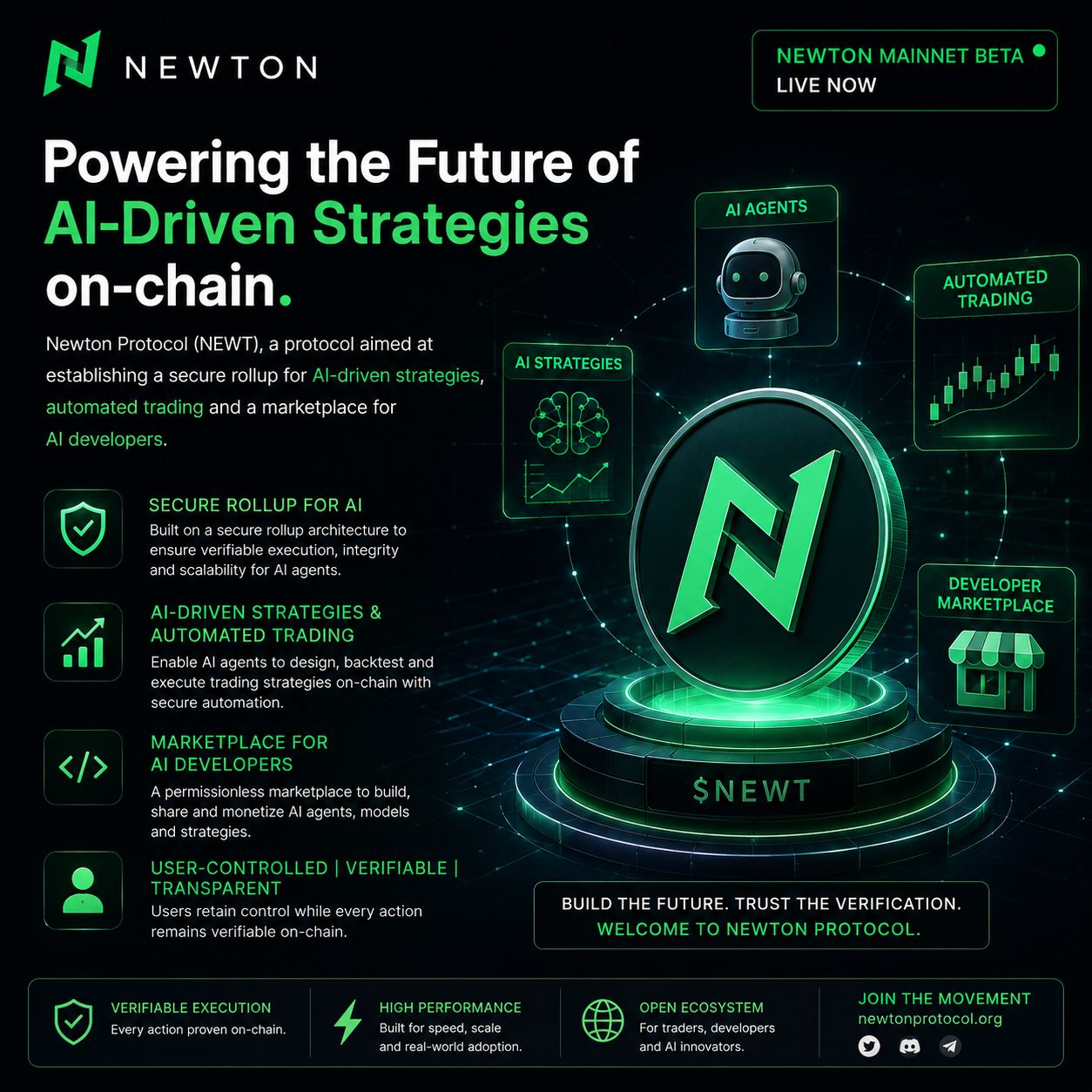
That is where Newton Protocol introduces an idea that feels increasingly relevant. Instead of treating blockchain as merely a ledger for transactions, it treats it as the trust layer for autonomous intelligence. Imagine a modern city. Roads allow movement, electricity powers activity, and laws create order so millions of people can cooperate without personally knowing one another. Newton Protocol aims to become that invisible infrastructure for AI agents. Rather than asking users to blindly trust algorithms, it creates an environment where important actions can be verified, permissions remain under user control, and automation can operate with transparent rules instead of hidden assumptions.
Its architecture reflects this philosophy. A secure rollup is more than a scaling technique; it is a way of balancing efficiency with verifiability. Transactions and computational work can happen at high speed while ultimately inheriting the security guarantees of the broader blockchain ecosystem. This matters because AI-driven strategies demand responsiveness. Whether an agent is executing automated trading logic, coordinating digital assets, or interacting with decentralized applications, delays and uncertainty quickly become expensive. Newton Protocol attempts to create an environment where speed does not require sacrificing integrity.
Equally compelling is the vision of an open marketplace for AI developers. Today, many of the world's most powerful AI systems exist behind corporate walls, accessible only through centralized platforms that dictate the rules of participation. Newton Protocol imagines something different: a permissionless ecosystem where developers can create intelligent agents, publish them, improve them collaboratively, and allow users to interact with them in transparent ways. Instead of intelligence becoming concentrated inside a handful of organizations, it can evolve through an open network where innovation is shared, verified, and continuously refined.
This shift reminds me of the early internet. At first, only a small number of organizations possessed the infrastructure necessary to publish information online. Then open standards transformed the web into a place where anyone with an idea could contribute. We often celebrate the applications that emerged, but the real revolution was the infrastructure that made participation possible. Newton Protocol appears to be pursuing a similar transition for autonomous software. It is not merely asking what AI can accomplish; it is asking who gets to build it, who controls it, and how everyone can verify what it is doing.
The arrival of the Newton Mainnet Beta represents more than a technical milestone. It marks the point where vision begins to meet reality. Developers can experiment, communities can contribute, and ideas can be tested in a living ecosystem rather than in theory alone. Every successful protocol has reached a moment where its architecture stopped being a concept and became something people could rely on. This is where meaningful ecosystems begin to grow.
Of course, no blockchain project should be viewed through the lens of certainty. Long-term success depends on execution, resilience, developer adoption, and a community willing to build through both optimism and adversity. The strongest networks are not those that generate the loudest headlines but those that consistently solve real problems over time.
Perhaps that is why Newton Protocol deserves attention. It recognizes that the future of blockchain is no longer just about moving digital assets from one wallet to another. It is about creating an environment where autonomous intelligence can operate responsibly, transparently, and securely. As AI becomes woven into everyday life, trust may become the most valuable resource of all. If Newton Protocol succeeds in making trust programmable, verifiable, and accessible, it will have contributed something far more enduring than another cryptocurrency. It will have helped build the invisible foundation on which the next generation of digital innovation can confidently stand. @NewtonProtocol #Newt $NEWT
