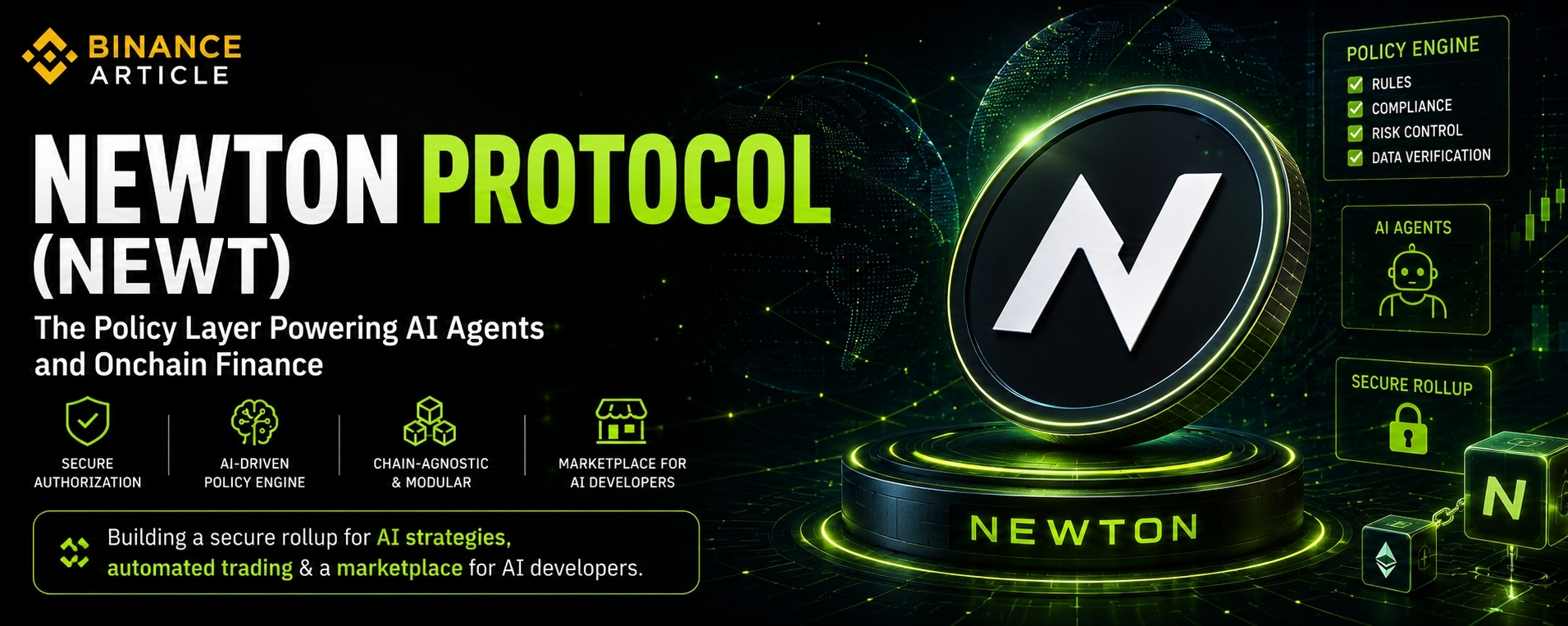
I’ve seen plenty of “AI + crypto” pitches, and most of them blur together after a while. Newton Protocol was one of the few that made me slow down, because it is not just talking about AI agents in the abstract. It is trying to put a policy layer in front of onchain actions, so transactions are checked before they execute instead of after something goes wrong. That idea felt more practical to me than the usual buzzword-heavy AI narrative. According to Newton’s own docs, the protocol is built as a decentralized policy engine for onchain transaction authorization, and the team says it can enforce things like spend limits, sanctions screening, fraud prevention, and compliance rules directly in smart contracts.
What caught my attention is the problem Newton is aiming at. Smart contracts are powerful, but they do not naturally understand offchain context like KYC status, sanctions lists, identity checks, market feeds, or whether an AI agent is about to do something reckless. Newton’s docs say that gap is exactly what they want to close, using a decentralized operator network and offchain data that gets evaluated before settlement. The project also says it is modular and chain-agnostic, with support for most EVM chains and a roadmap for non-EVM support. That matters because a policy layer only becomes useful if it can actually sit where real volume flows.
I also like that Newton is not pretending this is only for one niche. On the official site, the team points to DeFi vaults, RWAs, stablecoins, and agentic finance as main use cases. In plain English, that means they want to help builders control who can interact with assets, what rules apply, and what autonomous agents are allowed to do. The site even calls out policy examples like investor eligibility, transfer restrictions, sanctions screening, velocity limits, spending caps, and approved payees. That is the sort of stuff institutions care about, and it is also the sort of stuff retail users usually only think about after things go wrong.
The token side is where I spent extra time. NEWT is the native token, and the official token post says it has four main jobs: staking for protocol security, gas and fees, payments for the Newton Model Registry, and governance. I usually like token designs better when utility is tied to actual usage, not just “governance later.” Newton’s setup feels more concrete than that. If builders really use the model registry and if AI-agent transactions really need permissioning, then token demand has a clearer path than in a lot of project launches I’ve seen. The same post says the total supply is fixed at 1 billion NEWT, with 215 million circulating at launch, and that community allocations make up 60% of supply while internal allocations make up 40%.
That said, I do not ignore the unlock side. Newton’s own token post says the ecosystem, growth, and treasury allocations vest over 48 months with 20% unlocked at launch, while core contributors, early backers, and Magic Labs have a 36-month vesting period with a 12-month lockup. That is not a red flag by itself, but it does mean supply pressure is part of the story. In crypto, a good thesis can still struggle if the market is dealing with too many unlocks before real adoption shows up. For me, that is one of the main things to watch here.
The team side looks more serious than average too. Newton says it is built by Magic Labs, and the foundation says Magic Labs invented embedded wallet technology and has created over 50 million non-custodial wallets, with a large developer base around its products. The foundation also says it formed in October 2024 and that the NEWT token is issued by Magic Newton Foundry Ltd. I think that background matters because infrastructure projects often live or die on whether the team can actually ship integrations and keep builders around after the initial hype fades.
Adoption is still early, but I do see signs that they are trying to build something real rather than just write a whitepaper. Newton’s blog says mainnet beta went live on June 23, 2026, and that Newton is live on Base and Ethereum. The same blog family shows integrations around identity and data guardrails, including Persona, Human Passport, Neynar, Veriff, Etherscan, and Massive treasury yield data. To me, that suggests the team is trying to make policy enforcement work with actual onchain workflows instead of staying stuck in theory.
When I compare Newton to other crypto projects, I do not think of it as a normal L1 or a meme token. It feels closer to policy infrastructure for onchain finance, which puts it in a tougher but more interesting category. Its real competition is probably not “another AI coin,” but anything that solves compliance, identity, transaction guardrails, or safe automation for wallets and vaults. That can be a strong position if the market starts valuing practical rails over narrative, but it also means the project has to prove itself with builders, integrations, and live usage.
As for the market side, NEWT is still a small project in market-cap terms. Current trackers show it trading around five cents with a market cap near $10 million, and CoinGecko ranks it around the low 1100s by market cap at the moment. I would not read that as “cheap” or “undervalued” by itself. To me it just says the market is still pricing in a lot of uncertainty around adoption, token unlocks, and whether the protocol becomes a real standard for permissioned onchain activity.
My honest read is simple: Newton is one of those projects I respect more for the problem it is trying to solve than for any immediate price narrative. The idea of verifiable onchain authorization is genuinely useful if they can make it easy for protocols, vaults, and agents to use. The risks are just as real though: adoption has to follow, competition will be ugly, and unlocks can keep pressure on the token before the product is fully proven. Right now, I’m mostly watching whether more teams actually plug into Newton, whether the policy layer gets real traction on Base and Ethereum, and whether the token utility starts matching the product story.
#AzerbaijanDraftsVirtualAssetBillRequiringCentralBankLicense
#AAVERises13.16%To$94.32 #DowHitsRecordClose #SamsungSKHynixSharesRiseYTD