
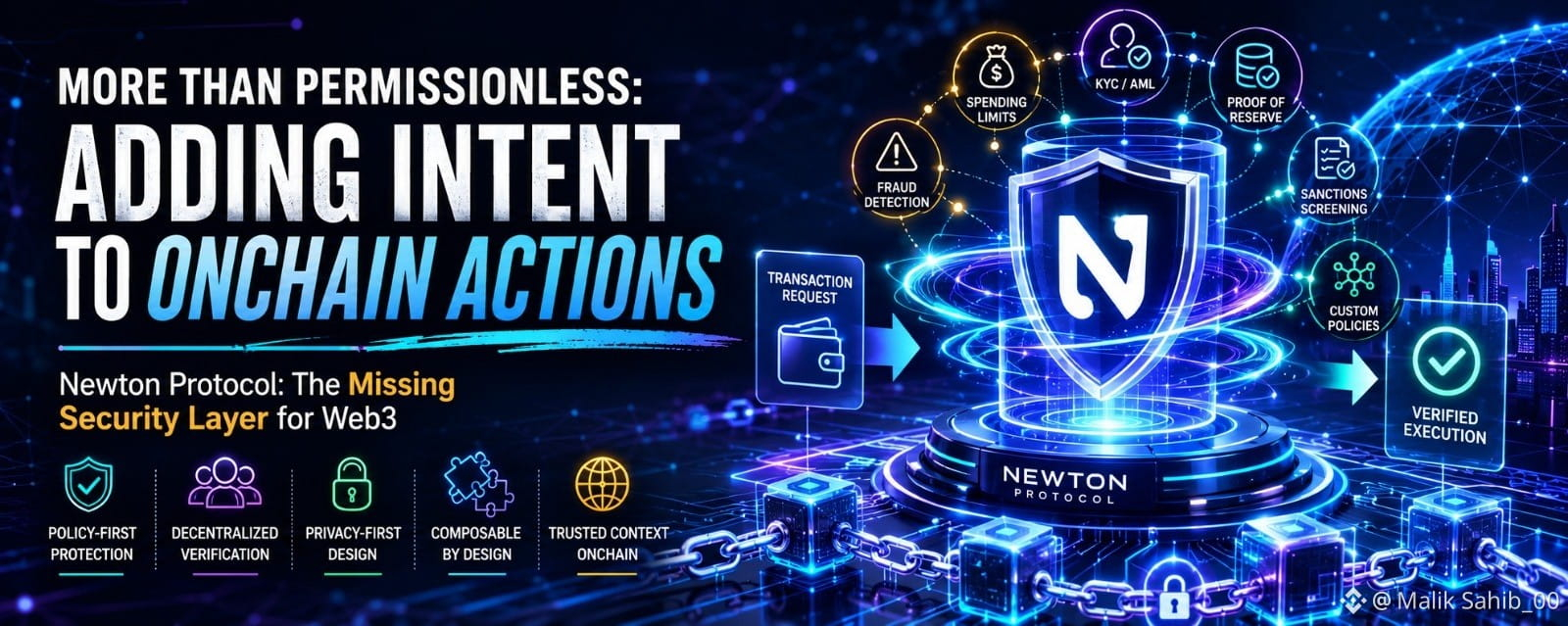
One conversation with a developer friend made me rethink what "permissionless" should really mean.
He was building an application that allowed automated agents to manage onchain assets. The contracts worked perfectly during testing, but he kept asking himself one question: "How do I stop an authorized agent from making an authorized mistake?"
The blockchain could verify signatures.
The smart contract could verify balances.
But neither could verify intent.
That challenge led me to explore Newton Protocol, and I found its approach surprisingly practical.
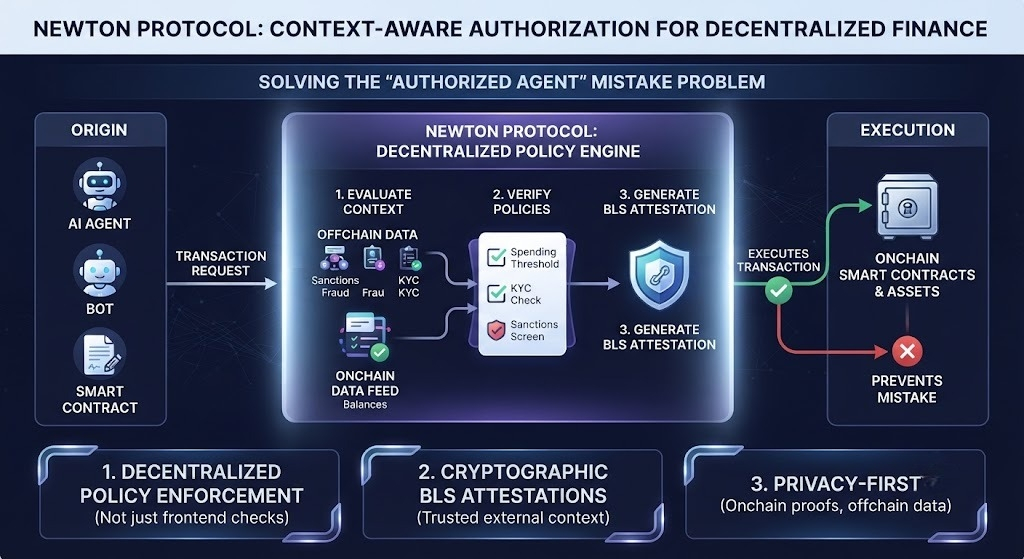
Newton acts as a decentralized policy engine sitting between a transaction request and its execution. Instead of assuming every valid transaction deserves to settle, it checks whether predefined policies approve the action first. Those policies can include spending thresholds, sanctions screening, fraud detection, proof-of-reserve verification, KYC status, or any external condition required by the application.
What makes this interesting is that these aren't simple frontend checks that disappear when someone interacts directly with a contract. The policies are enforced at the smart contract level, meaning the protection remains regardless of whether the transaction comes from a wallet, aggregator, bot, AI agent, or another protocol.
I believe this solves one of the biggest challenges facing modern decentralized finance. As applications increasingly depend on real-world information, they need a reliable way to bring trusted offchain context into immutable onchain logic.
Newton achieves this through decentralized operators that evaluate external information and return cryptographic BLS attestations. The contract doesn't need blind trust in an oracle or centralized company, it verifies mathematical proof that policy evaluation has occurred before allowing execution.
Another feature I admire is composability. Security shouldn't isolate protocols; it should integrate naturally with wallets, dApps, AI systems, and enterprise applications. Newton's standardized architecture makes policy enforcement feel like another programmable building block rather than an obstacle to innovation.
Equally important is its privacy-first philosophy. Sensitive user information doesn't need to become permanent blockchain data. Only cryptographic commitments and proofs are stored onchain, allowing applications to satisfy security and compliance goals without exposing confidential information.
As blockchain expands into institutional finance, autonomous AI, and large-scale digital commerce, simple transaction validation won't be enough. Networks will need context-aware authorization that remains decentralized, transparent, and independently verifiable.
After learning more about Newton Protocol, I've started seeing it less as another infrastructure project and more as a missing security layer. Smart contracts have become incredibly powerful over the years. Giving them the ability to understand trusted external context before executing may be one of the next major milestones in building safer, more intelligent decentralized systems.
