
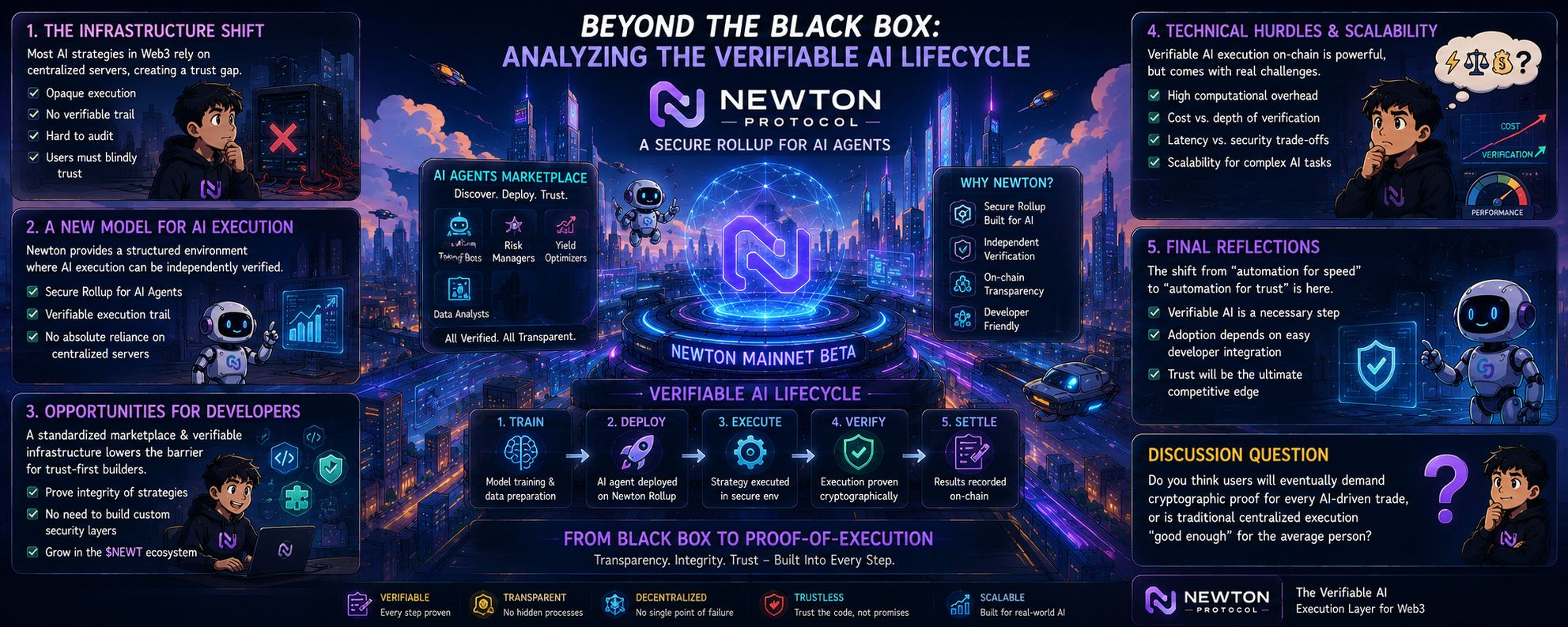

The Infrastructure Shift
From what I've seen in the current Web3 landscape, most AI-driven strategies still rely on centralized servers. This can create a trust gap for users who want greater visibility into how AI decisions are executed. One aspect that stood out to me while looking into @NewtonProtocol is their focus on a secure rollup specifically designed for AI agents.
A New Model for AI Execution
Reading through the documentation, the goal of the Newton Mainnet Beta appears to be moving toward a model where more aspects of AI execution may become independently verifiable. To me, this may represent a meaningful shift from the absolute reliance on centralized servers that we see in most current AI workflows. By providing a structured environment, the protocol aims to offer a verifiable trail for how a strategy was actually carried out.
Opportunities for Developers
Based on the project overview, one interesting possibility could be helping establish more consistent approaches to verifiable AI through a standardized marketplace. For developers, this could provide a way to prove the integrity of their work without needing to build custom security layers from scratch. This shift could potentially lower the barrier for $NEWT ecosystem builders who prioritize trust as much as performance.
Technical Hurdles and Scalability
However, I find myself questioning the practical scalability of such systems. One possible challenge I keep coming back to is the computational overhead. Providing verifiable records for AI execution on-chain is a heavy lift. From the information shared so far, the trade-off between the depth of verification and the cost of execution is a balance that the industry is still learning to navigate.
Final Reflections
From what I understand, the transition toward verifiable AI infrastructure is a cautious but necessary step. Whether the Newton Mainnet Beta sees broad adoption likely depends on how easily developers can adapt to these new verification requirements. It’s an interesting shift from "automation for the sake of speed" to "automation for the sake of trust."
Discussion Question:
Do you think users will eventually demand cryptographic proof for every AI-driven trade, or is traditional centralized execution "good enough" for the average person?