
Newton Protocol is one of those projects that makes you pause for a second, not because it is obviously revolutionary, but because it sits in a part of crypto that actually has a chance of mattering if the execution is real. And that already separates it from a lot of the noise. I have read enough whitepapers by now to know how this usually goes. The pitch starts clean, the architecture looks elegant on paper, the AI narrative gets layered on top, and somewhere between the token launch and the first market cycle, the whole thing either turns into a speculative wrapper or quietly disappears into the archive of “interesting ideas that never quite became infrastructure.”
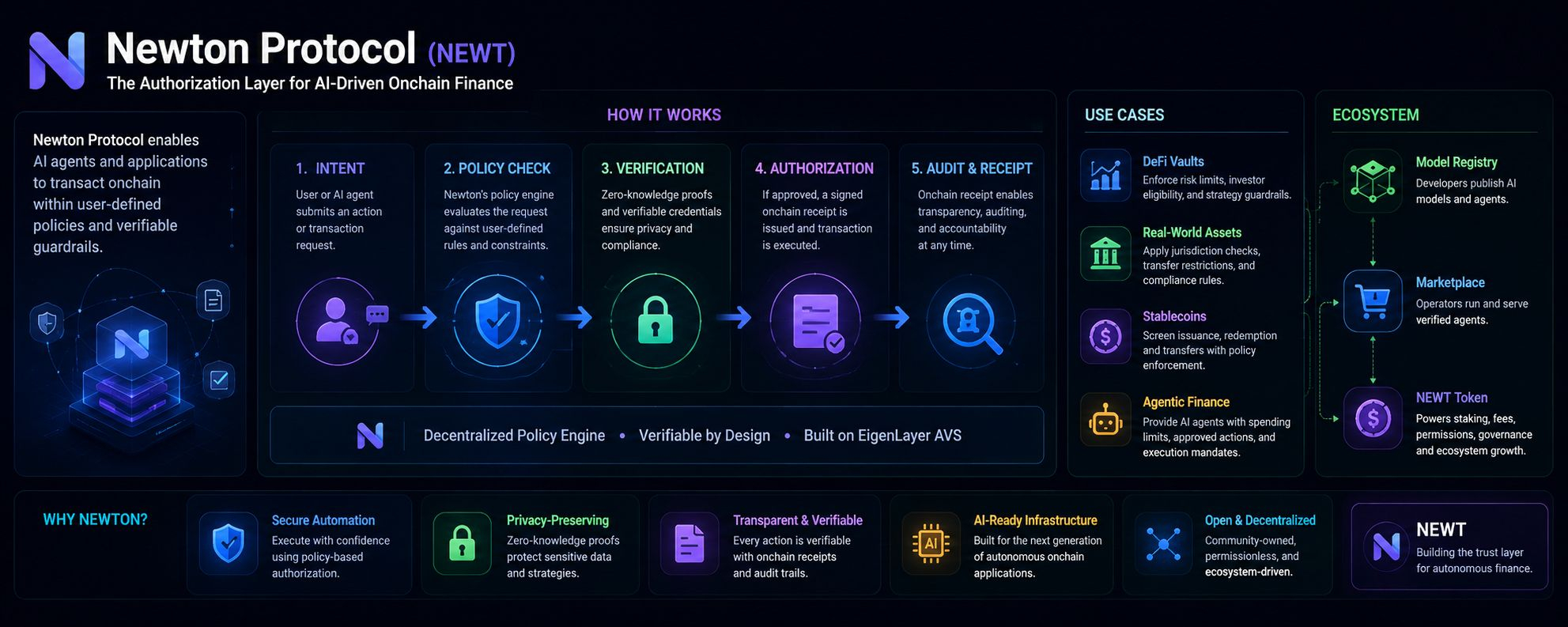
Newton is trying to avoid that fate by focusing on authorization, policy enforcement, and verifiable automation rather than just saying “AI will trade better than humans.” That part is at least more grounded. The project frames itself as an authorization layer for onchain transactions, which means it is not pretending that agents should run wild across DeFi with unlimited freedom. Instead, it is trying to define the rules before anything moves. A transaction only happens if it fits the policy. That sounds simple, almost boring, but in crypto, boring can sometimes be the sign that someone actually understands the problem.
What makes me mildly interested, even after reading far too many similar proposals, is that Newton seems to be targeting a very real tension in onchain finance. Everyone wants automation. Nobody wants uncontrolled automation. Everyone wants AI agents. Nobody wants an AI agent draining a vault because a prompt was interpreted too creatively. So the real question becomes: can you build a system that lets software act on behalf of users while still keeping the users meaningfully in control? That is the lane Newton is trying to occupy. And to be fair, that is a much more serious question than the usual “AI x crypto” branding exercise.
The architecture appears to reflect that seriousness, at least in intent. Newton talks about policies, transaction receipts, verifiable credentials, and zero-knowledge proofs. In other words, it is trying to turn automation into something auditable rather than opaque. That matters because once financial actions become delegated to agents, the problem is no longer just execution. The problem is trust. Who approved this? Under what conditions? Can anyone verify it later? If the answer is vague, then the system may be clever, but it is not ready for anything important. Newton seems to understand that, which is more than I can say for a lot of projects that confuse complexity with credibility.
The use cases are where the pitch becomes a little easier to digest. DeFi vaults, stablecoins, real-world assets, agentic finance — these are not new categories, and that is both good and bad. Good, because they are real and useful. Bad, because every cycle brings a new crop of projects claiming to “solve” them with fresh terminology and a slightly different stack. Still, Newton’s angle is not just to participate in these verticals, but to enforce policy inside them. A vault should be able to enforce eligibility rules, risk limits, and depeg protection. A stablecoin flow should be screened. RWAs should respect jurisdictional restrictions. Agents should not be allowed to drift outside approved boundaries just because they were given a wallet and a vague objective.
That sounds reasonable. Maybe even overdue.
There is also the token side, which I always approach with a certain amount of exhaustion, because the token often reveals whether a project is building infrastructure or just trying to package speculation in a cleaner wrapper. In Newton’s case, NEWT is described as serving staking, fees, permission management, registry functions, and governance. That is at least structurally coherent. A token tied to actual protocol behavior is a lot easier to take seriously than one that exists mainly to fill a column in the tokenomics chart. Still, I have learned not to overreact to elegant token design. Plenty of bad projects have had beautiful token models. The real test is whether the token does anything useful once the market stops being generous.
One thing I do appreciate is that Newton does not seem to be pretending that trustless systems can magically become riskless. That would be a ridiculous claim, and crypto has made enough of those already. Instead, it seems to be proposing a layer where automation is constrained, documented, and measurable. That is a more mature idea. Not glamorous, not easy to hype in one sentence, but probably closer to what institutions and serious builders actually want if they are going to touch AI-driven onchain systems at all.
The marketplace and model registry angle is also worth noting, even if I am not ready to overstate it. A protocol becomes more interesting when it creates a place for others to build, publish, and serve models or agents. That is how an idea moves from “product” to “ecosystem,” and crypto loves to talk about ecosystems even when they do not exist. Newton at least seems to understand that an automation layer is only useful if other people can plug into it without rebuilding the whole stack from scratch. Whether that happens in practice is another matter entirely.
So where does that leave Newton Protocol? Somewhere between “actually thoughtful” and “needs to prove it.” Which, honestly, is a better place than most projects get to occupy. It is not solving a magical new problem. It is trying to bring discipline to a space that keeps reinventing ways to be fragile. And maybe that is enough. Maybe the real value here is not some grand thesis about AI agents taking over finance. Maybe it is simpler than that: making delegated onchain activity less chaotic, more visible, and harder to abuse.
After enough whitepapers, you start noticing which projects are trying to impress you and which ones are trying to function. Newton gives off more of the second kind of energy. Still early, still unproven, still carrying all the usual crypto baggage, but at least the thing it is aiming at feels real. And in this market, after this many cycles, that already counts for something.