
I m watching a subtle shift in blockchain infrastructure. For years, most innovation focused on making transactions faster cheaper or more scalable. But as autonomous software and AI agents become capable of controlling wallets, managing treasuries, and interacting across protocols another question is becoming harder to ignore: who decides whether an action should happen before it reaches the blockchain?
That appears to be the problem Newton Protocol is trying to address.
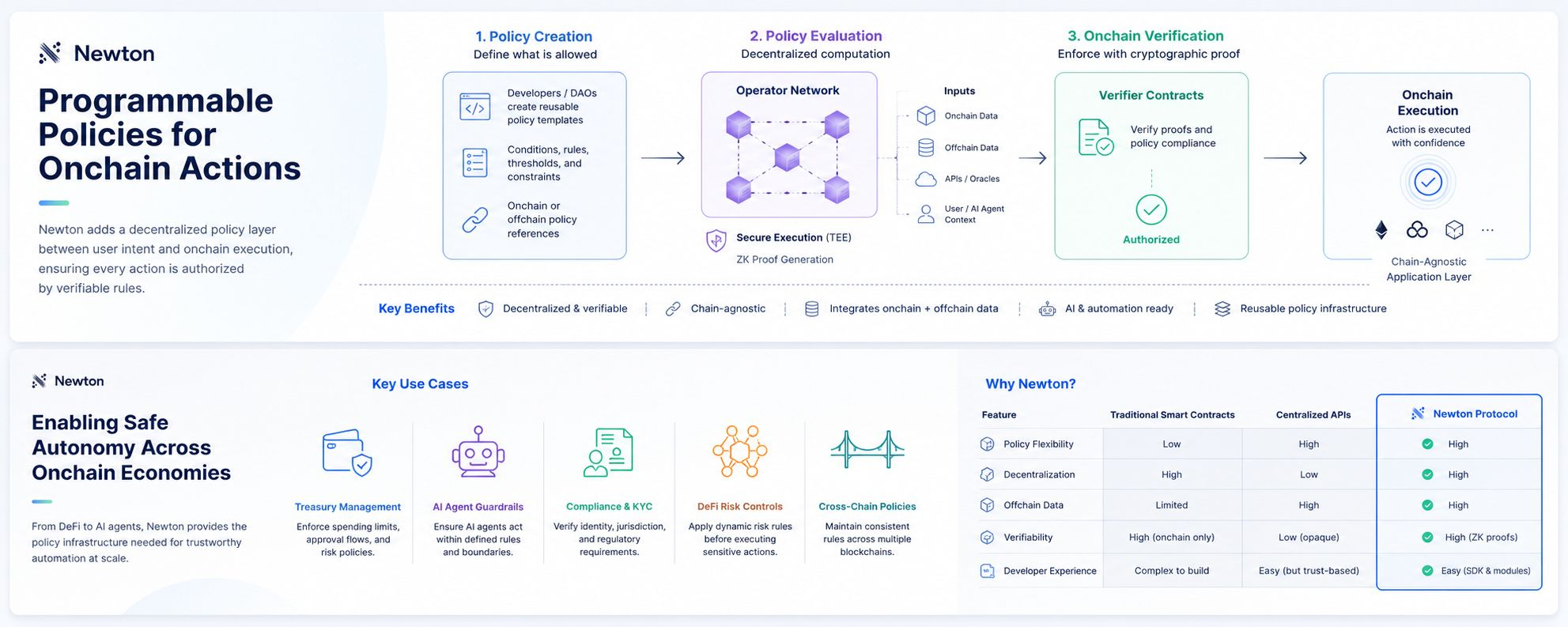
Most blockchains assume that if a transaction satisfies a smart contract's logic it should execute. This model works well for deterministic code but becomes more challenging when decisions depend on identity organizational policies regulatory requirements or trusted offchain information. Rather than redesigning blockchain execution itself Newton introduces a programmable policy layer that evaluates whether predefined conditions have been met before an action is authorized.
This distinction is more important than it may initially seem.
Instead of embedding authorization logic into every application Newton separates the system into three parts. Developers define reusable policies a decentralized network evaluates those policies using approved onchain and offchain inputs and verifier contracts enforce the result onchain through cryptographic proofs. This architecture allows policy rules to evolve independently from application logic potentially making complex authorization easier to manage across different ecosystems.
One area where this design becomes particularly relevant is autonomous AI. If software agents are eventually trusted to execute financial decisions onchain, the challenge is no longer simply automation. The challenge is ensuring those agents remain within clearly defined boundaries. Spending limits, governance requirements compliance rules or organizational approvals can become programmable conditions rather than manual operational processes. Newton treats these guardrails as part of transaction authorization instead of relying solely on application level restrictions.
For developers this creates a different way of thinking about infrastructure. Rather than rebuilding similar security and policy mechanisms for every protocol applications can reference standardized policies through Newton's verification framework. Whether this becomes widely adopted will depend less on the technology itself and more on whether developers view shared policy infrastructure as preferable to maintaining their own authorization systems.
The approach also introduces tradeoffs.
Newton performs much of its policy evaluation offchain before submitting verifiable proofs onchain. This improves flexibility and allows integration with external information but it also increases dependence on operator networks trusted execution environments cryptographic attestation and data integrity. While these mechanisms are designed to reduce trust assumptions they also make the overall architecture more complex than traditional smart contract execution.
Adoption presents another important uncertainty. A policy engine becomes valuable only if applications agree on common standards for authorization. Different ecosystems may continue building their own frameworks limiting interoperability despite Newton's chain agnostic design. Likewise, policy requirements vary across industries and jurisdictions making universal policy libraries difficult to standardize.
The most useful way to evaluate Newton is not by asking whether it is another Layer 1 AI protocol, or infrastructure project. A better question is whether blockchain applications increasingly need verifiable decision making before execution, not just verifiable execution itself.
If autonomous onchain economies continue to grow, that capability could become foundational infrastructure that operates quietly beneath the applications people use every day. If demand for programmable authorization remains limited Newton may instead represent an elegant technical solution to a problem that evolves more slowly than expected.
That is ultimately the question worth following not whether Newton is technically impressive but whether the future of onchain systems requires verifiable policies as much as it requires verifiable transactions.
