
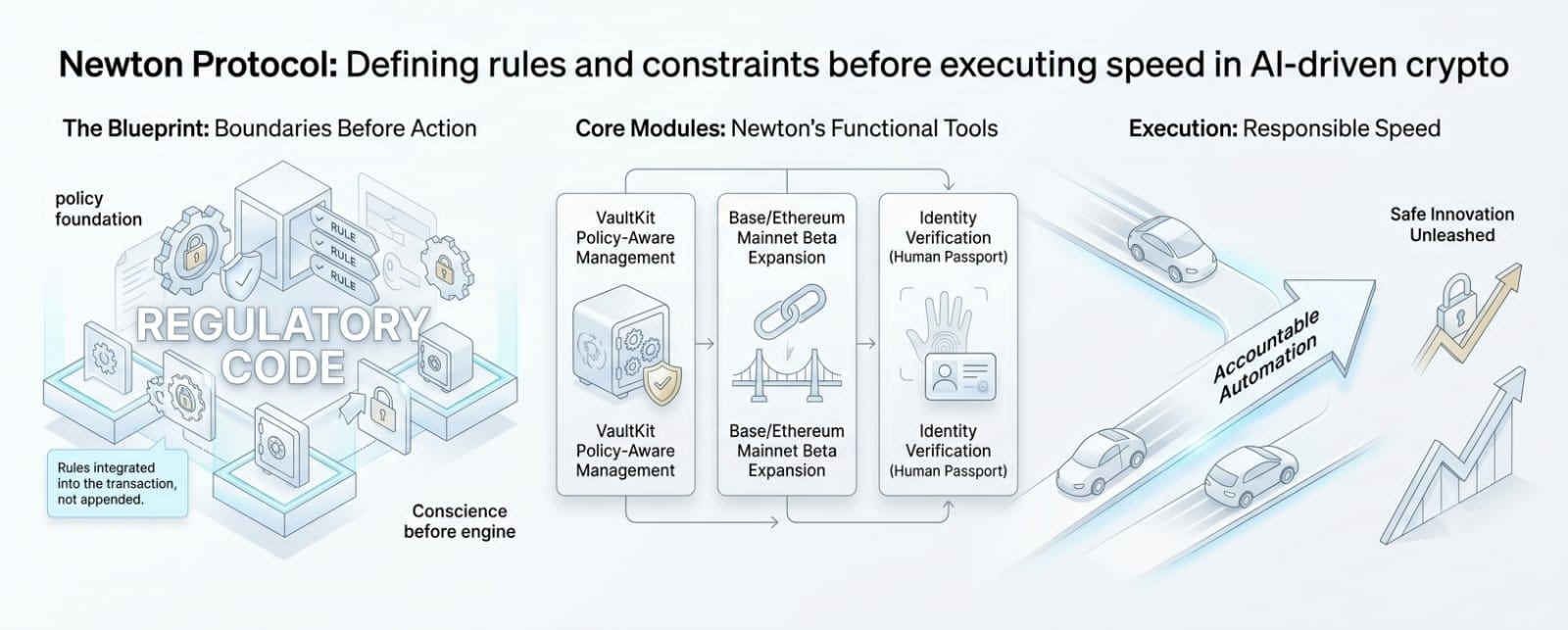
$NEWT When people talk about AI in crypto, the conversation usually revolves around speed. Newton Protocol made me think about something different: what happens before that speed is unleashed? A system can execute thousands of decisions in seconds, but if those decisions have no boundaries, speed becomes a weakness instead of a strength.
That is the idea I see behind Newton. Instead of treating compliance and security as boxes to tick after a transaction happens, it tries to weave those rules into the transaction itself. I like to think of it as giving autonomous systems a conscience rather than just a faster engine. The goal isn't to slow innovation down—it is to make every action accountable from the moment it begins.
The project's recent progress reflects that direction. Its mainnet beta has expanded onto Base and Ethereum, while VaultKit introduces policy-aware vault management instead of leaving control entirely to external applications. Newton has also been connecting with identity and verification solutions such as Human Passport, allowing developers to combine automation with proof of humanity and programmable trust. These updates suggest the team is focused on building practical infrastructure instead of chasing attention.
What stands out to me is that Newton is approaching AI from a less obvious angle. Many projects compete to make machines smarter, while Newton appears to be asking a quieter but more important question: how do you make those machines responsible for the decisions they make? That shift in thinking could matter far more than simply making automation faster.
The biggest strength of Newton isn't that it enables AI—it is that it is trying to make autonomous finance operate with rules before it operates with speed.