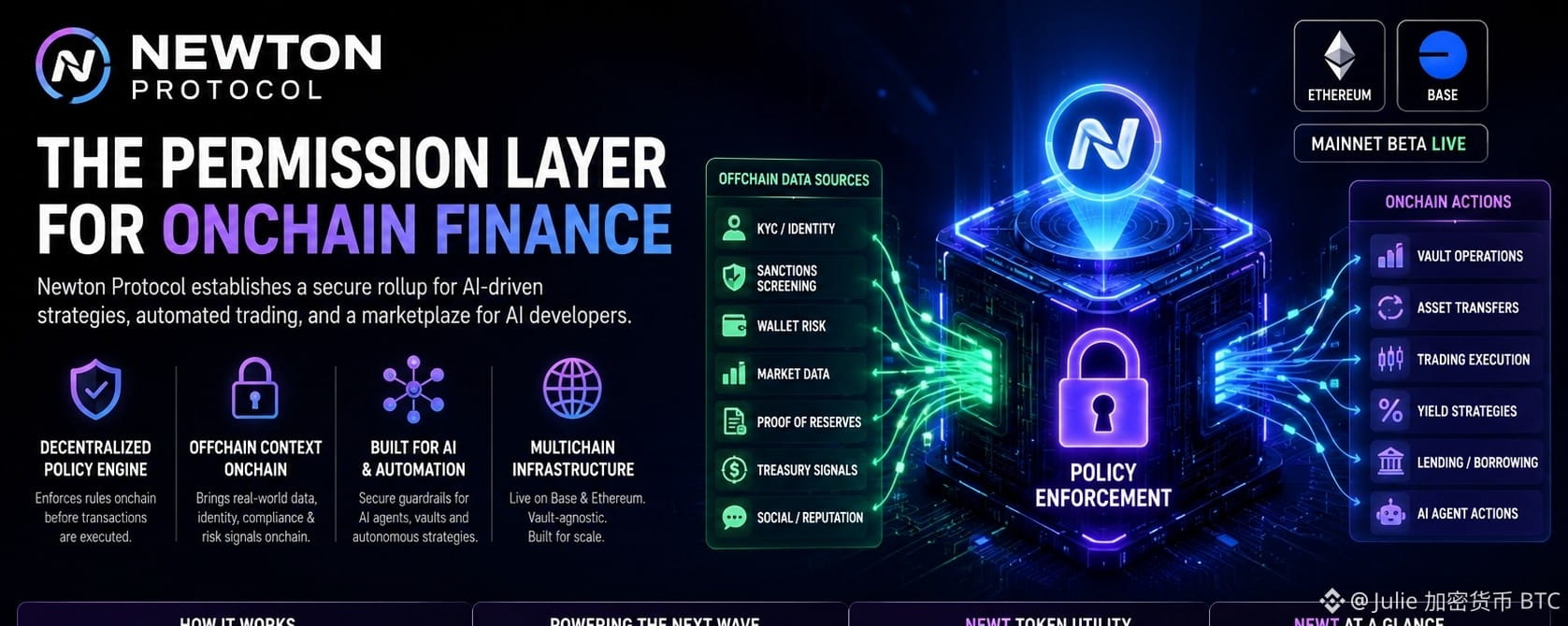
@NewtonProtocol Newton Protocol is easiest to misunderstand as another AI-crypto project. That framing is too small. The more useful read is that Newton is trying to build the permission and policy layer that sits in front of onchain action — a system that decides whether a transaction should be allowed before it reaches settlement. Its own docs describe it as a decentralized policy engine for onchain transaction authorization, built as an EigenLayer AVS, designed to enforce spend limits, sanctions screening, fraud prevention, and compliance rules inside smart contracts. The project’s whitepaper places that idea in a much larger market: stablecoins, tokenized assets, and agent-driven finance are already moving real value, but most of that value is still authorized offchain, not onchain.
That distinction matters because it changes what Newton is actually selling. Many crypto projects try to make execution faster. Newton is trying to make execution safer. In practice, that means bridging offchain context — KYC status, market data, proof of reserves, identity signals — into policy checks that are enforced at the smart-contract layer. The project’s docs are explicit that smart contracts are blind to offchain context and remain vulnerable when compliance is left to frontends or centralized APIs. Newton’s pitch is that policy should travel with the transaction, not sit around it. If that works, the protocol becomes less like a trading app and more like an authorization firewall for automated capital.
The most interesting thing about Newton’s recent development path is how quickly it has moved from abstract infrastructure into specific control surfaces. Since late 2025, the team has rolled out or integrated a sequence of data oracles and guardrails: Magic Labs wallet risk data, Vaults.fyi data for AI trading guardrails, Etherscan data for transaction guardrails, Veriff for identity and residency checks, Human Passport for humanity verification, Neynar for Farcaster identity guardrails, Persona for jurisdictional compliance, and Massive for treasury-yield trading signals. By June 2026, Newton said its mainnet beta was live on Base and Ethereum, and the latest VaultKit post says the infrastructure is live in mainnet beta, the SDK is on npm, and the first policy packs are open source. That is a meaningful shift: Newton is no longer only describing a future architecture; it is assembling a usable compliance stack around vaults, agents, and curated capital.
That product direction also reveals where Newton believes the wedge is. VaultKit frames the problem bluntly: curators promise to follow the rules, but the vault itself does not enforce them. Newton’s answer is to turn policy into code and make that code portable across vaults and chains. The project says VaultKit is vault-agnostic and multichain, with first integrations already live. In other words, Newton is aiming at the part of the market where institutions are willing to use onchain infrastructure, but only if controls are provable, privacy-preserving, and hard to bypass. That is a narrower and more credible target than “AI finance for everyone,” and it may be a better business bet because it maps to a pain point institutions already recognize: they do not lack policy; they lack enforceable policy.
On-chain, NEWT looks like a token with real circulation rather than a dormant placeholder. Etherscan currently shows a maximum supply of 1 billion NEWT, about 12,994 holders, a 24-hour volume of roughly $6.23 million, and a price near $0.05. CoinGecko shows the token’s all-time high at $0.8206 on June 24, 2025, and an all-time low of $0.04507 on June 26, 2026. Taken together, that profile says Newton has moved beyond a pure launch-event chart and into a lower, more textured trading range. The market is still active, but the valuation is now being tested by something more important than hype: whether the protocol’s utility can create persistent demand.
That is where the token design becomes important. Newton’s token disclosure says NEWT is used for staking and protocol security, gas and fees for issuing or revoking verifiable permissions, registration in the Newton Model Registry, and governance. It also says the fixed supply is 1 billion, with 215 million circulating at launch, and that 60% of supply is allocated to community categories while 40% goes to internal categories, with multi-year unlocks and vesting. The analytical point here is not simply that the token has “utility.” It is that Newton is trying to make NEWT behave like operating capital for the network: part security budget, part fee asset, part incentive rail, part governance claim. If the protocol gains adoption, those roles could reinforce one another. If adoption stalls, the same structure leaves the token exposed to supply overhang and token-demand skepticism.
The deeper question is whether Newton becomes a default middleware layer or remains a specialized compliance tool for a small set of advanced teams. Its architecture is attractive because it addresses a real market failure: onchain systems are excellent at execution but weak at ex-ante authorization. Yet the hard part is not proving the concept. It is getting protocols, vault curators, and agent builders to adopt Newton early enough that the policy layer becomes infrastructure rather than an optional add-on. That challenge is also its opportunity. In a market crowded with AI narratives, Newton’s most distinctive claim is not that it makes autonomous finance possible. It is that it tries to make autonomous finance governable. If that distinction survives contact with real usage, Newton could end up being remembered less as an AI token and more as one of the first serious attempts to turn onchain compliance into native infrastructure.