
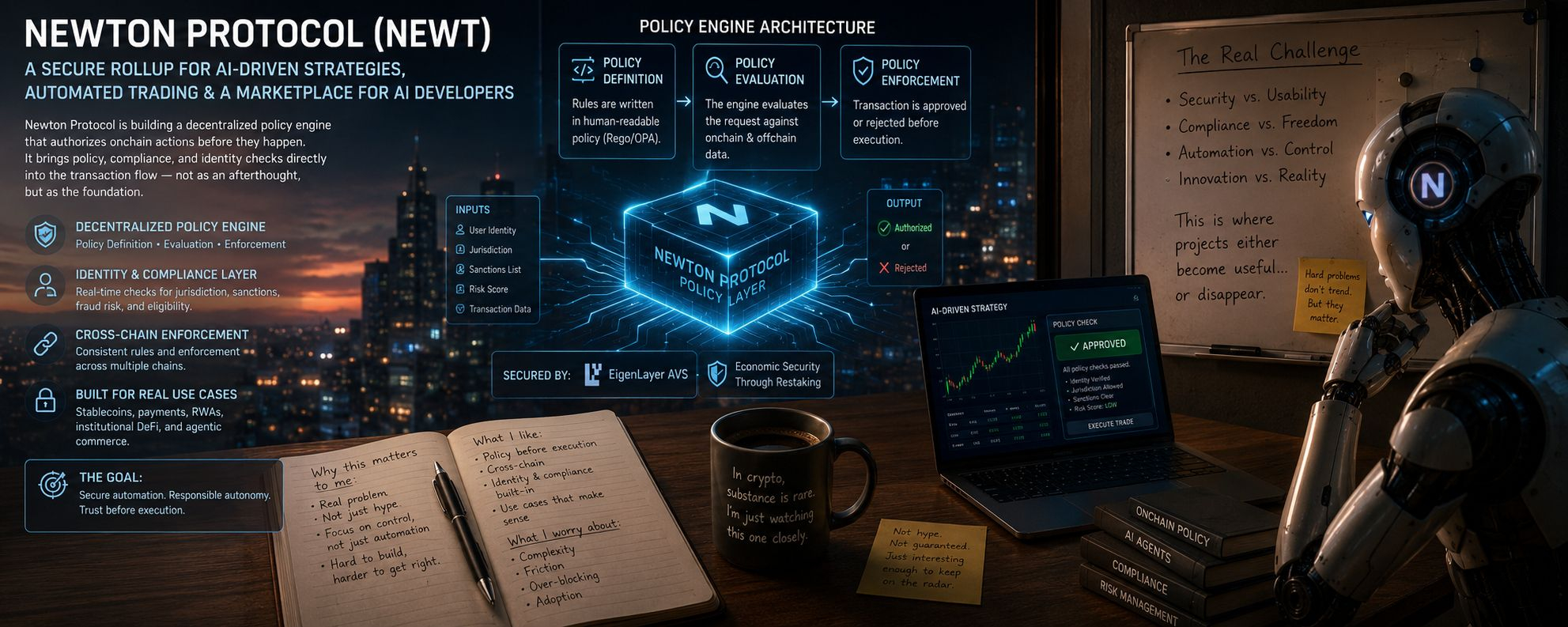

I’ve been around crypto long enough to stop getting excited by the first wave of words a project throws at me. Most of the time, it’s the same cycle with a different logo. Somebody says AI, somebody says automation, somebody says infrastructure, and suddenly people start acting like the future has arrived just because the pitch sounds cleaner than last month’s pitch. I usually let that noise pass. But every now and then something catches my attention not because it feels revolutionary, but because it seems to be circling around a problem that actually exists.
That is more or less how I’ve been looking at Newton Protocol.
I don’t fully trust it, and I think that is the right place to start. Crypto has trained me to be suspicious of anything that sounds too complete. Still, there is something about this that feels a little different from the usual speculative fog. Newton is not just talking about AI agents or automated trading in the vague way people do when they want the market to imagine too much. It is talking about the boring, difficult, unglamorous part: authorization, policy, and the question of how a system knows what it is allowed to do before it actually does it. According to its own documentation, it is trying to build a decentralized policy engine for onchain transaction authorization, with policy definition, evaluation, and enforcement built into the stack itself. That sounds more serious to me than the average crypto narrative.
And maybe that is why I keep coming back to it in my head. The market loves talking about autonomy, but it usually does not like talking about limits. It loves the idea of machines making decisions, but not the part where somebody has to define the rules, handle the exceptions, and deal with the mess when the machine gets something wrong. Newton seems to understand that the real problem is not just “can an AI trade?” It is “what prevents it from becoming dangerous, stupid, or just plain unusable the moment real money is involved?” That is a much better question. It is also a much harder one. The whitepaper frames the system around policy-based control, compliance, and cross-chain enforcement, which tells me the project is at least starting from the right kind of pain point.
I’ve seen this pattern before, though. A project identifies a real issue, then slowly discovers that solving the issue makes everything heavier. Slower. More complicated. Less elegant than the original promise. That is the part nobody wants to talk about in public. People want the clean version, the version where automation is smooth and secure and everyone feels smarter for using it. In reality, the moment you add policy, identity, compliance, or jurisdiction into a crypto system, you also add friction. Sometimes that friction is necessary. Sometimes it is the whole point. But it is still friction. Newton’s own materials lean into use cases like stablecoins, payments, institutional transactions, and agent-driven execution, which makes sense to me because those are exactly the places where control matters. They are also the places where people will be least patient with anything clunky.
That is probably the part I respect most about the project and distrust at the same time. It does not seem to be pretending the job is easy. It is not selling some airy promise that blockchain plus AI will magically fix everything. It is closer to saying that if onchain systems are going to handle actual decisions, then the system needs a way to check the decision before it settles. That is sensible. It is also the kind of sensible idea that can get buried under implementation pain. A lot of projects begin with a useful concept and then discover that usefulness is not enough. Users still have to understand it. Developers still have to integrate it. Operators still have to trust it. And trust, in crypto, is always more fragile than the people talking about decentralization want to admit.
The identity and compliance angle makes this even more interesting to me. Newton has described integrations and architecture that bring identity and jurisdictional rules into the policy layer, including work around real-time checks. That kind of thing is not exciting in a market sense, but it matters if the goal is to make onchain finance behave like something more than a casino with better branding. The trade-off is obvious, though: the more carefully you control access and behavior, the more you risk making the system feel restrictive, slow, or annoying. Too much blocking and you frustrate users. Too little and the whole security story starts to crack. I’ve watched enough protocols stumble on that exact balance to know it is not a minor detail. It is usually the whole story.
What I keep circling back to is that Newton feels aimed at a part of crypto that might actually have to become real if the space matures at all. Not the speculative edge. Not the meme-driven part. Not the part that survives on attention. I mean the part where money moves between systems, agents act on behalf of people, rules need to be enforced, and the gap between intention and execution becomes expensive. That is where a policy engine starts to make sense. That is also where hype dies quickly, because the market will not forgive failure just because the architecture was clever.
I’m not trying to oversell it. I don’t think this is one of those projects where you can look at the idea and decide the future already belongs to it. Crypto rarely works that way. Good ideas get buried. Bad ideas get pumped. Sometimes the thing that survives is the thing that was simply easier to ship, easier to explain, or easier to speculate on. Newton does not feel easy. It feels like one of those projects that may matter more in practice than in conversation, which is often a bad sign for market attention and sometimes a good sign for actual utility.
Still, utility is not a victory by itself. The space is full of protocols that were conceptually right and commercially flat. I’ve seen that enough times to know better than to cheer too early. If Newton works, it will probably be because it makes a hard thing boring in the right way. If it fails, it will probably be because the complexity of making automation safe turned out to be more than users, developers, or validators wanted to carry. That would not be a shocking outcome. It would just be another reminder that in crypto, the gap between a thoughtful system and a usable one is usually wider than people think.
So my honest feeling is somewhere in the middle. I’m not sold. I’m not dismissive either. I’m just paying attention, which in this market is usually the best compliment I can give. A lot of projects sound alive for a few weeks and then disappear into the background of the next narrative. Newton feels more grounded than that. Not proven. Not finished. Just grounded enough to deserve a longer look. And maybe that is all it needs right now.