
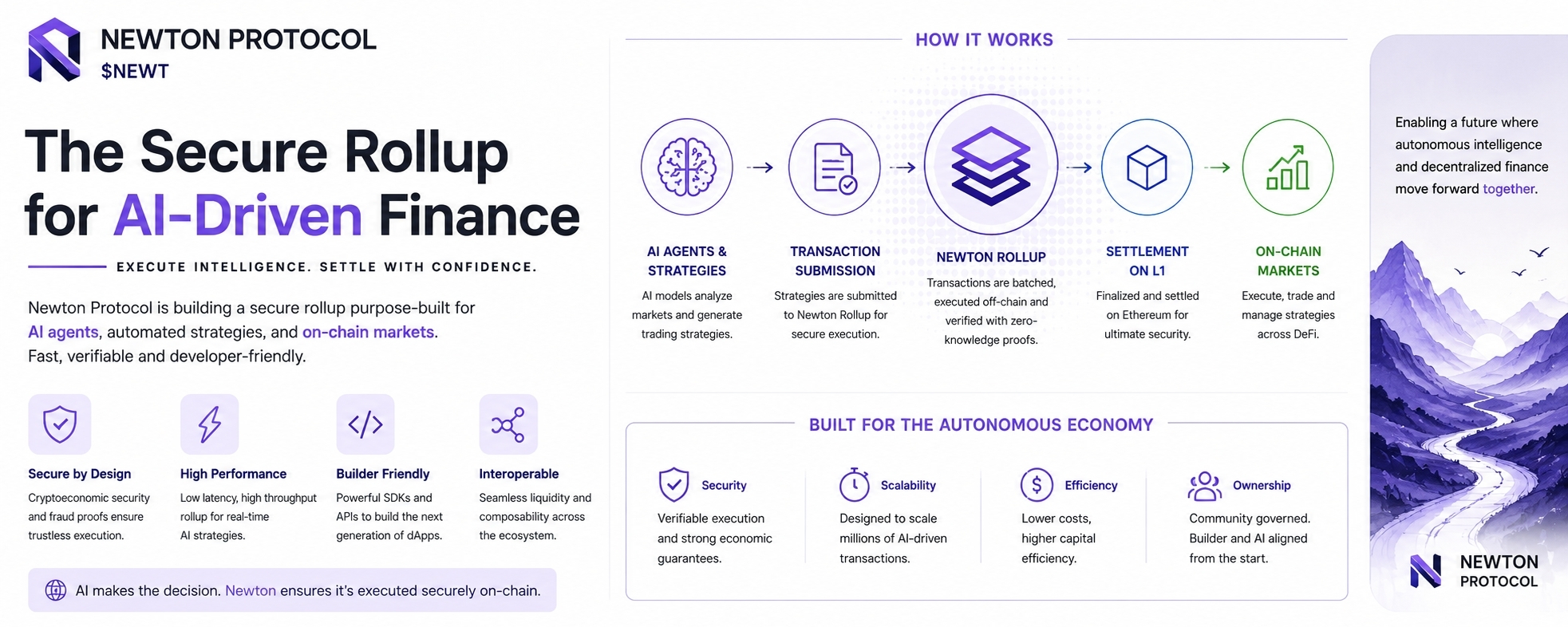
@NewtonProtocol What happens when AI stops giving advice and starts taking action?
It's a question I kept coming back to while researching Newton Protocol. Most conversations around AI in crypto still revolve around models becoming smarter or agents becoming more capable. That makes sense because intelligence is the visible part of the story. But once an AI begins executing trades, managing capital, or interacting with decentralized applications, intelligence becomes only one piece of a much larger system.
Execution suddenly matters just as much.
A trading strategy can be excellent on paper and still fail if the environment where it operates isn't reliable. Delays, inconsistent execution, fragmented infrastructure, or unclear verification can all reduce the quality of decisions after they've already been made. In other words, a good decision isn't necessarily a good outcome.
That's what made Newton Protocol interesting to me.
Rather than asking how to build a better AI model, the project appears to ask a different question: what kind of blockchain environment is needed when autonomous systems begin operating at scale?
That shift in perspective feels important.
For years, blockchains have been designed around human users. Wallets are controlled by people. Transactions are initiated by people. Governance is ultimately driven by people. AI introduces a different participant into the network one capable of acting continuously without waiting for human input.
That changes the design requirements.
Infrastructure must now support automated execution while remaining secure, predictable, and transparent. The discussion moves away from model quality alone and toward how autonomous agents interact with financial systems without creating unnecessary risk.
This also changes how I think about market value.
Many investors naturally focus on visible applications because they're easier to understand. Trading bots, AI assistants, and autonomous portfolios attract attention quickly. Infrastructure rarely does. Yet history across both technology and crypto suggests that enabling layers often become more important as ecosystems mature.
Roads become valuable because people travel on them.
Operating systems become valuable because applications depend on them.
Communication protocols become valuable because entire networks grow around them.
Perhaps AI infrastructure follows a similar pattern.
If autonomous systems become increasingly common, developers won't simply need smarter algorithms. They'll need environments where those algorithms can execute consistently across changing market conditions
That's where Newton Protocol seems to position itself.
Another thought stood out while reading through the project.
Most discussions assume AI adoption automatically creates value for every AI-related project. I'm not convinced that's how markets work. As more AI systems emerge, intelligence itself may become increasingly abundant. The scarce resource may instead become reliable execution.
If every project has access to capable models, differentiation shifts elsewhere.
It shifts toward infrastructure.
It shifts toward coordination.
It shifts toward reducing the gap between a decision and its successful execution.
Whether Newton Protocol ultimately becomes an important part of that future is impossible to know today. Early infrastructure projects always carry uncertainty because they're building for problems that haven't fully materialized yet.
Still, I find that uncertainty more interesting than another debate about which model performs best on benchmarks.
Benchmarks measure intelligence.
Markets eventually reward systems that help intelligence operate effectively.
Perhaps that's the more useful question to keep asking as AI and blockchain continue moving closer together.
@NewtonProtocol #Newt #newt $NEWT
