
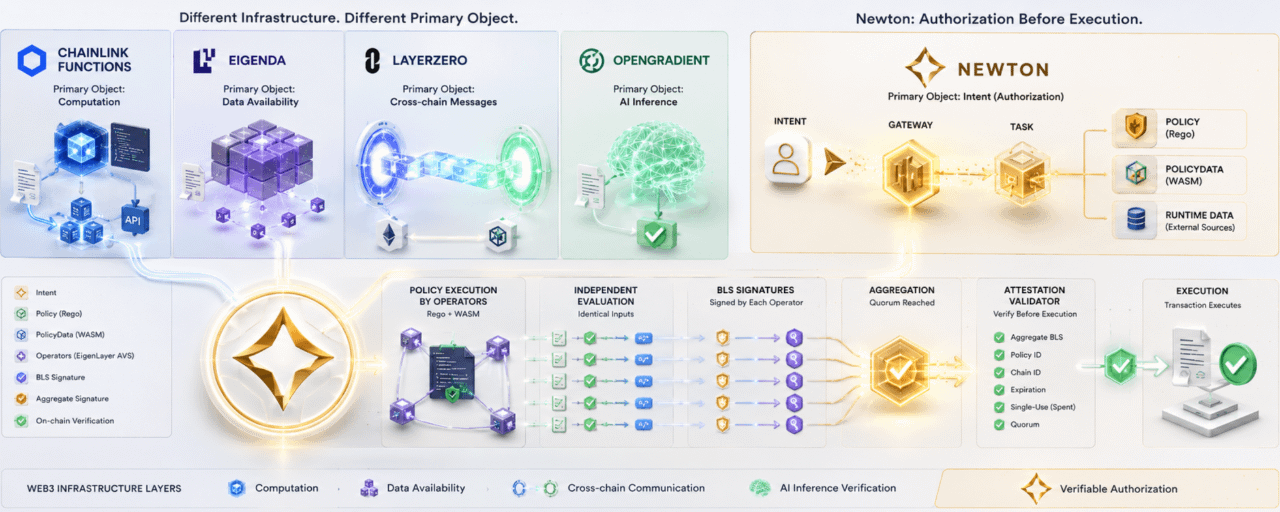
Every new infrastructure protocol is eventually compared with the projects that came before it. Since @NewtonProtocol introduced its Mainnet Beta, comparisons with Chainlink Functions, EigenDA, LayerZero, OpenGradient and even EigenLayer have become common. The similarity seems obvious until you stop comparing technologies and start comparing what each protocol actually processes.
Chainlink Functions processes external computation. Smart contracts request off-chain APIs or computations that cannot be performed inside the EVM.
EigenDA processes data availability. It ensures rollup transaction data remains accessible after execution so anyone can reconstruct and verify state.
LayerZero processes cross-chain messages. It verifies and transports information between independent blockchain networks.
OpenGradient processes AI inference. Its architecture proves that a specific AI model produced a specific output inside a verifiable execution environment.
Newton processes none of these.
The primary object inside the architecture of $NEWT is the Intent.
This is a crucial distinction. Newton is not designed to execute transactions, transport messages, store data or verify AI outputs. It decides whether a transaction should be allowed to execute before any state change occurs.
That design decision explains why the protocol introduces an entirely different execution pipeline.
Instead of sending a transaction directly to a smart contract, an Intent is submitted to the Gateway, where it becomes a Task. The Task links together three independent elements: the Intent itself, a Rego Policy that defines authorization rules, and one or more PolicyData components responsible for supplying external runtime information.
PolicyData is not a traditional oracle. It is a WebAssembly component that can be written in JavaScript, Python or Rust, compiled to WASM, and executed identically by every operator. Through WIT interfaces it can retrieve external information such as KYC status, sanctions data, gas prices, protocol exposure, treasury yields or AI agent activity. The returned values become available inside the policy as data.wasm, while developer-defined configuration is exposed through data.params.
Every EigenLayer operator independently executes exactly the same Rego policy using identical inputs. No operator decides the result for the network. Each produces its own evaluation and signs the outcome with its registered BLS key.
Once the required quorum is reached, the Aggregator combines individual signatures into a single BLS attestation. That proof is submitted together with the original transaction to the PolicyClient, which verifies it through the AttestationValidator before execution. Verification includes the aggregate BLS signature, policy identifier, chain ID, expiration, single-use protection and quorum requirements. Only after every validation succeeds can the protected transaction execute.
Seen from this perspective, Newton occupies a different position within Web3 infrastructure. Chainlink Functions extends computation. EigenDA extends data availability. LayerZero extends communication. OpenGradient extends verifiable AI execution. Newton extends verifiable transaction authorization, creating an infrastructure layer that evaluates permission before execution rather than execution itself. That architectural boundary is what makes #Newt a distinct infrastructure category instead of another variation of existing middleware.