
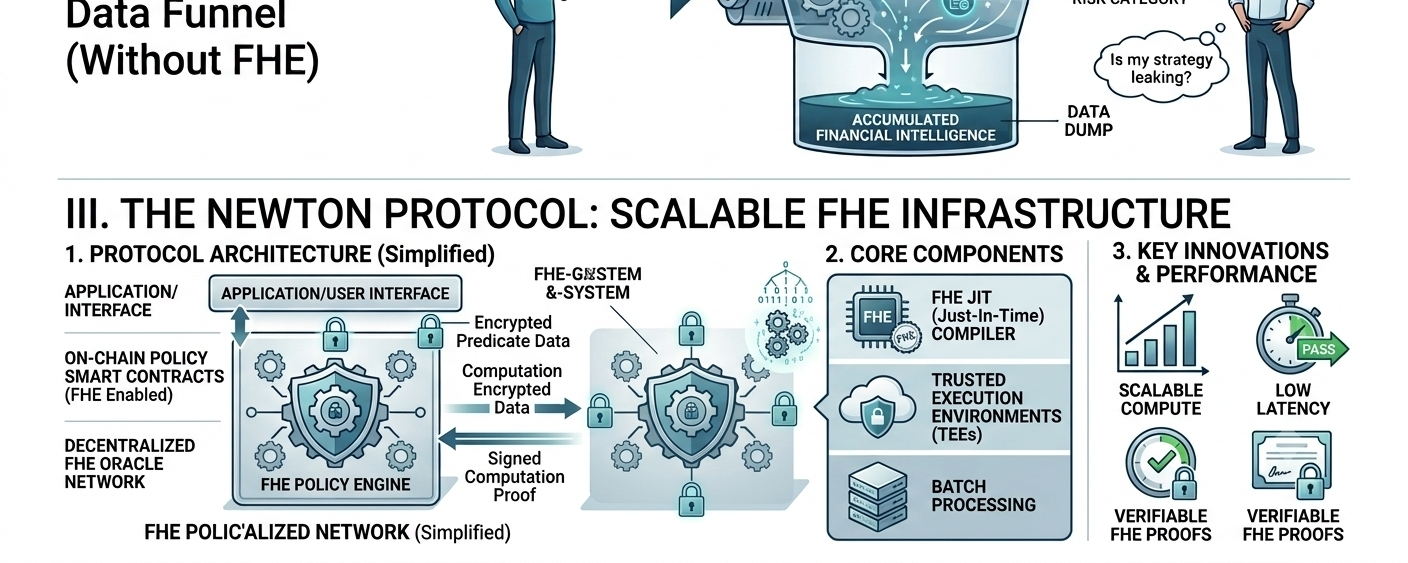
If you think the long-term integration of Fully Homomorphic Encryption (FHE) into crypto is just about "hiding transactions," you are completely missing the sharper point.
The standard critique of blockchain privacy is always the same: “If you hide the data, how do you verify compliance? How do you enforce internal controls, jurisdictional boundaries, or anti-money laundering rules?”
The easy answer has always been to compromise. You build a policy layer that looks at the data, judges it, and then passes the transaction through. But underneath, that structure creates a massive, quiet danger: The compliance layer becomes a hyper-concentrated honeypot for sensitive financial intelligence.
The real breakthrough of FHE isn't that it hides data. It’s that it allows us to evaluate rules without forcing private information to become part of the inspection surface.
The Hidden Trap: When Compliance Becomes a Data Funnel
On the surface, policy evaluation looks simple:
A transaction comes in.
A rule checks it.
The system decides whether it can move.
But look closer. To judge a transaction, a policy engine needs deep context: the exact amount, counterparty types, risk categories, timing, liquidity positions, and jurisdictional data.
In almost every traditional or early onchain setup, that context must be entirely revealed before it can be judged.
Financial activity carries a heavy texture. It reveals strategic urgency, operational alpha, corporate partnerships, and systemic vulnerabilities. If every single rule-check requires full visibility, then compliance ceases to be a clean boundary. It becomes a permanent data funnel, leaking sensitive proprietary information to validators, oracles, or centralized gatekeepers.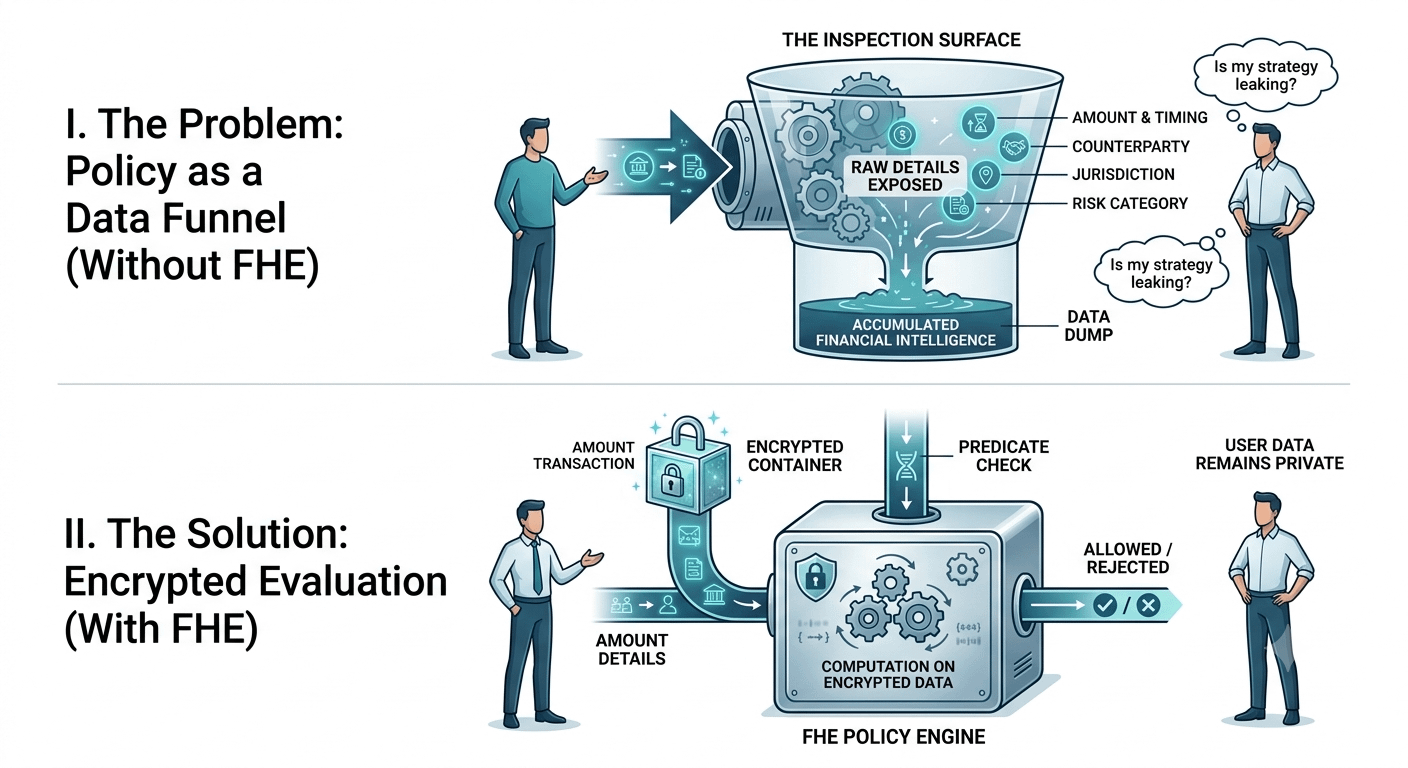
The Newton Architecture: Authorization Without Exposure
This is exactly why the technical direction of Newton Protocol (@NewtonProtocol) is one of the most compelling spaces to watch in Web3 infrastructure right now.
Newton’s architecture is fundamentally unique because its decentralized policy layer sits pre-execution. It operates as a strict runtime gatekeeper. The system doesn't just ask if a wallet signed a payload; it asks whether the intended action has cryptographically earned permission under an explicit rule before a single cent can move.
By mapping an FHE framework onto this pre-execution gate, the entire dynamic of risk management shifts:
See less. Prove enough. Execute only when the condition is met.
Instead of handing over a raw dataset so a compliance engine can read it, FHE allows the data to remain fully encrypted. The policy engine runs its code over the encrypted data, generating a simple, narrow output: Allowed, Rejected, or Condition Not Met.
The Hard Counter: Cost, Latency, and Engineering Pressure
Let’s be entirely real—FHE is not a magic switch you just flip on overnight. It is mathematically heavy, computationally expensive, and carries immense engineering pressure.
If a system protects data but introduces multi-minute latencies, insane gas overheads, or becomes an unverifiable black box, it will completely crumble under real-world market usage. The trade-offs are brutal:
The Trade-Off Traditional Policy Layers FHE-Enabled Policy Layers
Data PrivacyPoor (Requires full visibility to judge)Absolute (Evaluates without decrypting)
Processing SpeedMicrosecondsHigh computational latency overhead
Infrastructure CostLow / Standard ComputeHigh (Demands heavy cryptographic proof generation)
Security SurfaceHigh risk of intelligence leaksHardened mathematical isolation
The claim here isn't that FHE magically solves every bottleneck today. The claim is that it provides a cleaner architectural direction.
The Structural Shift: The Future of Onchain Finance
The long-term bet for institutional, sovereign, and hyper-scale onchain finance isn't just about building faster execution rails or throwing more transparent data into public view.
It is about predictable authorization that does not turn private transaction details into shared infrastructure.
In the next era of crypto infrastructure, the dominant networks won't be the ones that vacuum up the most data to ensure compliance.
The strongest policy engines will be the ones that know exactly when not to look.
What’s your take? Will the future of onchain institutional volume rely on zero-knowledge/FHE policy layers, or will speed always trump absolute data isolation? Let’s talk in the comments below! 👇
