


Most blockchain “security layers” ask developers to rebuild the whole stack. Newton Protocol takes a different route: it slips in as an authorization layer before execution, which is a much smarter way to fix real-world risk without forcing every app to migrate chains or rewrite everything from scratch. That part matters more than people think.

Newton Protocol is built as a decentralized policy engine for onchain transaction authorization. In simple terms, it lets developers define rules like spend limits, sanctions screening, fraud checks, allowlists, and other business logic before a transaction is approved. The docs also describe it as modular and chain-agnostic across EVM networks like Ethereum, Base, and Arbitrum, which means teams can plug it into existing systems instead of migrating to a brand-new chain. That is a big deal for adoption because most projects do not want to break what already works just to add more control.
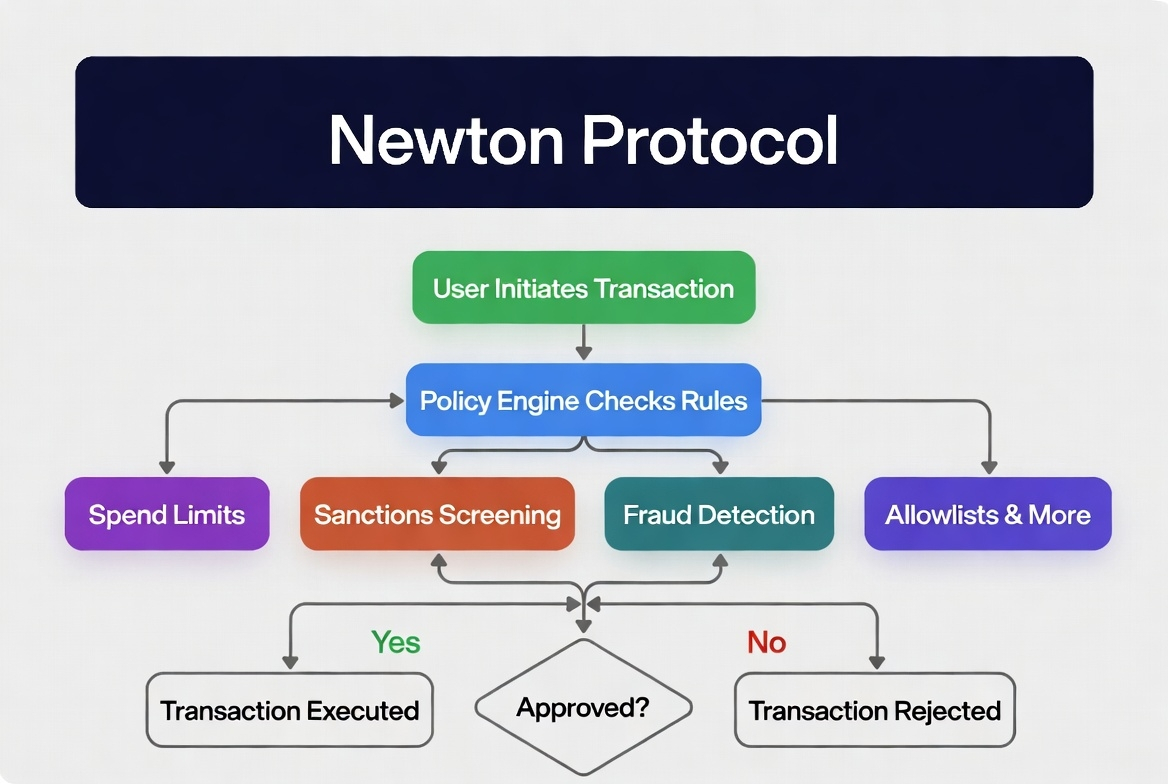
Why is it trending now? Because Newton’s mainnet beta went live on June 23, 2026, and the foundation says it is already enforcing rules onchain, starting with DeFi vaults. That shifts the project from “interesting concept” to something people can actually test, integrate, and debate in live market conditions.
My take is simple: Newton is not trying to become another flashy L1. It is trying to become the missing control layer that sits between intent and execution. That’s a very different bet. Instead of selling speed or cheaper gas, it sells trust, policy, and safer automation. For developers, that could be more valuable than another chain with better branding.
What a lot of people still miss is that blockchain applications do not just fail because of bad code. They also fail because of missing rules. A wallet can be technically correct and still be operationally dangerous if it sends funds to the wrong address, ignores jurisdiction rules, or lets an AI agent act with too much freedom. Newton is built around that exact gap.
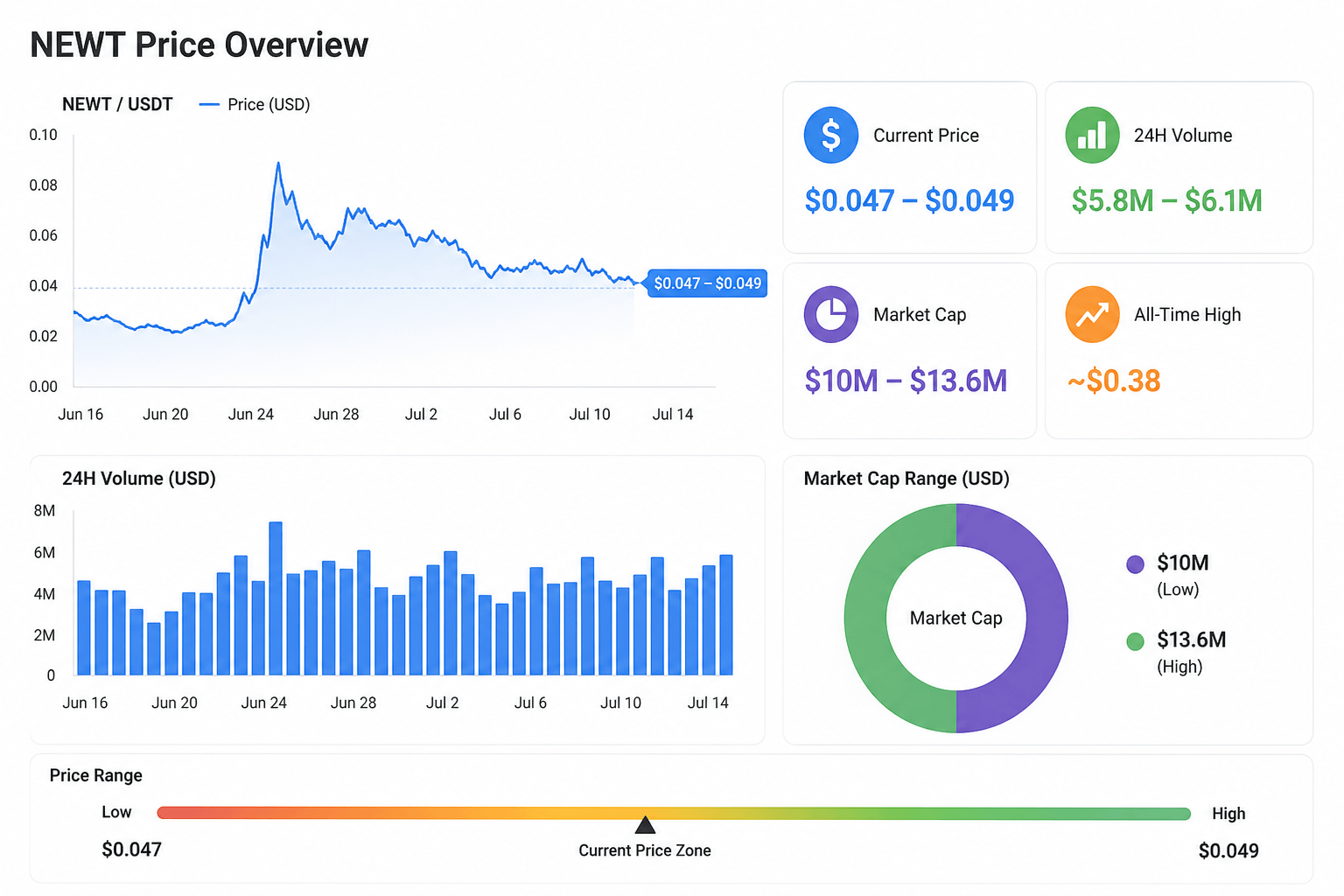
The market is at least paying attention. Based on current public price trackers, NEWT is trading around the $0.047 to $0.049 zone, with roughly $5.8M to $6.1M in 24-hour volume and a market cap around $10M to $13.6M depending on the source snapshot. It is also still far below its all-time high, which tells me this is still a price-discovery story rather than a mature market.
The token structure also looks designed for long-term protocol use rather than pure speculation. Official materials say NEWT has a fixed supply of 1 billion tokens, with 215 million circulating at launch, and the token is meant to support staking, protocol fees, model registry activity, and governance. That kind of utility matters because it gives the market more than one reason to care.
I’m mildly bullish, but not in a blind “buy anything with a story” way. For me, Newton looks strongest when viewed as an infrastructure play tied to compliance, stablecoins, tokenized assets, and agent authorization. Those are not small narratives; they are some of the most important use cases in crypto right now. Newton’s own site points to huge activity in stablecoins, monthly transfer volume, tokenized real-world assets, and compliance costs, which is exactly where a policy layer could matter most.
From a trading perspective, the interesting zone is not chasing green candles. It is watching whether NEWT can hold recent range support and reclaim momentum with volume after the mainnet beta catalyst. If the market starts pricing in actual integrations, that is where continuation usually comes from. If volume fades and unlock pressure dominates, then the story can cool off fast.
I’ve been watching projects that try to fix “trust” at the protocol level for a while, and most of them overpromise. Newton feels more practical than most because it is not asking developers to abandon their stack. It is basically saying: keep your app, keep your chain, but add a serious policy layer where it actually counts. That framing makes a lot more sense to me than another grand redesign pitch.
Still, there are real risks here. First, policy-heavy infrastructure can be harder to sell than pure performance upgrades. Second, any protocol tied to compliance has to prove it can stay useful without becoming too rigid or too centralized in practice. Third, NEWT has a large fixed supply and a meaningful unlock/vesting structure, so token performance can stay choppy even if the product keeps improving. And because it is still early, execution risk is very real.
For me, Newton is one of those projects that gets more interesting the more you think about actual builders instead of just traders. If the next wave of crypto is going to involve stablecoins, tokenized assets, and autonomous agents, then the authorization layer might end up being more important than the chain itself. Do you see Newton as a real infrastructure bet, or just another narrative with a good timing window?