
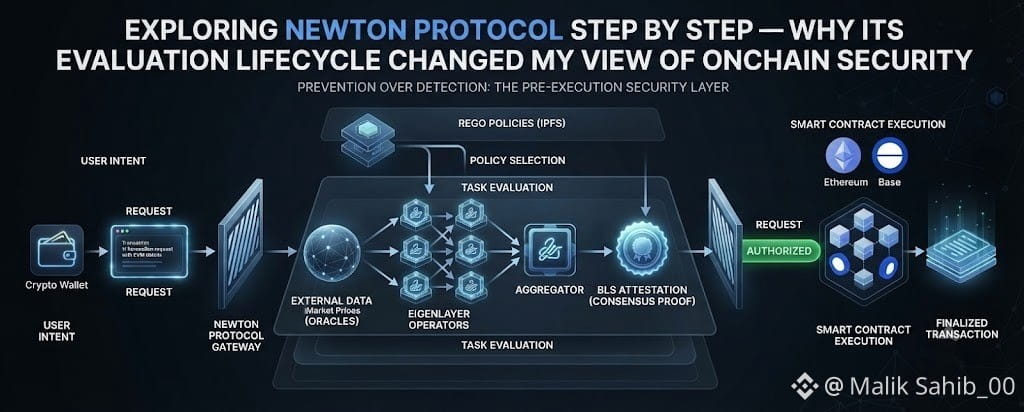
While learning about Newton Protocol, I kept asking myself one question: Why do most blockchain security systems only analyze transactions after they have already been executed?
Newton answered that question in a way I hadn't seen before.
Instead of monitoring completed transactions, Newton evaluates every transaction request before execution. The more I studied this workflow, the more I realized that prevention is far more powerful than detection.
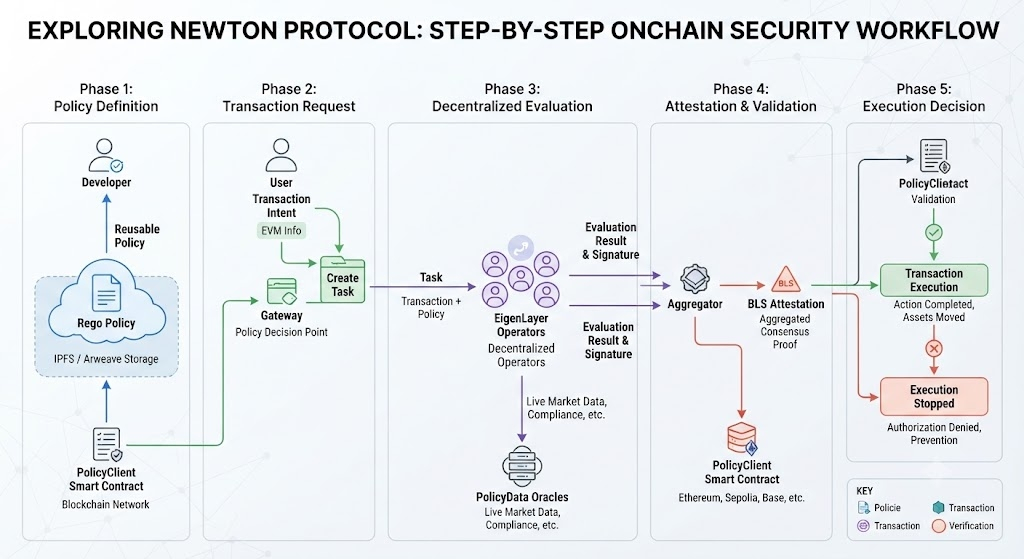
What first caught my attention was the idea of Policies. Rather than embedding countless security checks inside smart contracts, Newton lets developers write policies separately using Rego. These policies define approval rules that can be updated, reused, and referenced through IPFS without changing the application itself. That separation between business logic and contract execution makes the entire system much cleaner.
As I walked through Newton's evaluation lifecycle, each component started fitting together naturally.
A developer first deploys a reusable policy. Then a PolicyClient smart contract is configured with parameters like transaction limits, allowlists, or expiration settings. When someone wants to perform a blockchain action, their transaction becomes an Intent containing all essential EVM information.
Instead of immediately executing that Intent, Newton combines it with the selected policy, creating a Task. This Task becomes the unit that operators evaluate.
I found the decentralized evaluation process especially interesting. Registered EigenLayer operators independently execute the same policy while retrieving any required external information through PolicyData oracles. Since policies can access live information like market prices or compliance status, authorization decisions become much more intelligent than relying solely on onchain data.
Every operator signs its evaluation result individually. Once enough signatures are collected, the Aggregator combines them into a single BLS Attestation representing decentralized consensus. Rather than submitting multiple signatures onchain, only one efficient proof needs to be verified.
That design immediately struck me as both scalable and practical.
The smart contract then validates this Attestation using either Newton's standard verification method or the lower-gas direct validation approach. Only after successful verification does the contract execute the transaction. Otherwise, execution stops before any assets move.
Another aspect I appreciated is Newton's layered architecture. Policy creation remains independent from operator computation, while onchain verification stays lightweight and efficient. This separation allows developers to improve policies without redesigning their contracts and lets decentralized operators handle complex computation offchain.
Seeing support for networks like Ethereum Mainnet, Ethereum Sepolia, Base, and Base Sepolia also demonstrated that Newton is designed to integrate across multiple ecosystems rather than remaining tied to a single chain.
After spending time understanding how Policies, Intents, Tasks, Operators, PolicyData, Gateways, and Attestations work together, I came away with a different perspective on blockchain authorization. Newton isn't replacing smart contracts, it strengthens them by ensuring every transaction proves it satisfies predefined rules before execution ever begins.
For me, that's the most meaningful innovation. Security shouldn't start after a transaction is finalized. It should begin the moment someone requests permission to execute it, and Newton Protocol delivers exactly that vision.
