
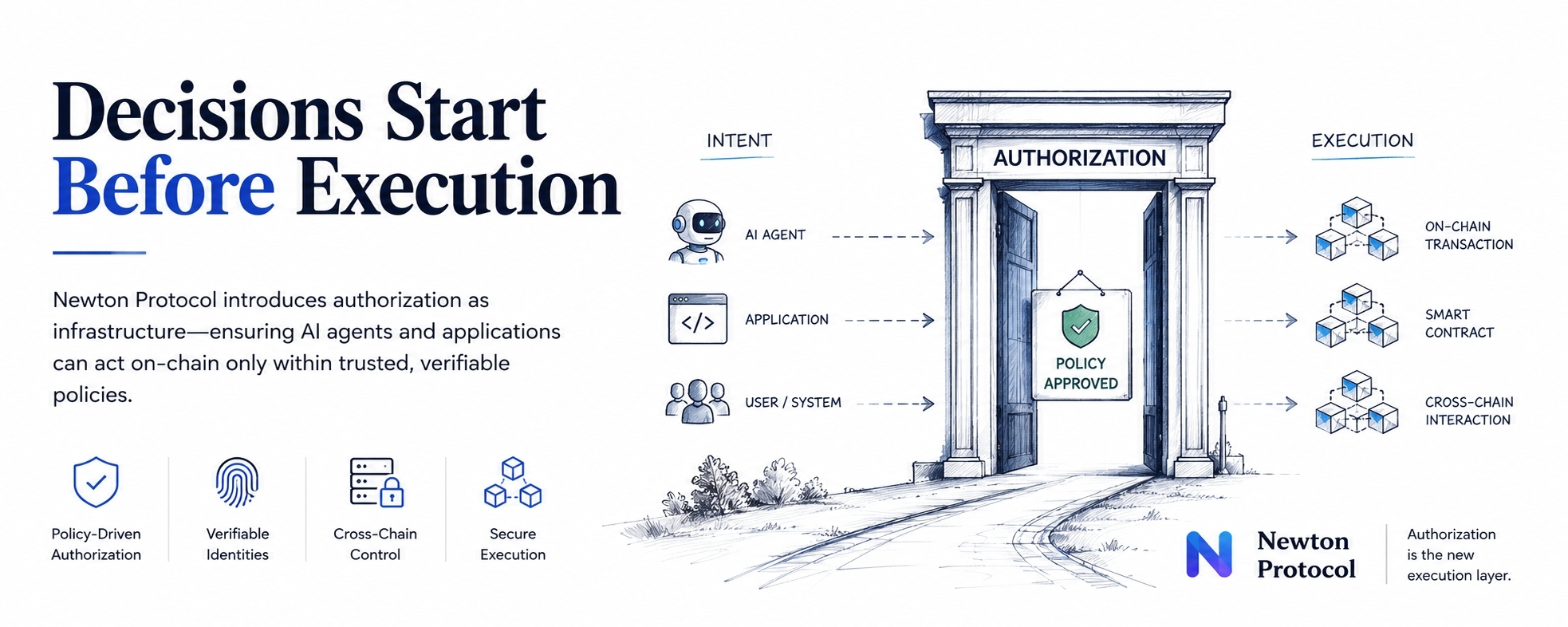
@NewtonProtocol One assumption kept bothering me while I was exploring Newton Protocol. We often discuss whether AI systems can make good decisions, but we spend surprisingly little time asking who determines whether those decisions should be carried out in the first place.
That difference sounds minor until software begins interacting with real economic systems.
For years, blockchain infrastructure has been optimized around execution. A transaction is submitted, consensus is reached, and the network confirms that everything happened according to protocol. It has worked remarkably well because humans remain responsible for deciding what gets signed.
AI changes that relationship.
If software eventually manages portfolios, allocates treasury assets, executes business logic, or coordinates activity across applications, the network is no longer validating only human intent. It is increasingly validating machine-generated intent.
Reading through @NewtonProtocol I found myself thinking less about AI itself and more about where judgment should exist inside the transaction lifecycle.
Instead of assuming execution is the first meaningful checkpoint, the architecture introduces an authorization stage before actions become final. At first, I viewed that as another security mechanism. The more I considered it, the more it felt like a different way of organizing responsibility.
That distinction matters because authorization isn't simply about preventing malicious activity. It is also about creating consistent expectations between different participants.
Developers usually write their own permission logic. Every application interprets policies slightly differently. Every integration introduces another place where assumptions can diverge.
Over time, that fragmentation becomes difficult to manage.
Newton's approach suggests something different: treat authorization as shared infrastructure instead of application-specific code.
I don't know whether that becomes the dominant model. Developers value flexibility, and many teams will always prefer custom implementations. Yet history shows that common infrastructure often emerges when the cost of solving the same problem repeatedly becomes greater than adopting a shared standard.
The interesting part is how this influences coordination rather than raw performance.
If multiple applications rely on comparable authorization policies, interactions become more predictable. Audits become easier because policy logic is no longer scattered across independent systems. Organizations spend less effort rebuilding similar safeguards from scratch.
None of those improvements are particularly visible.
They don't create dramatic product launches or headline announcements.
Yet invisible infrastructure has often shaped technology markets more than the products receiving the most attention.
Road networks mattered because they allowed commerce to expand.
Internet protocols mattered because they allowed different systems to communicate consistently.
Operating systems mattered because developers could build without reinventing foundational components every time.
Perhaps authorization eventually follows a similar path.
There are still obvious questions.
Additional policy evaluation introduces complexity.
Shared infrastructure succeeds only if developers genuinely trust it.
Different jurisdictions and industries may require different rule sets, making universal standards difficult.
Those are meaningful challenges rather than details to ignore.
Still, I came away thinking that Newton Protocol is trying to address a problem that becomes more relevant as software gains greater autonomy.
The market often evaluates AI projects by asking how intelligent their systems become.
After reading through the architecture, I found myself asking something else.
What if the next important layer isn't intelligence at all?
What if it's deciding when intelligence should be allowed to act?
@NewtonProtocol #Newt #newt $NEWT
