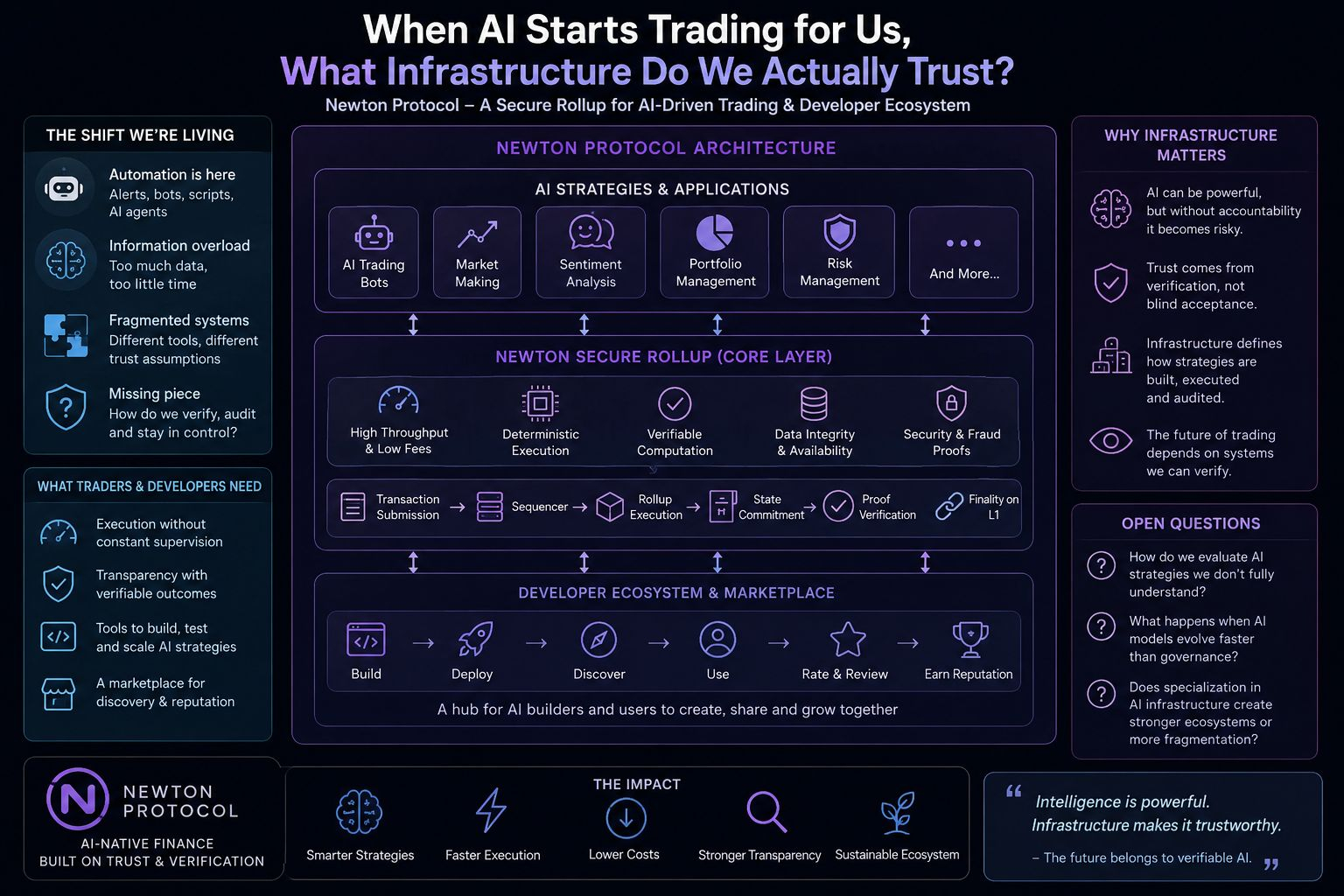

There was a time when crypto felt simple. You picked a coin, watched a chart, maybe placed a trade, and spent the rest of the day wondering if you were early or just impatient. Now it feels like we are managing dashboards, bots, AI agents, execution tools, data feeds, and strategies that operate faster than any human can react.
I catch myself thinking about that shift quite often.
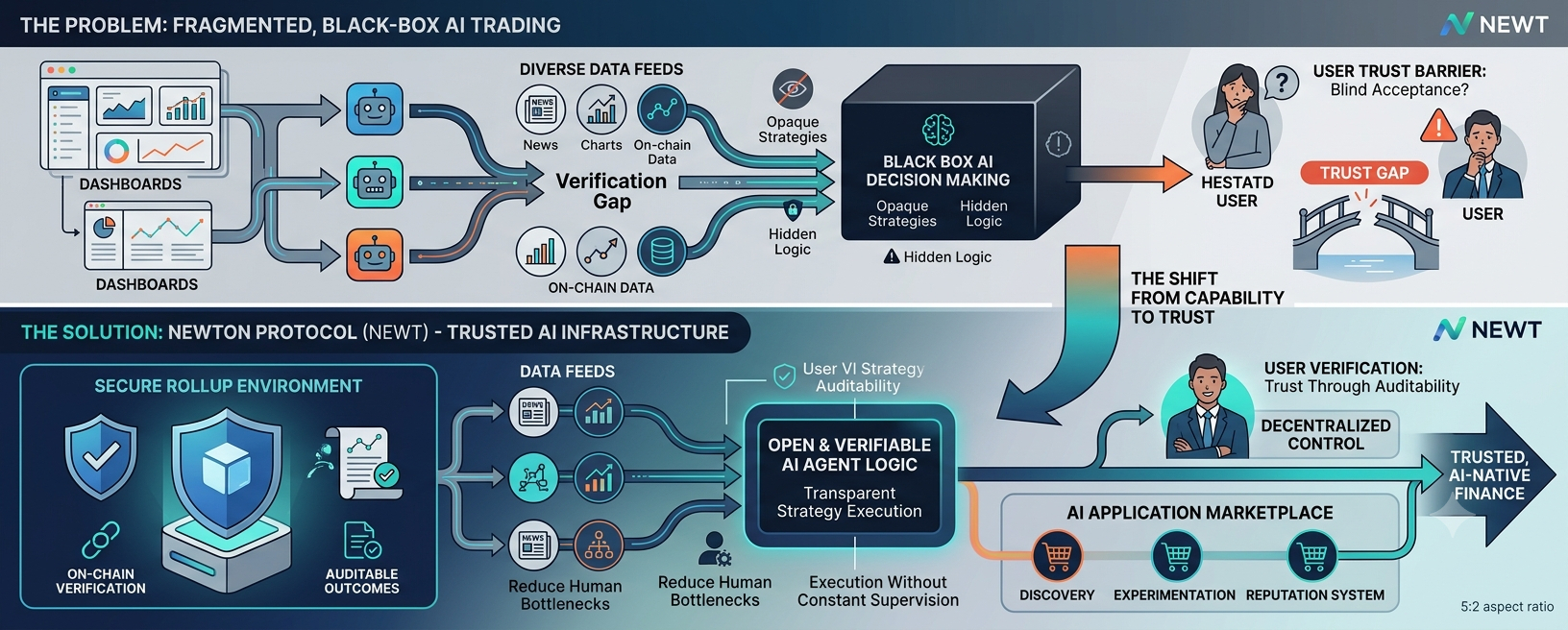
A lot of traders already use automation in some form. Alerts replace constant chart watching. Scripts handle repetitive tasks. AI is starting to filter information that would normally take hours to process. Yet there is still a missing piece. Most of these systems remain fragmented. They work independently, with different trust assumptions and different ways of verifying outcomes.
That is probably why Newton Protocol caught my attention.
The idea behind NEWT focuses on building a secure rollup environment designed for AI-driven strategies, automated trading systems, and an ecosystem where developers can create and share AI-powered applications. At first glance it sounds technical, almost abstract. But when I thought about it longer, it started feeling more practical than theoretical.
I remember when automated trading bots became widely accessible. Everyone seemed excited until the difficult questions appeared. Who controls the strategy logic? Can users verify what an AI system is actually doing? How much trust are we placing in black box decision making? It felt strange at first because crypto has always been built around verification rather than blind acceptance.
Protocols like Newton seem to be exploring that tension.
AI can process market information at a speed humans simply cannot match. It can monitor liquidity changes, analyze sentiment, track onchain behavior, and adjust positions automatically. But intelligence without accountability creates its own problems. If strategies become increasingly autonomous, then infrastructure matters even more.
A secure rollup designed specifically around these use cases makes sense from that perspective.
Maybe I'm overthinking it, but I suspect the conversation around AI in crypto is moving away from capability and toward trust. Most people already believe AI can perform useful tasks. The harder challenge is understanding how those decisions are validated, how results are audited, and whether users remain in control.
Newton appears to be approaching this from an infrastructure angle rather than treating AI as a marketing label.
The marketplace component is interesting too. Developers building AI applications often face distribution challenges. Good tools exist, but finding users is difficult, and users struggle to evaluate which systems are reliable. A marketplace introduces another layer where discovery, experimentation, and reputation can potentially develop over time.
Of course, marketplaces are rarely straightforward.
Some projects attract meaningful builders while others become crowded with copy pasted strategies chasing attention. It is difficult to predict where Newton ultimately lands. Success depends less on architecture diagrams and more on whether developers decide that this environment genuinely helps them create better products.
That uncertainty is part of what makes crypto fascinating.
We spend so much time discussing tokens and price action that we occasionally forget infrastructure trends shape entire market cycles. Decentralized exchanges changed how trading happened. Layer two ecosystems changed user expectations around speed and cost. AI could become another structural shift, though I am still not completely convinced anyone has figured out the ideal model yet.
What I find compelling about NEWT is that it seems to acknowledge the complexity instead of pretending everything is already solved.
There are still open questions.
How do users evaluate autonomous strategies they cannot fully understand? What happens when AI models evolve faster than governance mechanisms? Does specialization around AI infrastructure create stronger ecosystems or simply add another layer of fragmentation?
I do not have clear answers.
What I do know is that crypto keeps moving toward systems that reduce human bottlenecks. Traders want execution without constant supervision. Developers want environments tailored to advanced applications. Users want transparency without sacrificing efficiency. Those demands are converging, and projects positioned at that intersection are worth paying attention to.
I think back to earlier periods in crypto when concepts seemed niche until suddenly they were everywhere. Yield farming once felt experimental. Rollups were discussed mostly by technical communities. Even automated trading was considered unusual outside professional circles.
Now these ideas are normal.
Maybe Newton Protocol becomes an important building block for AI-native finance. Maybe it remains a specialized tool serving a smaller audience. I genuinely do not know. But I find myself curious enough to keep watching.
And honestly, that curiosity is usually the first signal I pay attention to in this space. Not certainty. Not predictions. Just the feeling that a project is asking questions the industry will eventually have to answer.