
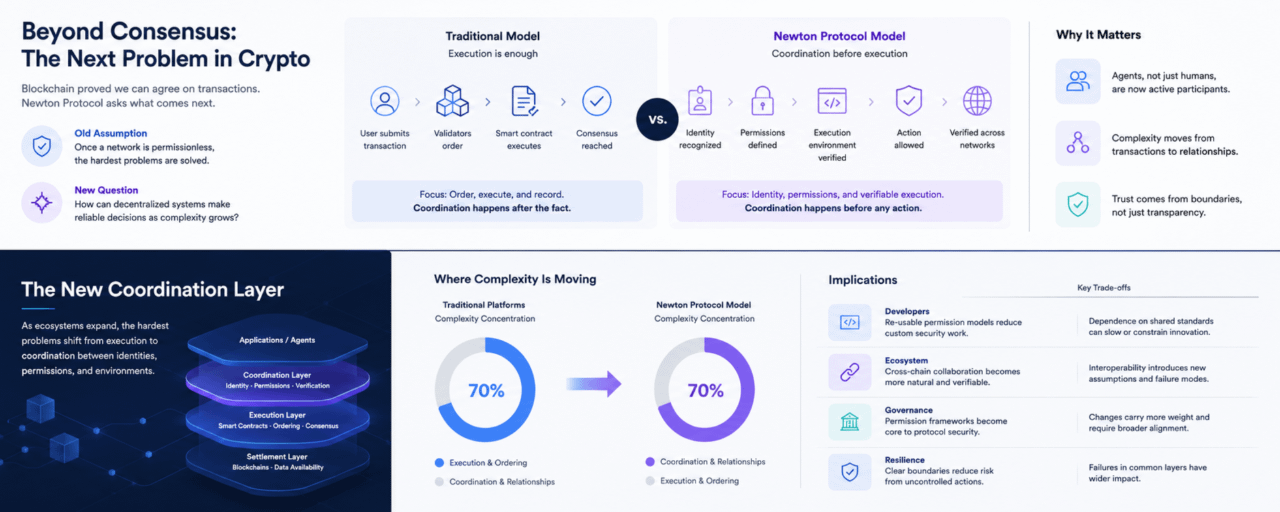
When I started reading through Newton Protocol I expected another attempt to make blockchains faster or cheaper. Instead I kept coming back to a different idea. Newton appears to question an assumption that has shaped crypto from the beginning. The belief that once a network becomes permissionless the hardest problems are already solved.
That assumption made sense when blockchains were mostly transferring value. If anyone could verify transactions and no single party controlled the ledger then the system achieved something important. But today's networks are no longer limited to simple payments. They support agents applications cross chain interactions and automated decision making. The question is no longer only who can participate. It is also how participation should be coordinated without creating new trust assumptions.
That seems to be where Newton is trying to place itself.
What caught my attention is that the protocol spends less time treating decentralization as the final objective and more time asking whether decentralized systems can make reliable decisions when activity becomes increasingly complex. Those are related problems but they are not the same problem.
Most blockchain infrastructure assumes that execution is enough. Users submit transactions. Validators order them. Smart contracts execute deterministic logic. The network reaches consensus and moves forward. Newton appears to argue that this model starts to struggle when software agents rather than humans become active participants across multiple environments.
That is an interesting shift because it challenges the old assumption that neutral infrastructure alone is sufficient.
The architecture introduces components around identity permissions and verifiable execution that are intended to give automated actors clearer boundaries. Rather than allowing every process to operate with unlimited authority the protocol explores ways to define what an agent is actually allowed to do before actions take place.
I kept wondering whether this represents added complexity or necessary structure.
Crypto has often treated restrictions as something to remove. Newton seems to ask whether some carefully designed restrictions actually make decentralized systems easier to trust over time.
That question deserves more attention than the protocol itself sometimes receives.
One thing I noticed while comparing Newton with traditional smart contract platforms is that much of the complexity moves away from transaction ordering and toward coordination between identities permissions and execution environments. The blockchain still provides verification but a larger share of the challenge becomes managing relationships between participants rather than simply recording activity.
That creates different incentives.
Developers may spend less time building custom security controls if permission models become reusable. At the same time they become more dependent on whatever standards Newton establishes for identity and authorization. If those standards evolve slowly innovation could slow with them. If they evolve too quickly compatibility could become difficult.
Neither outcome feels impossible.
Another assumption Newton quietly challenges is the idea that every application should build its own trust framework from scratch. Many decentralized applications today duplicate similar permission systems access controls and security logic because the underlying infrastructure offers only basic execution guarantees.
Newton appears to ask whether some of that responsibility belongs closer to the protocol layer.
The potential benefit is consistency. The possible downside is concentration around shared infrastructure. Whenever many applications depend on the same coordination mechanisms the impact of failures becomes larger. A weakness inside a common layer rarely stays isolated.
Cross chain behavior also becomes more interesting under this model.
As blockchain ecosystems continue expanding users increasingly expect applications to operate across multiple networks without thinking much about the underlying infrastructure. Newton seems designed with that reality in mind rather than assuming one chain will dominate.
Still I found myself asking where coordination becomes hardest.
Cross chain communication introduces additional assumptions about message verification timing and failure recovery. Identity systems that work smoothly on one network may become much harder to maintain across several environments with different security models. Solving interoperability often means accepting more operational complexity somewhere else.
That trade off never completely disappears.
Governance raises similar questions.
If permission frameworks become an important part of protocol security then changes to those frameworks carry greater weight than ordinary software updates. Governance decisions may gradually influence how applications define authority not just how the network processes transactions.
That gives governance a wider role than many protocols currently assign to it.
Whether that creates resilience or additional centralization pressure probably depends less on the design itself and more on how governance behaves under real disagreement.
After spending time with Newton I came away thinking it is less interested in proving that permissionless systems work and more interested in asking what permissionless systems still cannot do well.
That feels like a different starting point.
The oldest assumption in crypto has never really been that blockchains can reach consensus. It has been that once consensus exists the rest of coordination naturally becomes easier.
I am no longer convinced that assumption survives once software begins acting on behalf of millions of users instead of simply executing their transactions.
